

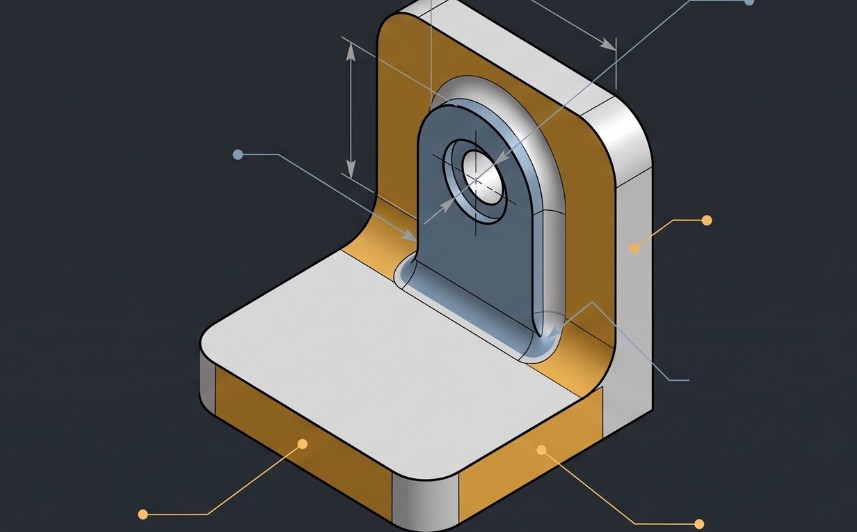
CAD design reviews generate important decisions and comments, but feedback often loses its connection to the geometry it concerns. Notes stored in meeting minutes, screenshots, emails, or issue trackers may preserve wording or status, yet engineers can struggle to determine exactly which feature prompted the comment. Leo AI argues that attaching comments directly to CAD geometry creates a more useful engineering record.
The article distinguishes between screen-space and model-space pins. Screen-space annotations are tied to coordinates in a rendered view, so rotating or modifying the model can make them inaccurate. Model-space pins instead reference a specific topological entity, such as a face or edge, along with the point and viewpoint associated with the review. This approach resembles model-based definition, where semantic annotations are connected directly to geometry.
Maintaining these connections across design revisions is more difficult. Feature-based CAD systems regenerate faces whenever the feature tree changes. Faces may split, merge, disappear, or receive different identifiers, potentially leaving comments attached to the wrong geometry or orphaned. Persistent identifiers can help track these relationships, but review systems must also clearly flag comments whose original geometry no longer exists rather than automatically reassigning them.
A useful pinned comment should therefore contain more than text. The article recommends storing the entity reference, model revision, viewpoint, author, date, status, and engineering constraint behind the observation. Capturing the underlying constraint turns feedback into reusable design rationale rather than a temporary instruction.
Leo applies this approach through its 3D viewer, allowing reviewers to select a part or face and attach feedback directly to it. The system can connect these comments with information from PDM, PLM, ERP, and engineering file repositories. The broader idea is that geometry-linked feedback can transform design reviews from isolated meetings into a persistent record of engineering decisions, helping teams retain context as products and personnel change.
