

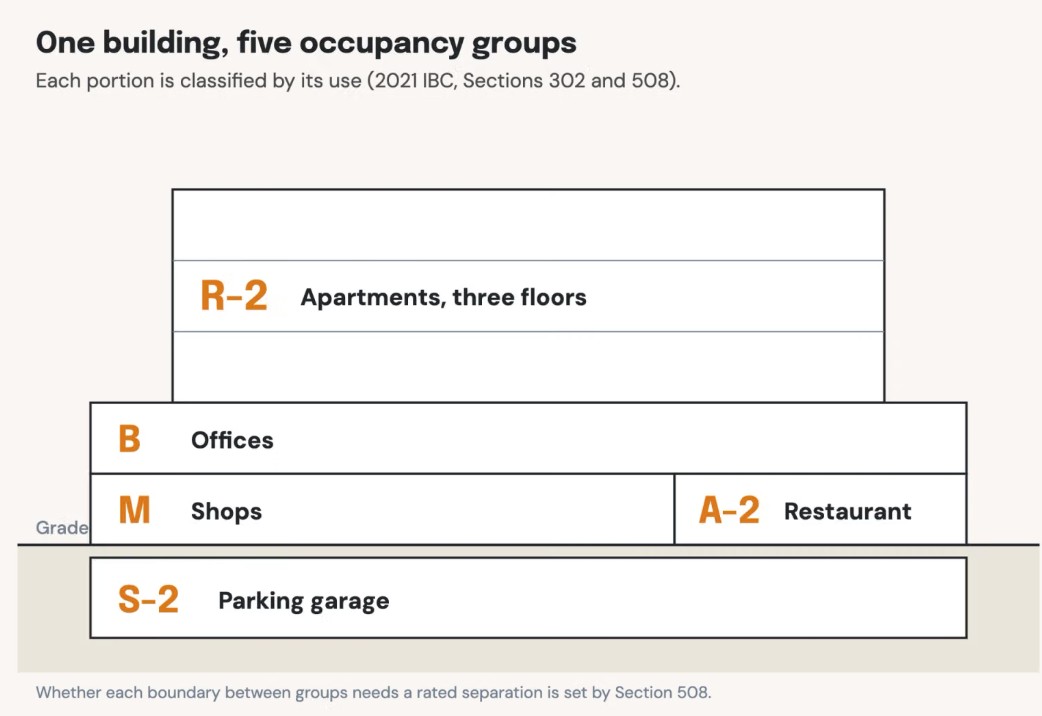
Occupancy classification is a fundamental step in building design, influencing fire safety, occupant loads, exits, and construction requirements. Pirros explains the International Building Code (IBC) classification system and explores how artificial intelligence can help architects maintain accurate, compliant construction documentation.
The IBC divides buildings into 10 occupancy groups: Assembly, Business, Educational, Factory, High-hazard, Institutional, Mercantile, Residential, Storage, and Utility. Each classification establishes requirements for building height, floor area, fire protection, plumbing fixtures, and emergency exits.
Classifying mixed-use buildings presents additional challenges. Architects must determine whether spaces qualify as accessory, nonseparated, or separated occupancies. These decisions affect fire barriers, construction costs, and allowable building dimensions.
Common errors arise when building functions change during design. For example, converting a conference room into a larger training facility may increase occupant loads and require additional exits. Similarly, accessory spaces exceeding 10% of a floor’s area may trigger different occupancy requirements.
Pirros addresses these challenges through its AI-powered Quality Management System, which reviews Revit models and drawing sets against applicable building codes, including the IBC. The system identifies potential violations, references relevant code sections, and highlights affected drawing locations. Architects retain responsibility for reviewing and approving findings.
The company’s AI agent, Mira for Revit, also automates repetitive documentation updates. For example, it can locate references to outdated building code editions across drawing notes and propose replacements. Before making changes, Mira identifies affected text, requests clarification, and requires user approval.
However, updating code references does not establish compliance with revised regulations. Architects must independently verify whether the applicable requirements have changed.
The article illustrates how AI-assisted quality management can reduce documentation inconsistencies and repetitive work while supporting more reliable building code reviews. By combining automated checks with professional oversight, architects can improve coordination and maintain greater control over evolving design requirements.
