

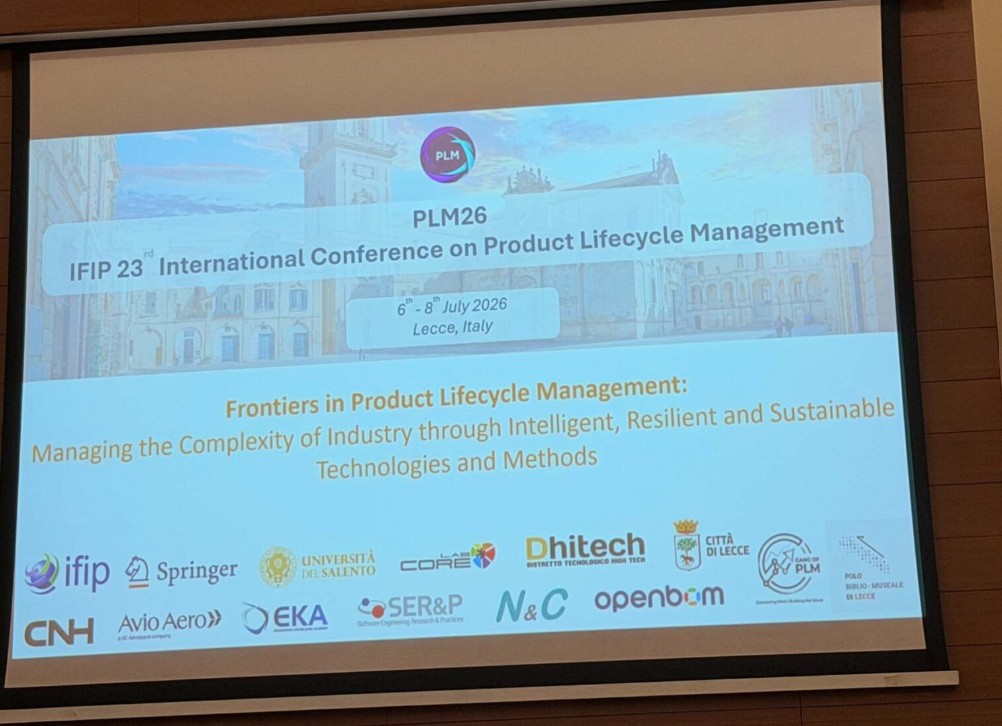
The 23rd IFIP International Conference on Product Lifecycle Management (PLM26), held in Lecce, Italy, highlighted a significant shift in the way the manufacturing and engineering communities view product lifecycle management. Rather than treating PLM as a system for managing engineering documents, the conference presented it as a connected digital ecosystem that links design, manufacturing, operations, maintenance, and end-of-life activities through intelligent technologies, tells Beyond PLM blog.
The conference theme focused on managing industrial complexity through intelligent, resilient, and sustainable methods. Throughout the event, three concepts repeatedly emerged as the foundation of modern PLM: the digital thread, the digital twin, and artificial intelligence. Speakers described the digital thread as the continuous flow of engineering information across the product lifecycle, the digital twin as the evolving virtual representation of a physical product, and AI as the technology that transforms lifecycle data into actionable knowledge.
The keynote presentations reflected both academic research and industrial realities. One keynote explored the growing role of agentic AI in creating hybrid products that combine physical devices with AI-driven services. Another, delivered by executives from Leonardo Aeronautics, demonstrated how AI is being applied selectively in areas such as computer vision, predictive maintenance, automated manufacturing, and multidisciplinary design optimization rather than as a universal solution. The speakers emphasized that organizational culture and change management remain greater challenges than technology itself.
Beyond technical sessions, PLM26 reinforced its role as a collaborative forum connecting researchers, students, software developers, and manufacturers. The conference featured a doctoral workshop, Digital Twin Contest, industry sessions, and discussions on topics ranging from model-based systems engineering and sustainability to cybersecurity, additive manufacturing, and AI-driven benchmarking. A new special interest group dedicated to AI in PLM was also announced, reflecting the technology’s growing influence on future research.
The strongest message from the conference was that the industry has moved beyond asking whether AI belongs in PLM. Instead, the focus has shifted toward building the data foundations that enable AI to understand products, engineering decisions, and product history. As digital threads become more mature, the next phase of PLM will likely emphasize capturing engineering knowledge and product memory, allowing AI systems to understand not only what happened during a product’s lifecycle but also why those decisions were made.
