

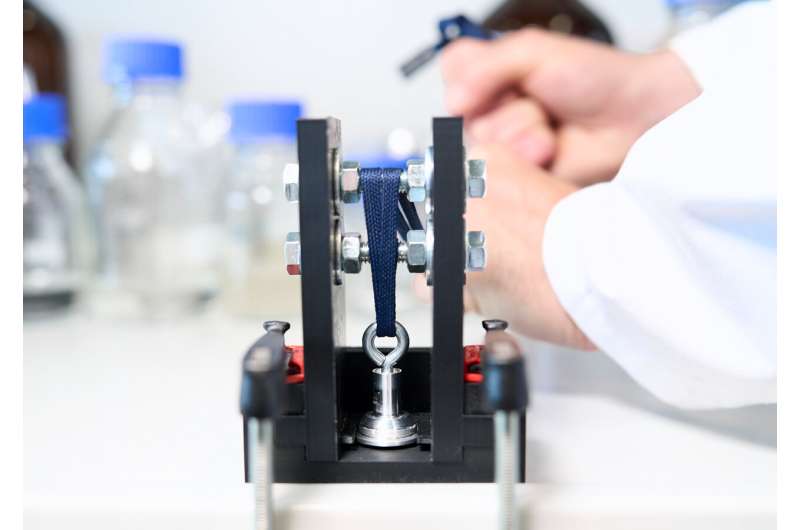
Researchers at the Fraunhofer Institute for Applied Polymer Research (IAP) have developed a microencapsulated adhesive system that could simplify industrial bonding processes while significantly improving workplace safety. The technology packages the two reactive components of a conventional adhesive inside microscopic capsules, preventing them from coming into contact until pressure is applied during assembly. This eliminates the need to manually mix or dispense reactive chemicals, reducing both process complexity and occupational hazards, tells Tech Xplore.
Traditional two-component adhesives are widely used because they provide strong, durable bonds across a range of materials. However, they require careful dosing, mixing, and handling before application, exposing workers to reactive substances and adding extra manufacturing steps. The Fraunhofer team addresses these challenges by encapsulating each adhesive component separately. When two surfaces are pressed together at room temperature, the capsules rupture, allowing the components to mix and cure only at the bonding interface.
The researchers designed the microcapsules to remain stable during storage and handling while breaking reliably under controlled pressure. This makes the adhesive easier to transport, automate, and integrate into manufacturing lines without specialized mixing equipment. The approach also offers greater flexibility for assembling lightweight structures and joining dissimilar materials, both of which are increasingly common in industries such as automotive, aerospace, electronics, and consumer products.
Beyond improving safety, the technology has the potential to reduce production costs and improve manufacturing efficiency. Because the adhesive is activated only when pressure is applied, manufacturers can streamline assembly operations and reduce waste associated with unused mixed adhesive. The process also eliminates the need for heat to initiate bonding, making it suitable for temperature-sensitive materials and energy-efficient production environments.
Fraunhofer IAP is now seeking industrial and research partners to evaluate the technology using different adhesive chemistries, carrier materials, and manufacturing processes. If successfully commercialized, the microencapsulation technique could provide manufacturers with a safer, more efficient alternative to conventional two-component adhesives while supporting the growing demand for automated, high-performance assembly technologies.
