

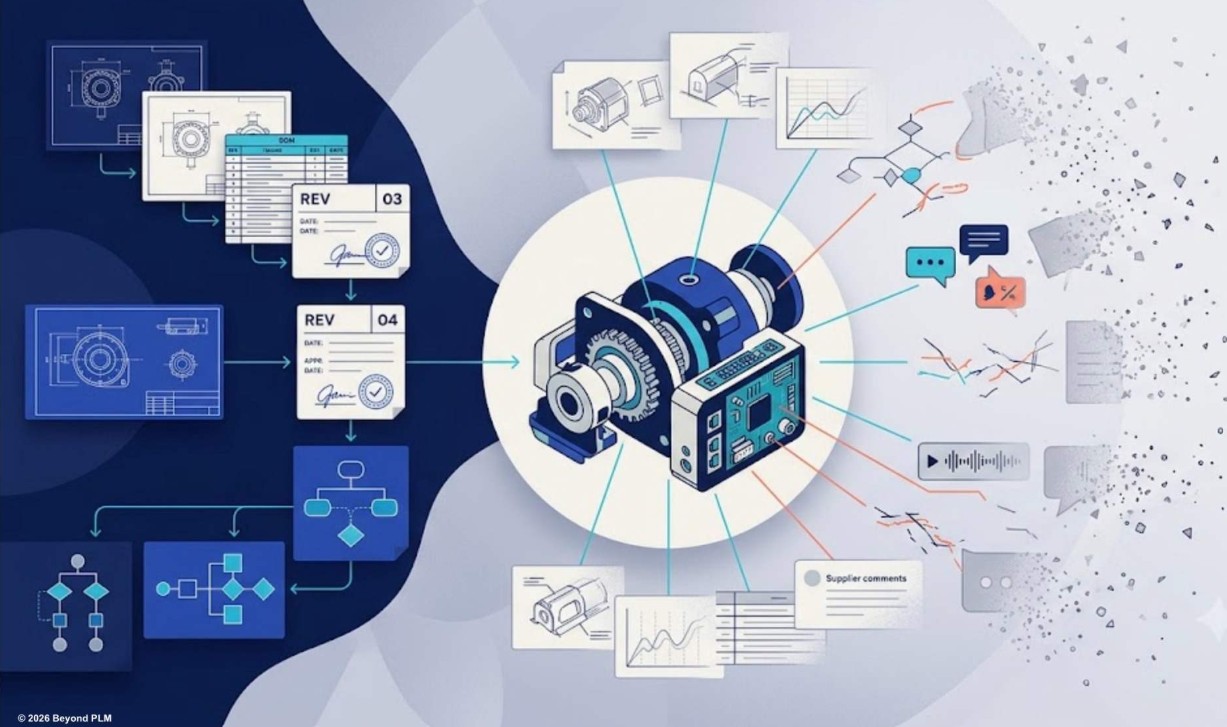
The Beyond PLM article argues that Product Memory is not a rebranding of product lifecycle management (PLM), but a new capability designed to capture the reasoning behind engineering decisions. While acknowledging that the PLM industry has a history of introducing new terminology without addressing implementation challenges, the author contends that Product Memory addresses a genuine gap that existing PLM systems were never designed to fill.
PLM remains the system of record for product data, managing revisions, bills of materials, approvals, lifecycle states, and engineering changes. It effectively records what decisions were made, when they were made, and who approved them. However, it rarely captures why those decisions were made, what alternatives were considered, or the trade-offs that led to the final outcome. That knowledge often remains scattered across emails, spreadsheets, chat platforms, meeting notes, presentations, and the memories of engineers.
The author defines Product Memory as a layer that connects decision rationale to the engineering items it governs without replacing or competing with existing systems of record. Unlike PLM, it has no authority over product data. Instead, it preserves the semantics, relationships, history, and engineering context that exist between enterprise systems. This distinction makes Product Memory a complementary concept rather than a replacement for PLM or the digital thread, which links existing records but cannot recreate reasoning that was never documented.
Artificial intelligence has made this missing layer increasingly important. AI assistants retrieve information from available records, but they cannot explain engineering decisions when that reasoning was never captured. As a result, AI often produces convincing summaries of revision histories without answering the questions engineers actually ask, such as why a specific material, tolerance, or architecture was chosen. According to the author, this is fundamentally a data problem rather than an AI limitation.
The article concludes that Product Memory represents a concept, not a product. Advances in low-cost transcription, knowledge extraction, and AI now make it practical to capture engineering rationale as a byproduct of everyday work. Whether implemented by existing PLM vendors or new platforms, Product Memory could become the missing knowledge layer that improves AI-assisted engineering, preserves institutional expertise, and reduces the repeated rediscovery of past decisions during both product development and PLM implementations.
