

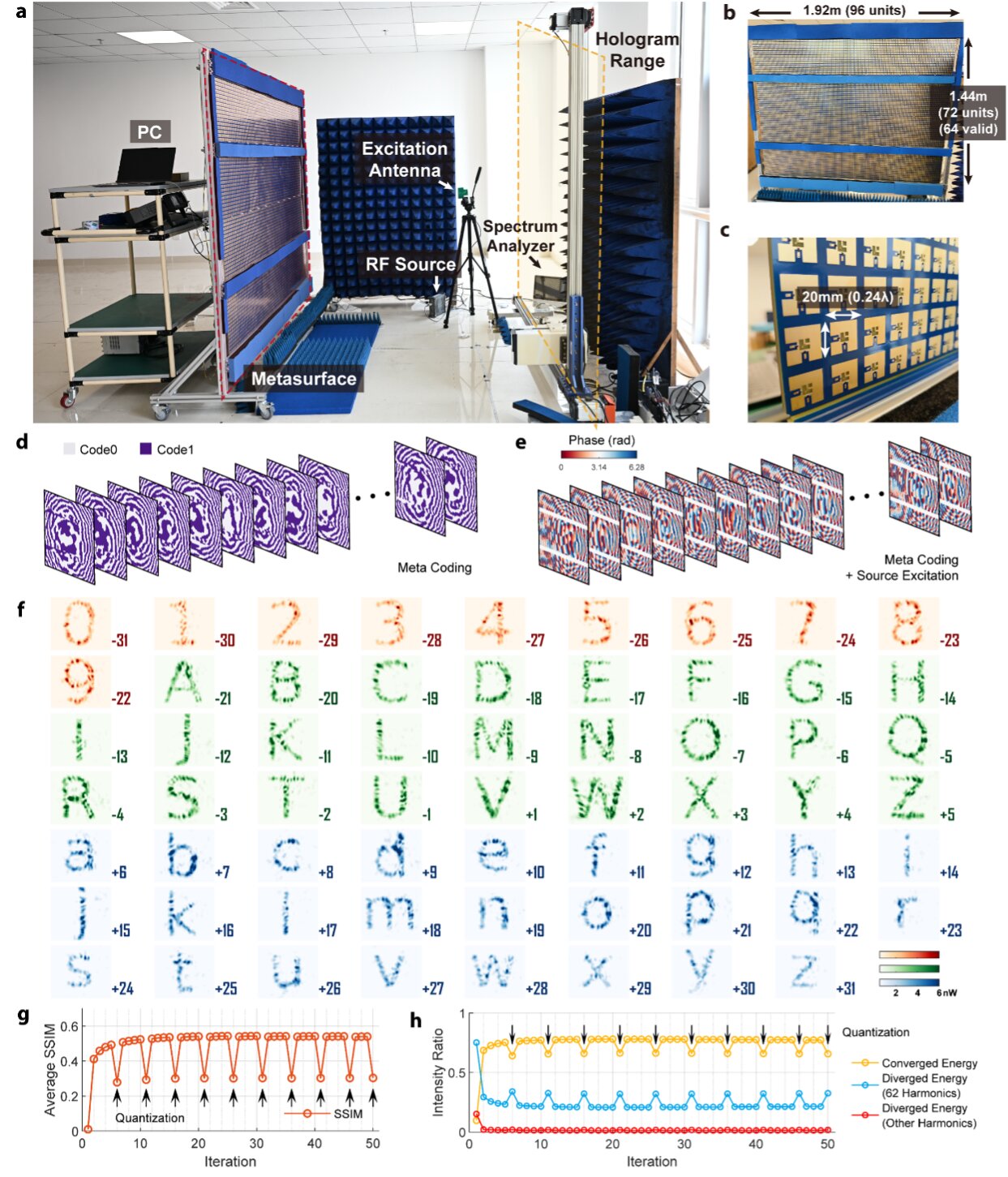
Researchers have developed a programmable metasurface capable of generating dozens of holographic images simultaneously, marking a significant advance in electromagnetic wave control. Unlike conventional holographic systems that project images sequentially or require multiple input frequencies, the new platform creates many independent holographic channels from a single input frequency. The breakthrough combines a programmable metasurface with a newly developed computational method called the space-time Gerchberg-Saxton (ST-GS) algorithm, enabling faster and more efficient generation of complex holographic patterns, tells Tech Xplore.
The programmable metasurface contains 6,144 independently controlled elements that operate at a frame refresh rate exceeding 1 MHz while providing an equivalent coding bandwidth of 6 Gb/s. Instead of displaying one image after another through time multiplexing, the system produces multiple holograms in parallel. This simultaneous operation eliminates blind zones and reduces distortions that typically occur when multiple channels share the same frequency. According to the researchers, the architecture offers a practical way to manipulate electromagnetic waves with greater flexibility and precision than previous programmable holographic systems.
A key innovation lies in the ST-GS algorithm, which independently designs holographic patterns for each harmonic generated by the metasurface. Compared with conventional optimization methods, such as particle swarm optimization, the new algorithm accelerates hologram generation by several orders of magnitude, making real-time dynamic operation possible. During experimental demonstrations, the researchers successfully projected 62 independent holographic images while also validating the system in a dynamic multi-target tracking application, confirming both its reliability and practical performance.
The technology has potential applications well beyond holographic displays. The ability to direct multiple beams toward different moving targets simultaneously could improve next-generation radar systems, wireless communications, spectrum analysis, remote sensing, and environmental monitoring. The research team also plans to integrate the ST-GS algorithm directly into the field-programmable gate array controller that manages the metasurface. This would eliminate reliance on an external computer, increasing processing speed and paving the way for compact, self-contained programmable holographic devices suitable for real-world deployment.
