

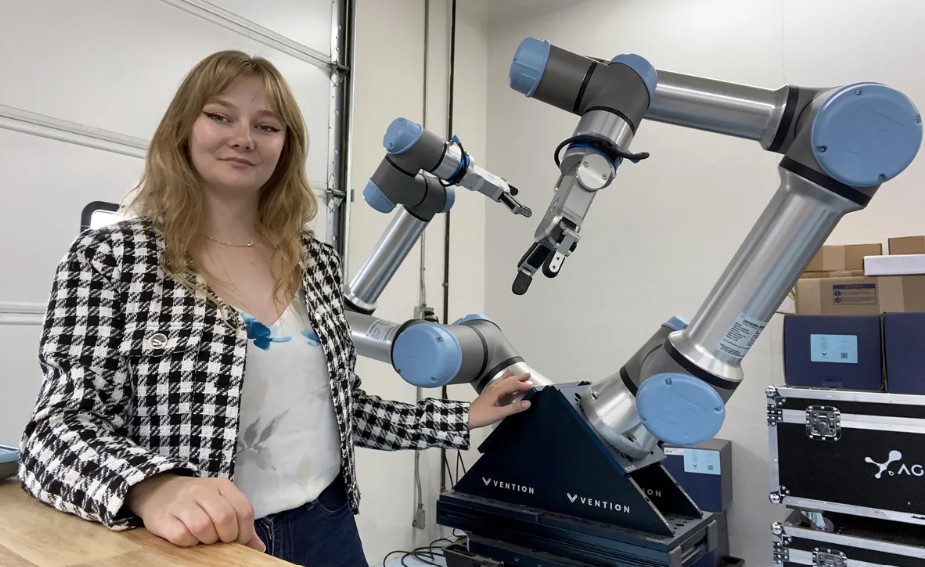
Sarah Downs, a Ph.D. student in electrical engineering at Texas A&M University, is helping advance robotic technologies that could transform satellite assembly in space. Working in collaboration with NASA and the U.S. Air Force, Downs developed an algorithm that enables robotic systems to install antennas on satellites without relying on cameras. The research addresses the classic “peg-in-hole” robotics challenge, in which a robot must accurately insert one component into another. In the harsh environment of space, where cameras can suffer from delays or reduced reliability, her force-based approach offers a more robust alternative for autonomous assembly, tells IEEE Spectrum.
Instead of using computer vision, the robotic arm senses forces and torques through its gripper to determine the position and orientation of the antenna and satellite. The robot then guides the antenna into the correct location while maintaining stability during the bonding process. Because the work is performed in a zero-gravity environment, the robot must also account for reaction forces that could unintentionally move the satellite. Downs is developing calculations that generate reverse thrusts to counter these forces, allowing the robot to complete delicate assembly tasks without disturbing the spacecraft.
Downs’ interest in robotics began in middle school through the First Lego League and later expanded through FIRST Robotics competitions. Inspired by NASA’s Mars rover missions, she pursued electrical engineering at the University of Tulsa, where she completed projects ranging from an interactive lunar exploration exhibit to an assistive robotic arm designed to help older adults and wheelchair users perform everyday tasks. These experiences shaped her focus on developing robots that interact safely and effectively with their surroundings.
Now conducting doctoral research in Texas A&M’s Robotics and Automation Design Lab under former NASA roboticist Robert Ambrose, Downs continues to study satellite assembly and space manipulation on a larger scale. She hopes to contribute to future NASA missions involving planetary rovers and robotic systems for space stations. Beyond her research, she encourages engineering students to gain practical experience through projects, internships, and professional organizations such as IEEE, emphasizing that curiosity, hands-on learning, and collaboration are essential to success in robotics.
