

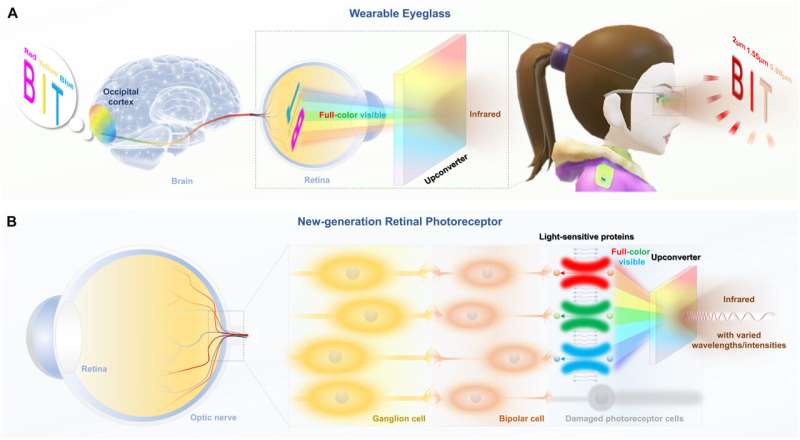
Researchers have developed a prototype pair of glasses that enables people to perceive infrared light as visible color, potentially opening a new chapter in wearable vision technology, tells Tech Xplore. Unlike conventional night-vision goggles, which typically produce grainy green or black-and-white images, the new system converts different infrared wavelengths into distinct visible colors, allowing users to distinguish subtle details that would otherwise remain invisible. The work, led by scientists at the Beijing Institute of Technology, was published in Science Advances.
Human vision is naturally limited to the visible portion of the electromagnetic spectrum because infrared photons do not carry enough energy to activate retinal cells. Existing infrared imaging systems overcome this limitation with bulky cameras and electronic processing, making them expensive and impractical for everyday use. The new prototype instead integrates the conversion process directly into wearable eyewear, eliminating the need for complex external imaging systems.
The technology relies on microscopic mercury telluride colloidal quantum dots embedded within the optical device. These quantum dots absorb incoming infrared light and convert it into electrical charges, which are then transformed into visible light. By assigning different visible colors to different infrared wavelengths and intensities, the system creates a richer representation of the infrared world than traditional monochromatic night-vision devices.
The researchers demonstrated that users wearing the prototype glasses could perceive infrared signals under both dark and daylight conditions. Because the conversion occurs optically rather than through digital image processing, the glasses remain compact and lightweight. The technology could eventually support applications in night navigation, search and rescue, industrial inspection, medical imaging, and security, while also helping people detect information that lies beyond the normal limits of human sight.
Although the prototype remains in the research stage, further improvements in image resolution, efficiency, and material performance could make the technology suitable for practical use. The study represents an important step toward wearable devices that naturally extend human vision, offering a future in which infrared information can be viewed as easily as ordinary colors without relying on conventional night-vision hardware.
