

PTC is advancing its artificial intelligence roadmap for Creo with three tools designed to bring practical AI assistance directly into CAD workflows. Creo 13 introduces more than 150 enhancements across areas including simulation, composites, ECAD, and productivity, but its emerging AI capabilities represent a significant shift in how engineers may interact with the software, tells Develop 3D.
PTC calls its approach the Triple A of AI: Advise, Assist, and Automate. The company says its strategy is not to introduce AI simply because the technology is available, but to apply it where it can improve engineering, manufacturing, and service workflows.
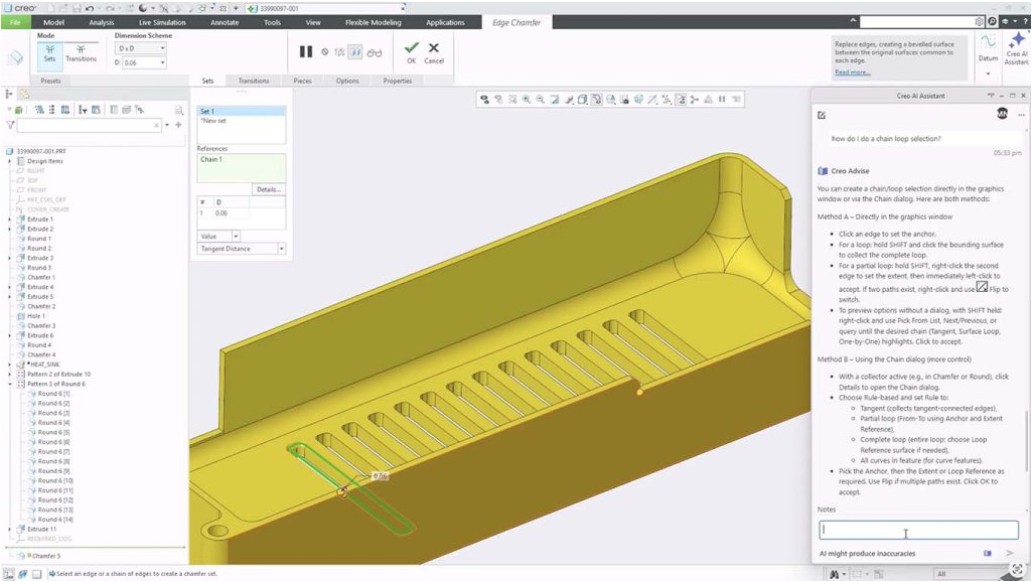
Advise, available to Creo 13 users through a chatbot interface, acts as an everyday assistant. It can explain features, troubleshoot problems, locate commands, and guide engineers using decades of Creo knowledge, best practices, standards, and regulations.
Assist goes further by understanding the context of the CAD model. Currently in beta, it can extract model information and perform tasks that might otherwise require significant manual effort. For example, it can identify every round in an engine model, report dimensions and radii, and help create parameters that control matching features throughout an assembly. PTC expects Assist to reach users in late autumn.
Automate, still in alpha, takes a more active role by optimizing designs according to engineering requirements. In one demonstration, it optimized an exhaust pipe for factors such as flow and acoustics. Proposed changes are created in a sandbox, protecting the original model and allowing engineers to compare results before accepting them.
PTC emphasizes transparency and human oversight throughout this process. Engineers remain responsible for approving or rejecting AI-generated modifications. With Creo 2027 expected to be announced before year-end, PTC plans to expand these AI capabilities while focusing on accuracy, reproducibility, and practical engineering value.
