

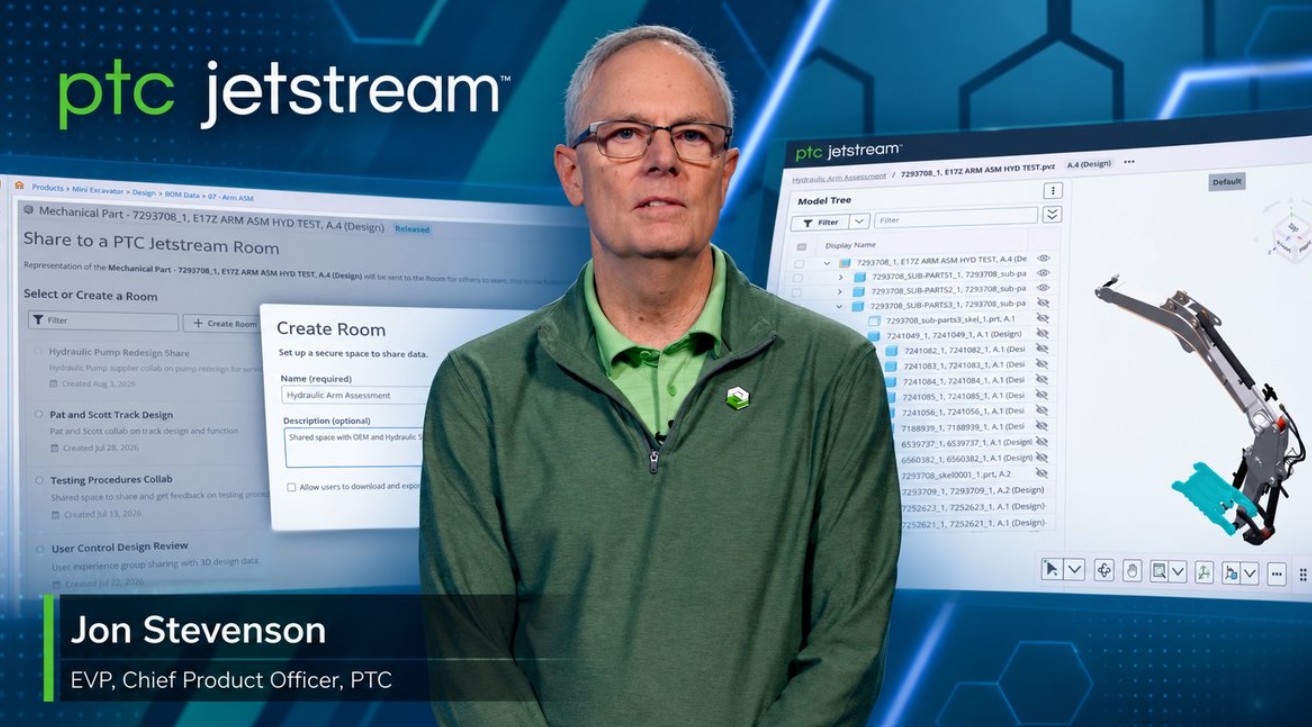
PTC’s launch of Jetstream introduces a cloud-based collaboration environment designed to capture engineering discussions alongside the product information being reviewed. Beyond PLM’s Oleg Shilovitsky sees the platform as a potential step toward Product Memory, where organizations preserve not only what a product became but also the reasoning behind engineering decisions.
Jetstream allows teams to create access-controlled Rooms where employees, suppliers, and other participants can review 2D and 3D content through a browser. Comments remain connected to the relevant product version, participant, time, and view, while AI-generated summaries help users understand discussions and next actions. Windchill remains the system of record, although Jetstream can also work with directly uploaded files.
This approach addresses a persistent PLM problem. Design reviews often involve manufacturing specialists, suppliers, quality experts, and others whose knowledge affects engineering decisions. The final product definition may record the resulting change, but the assumptions, alternatives, constraints, and conversations behind that decision can disappear. Jetstream provides a way to capture more of this context as collaboration occurs.
Shilovitsky argues that retaining information is only the first step. Useful Product Memory should connect decisions with their assumptions, evidence, scope, approvals, and later outcomes. If circumstances change, engineers should be able to retrieve the original reasoning and determine whether a previous decision still applies.
Jetstream can export Room activity as a PDF for storage in Windchill, and AI could extract information from those records. However, the article questions whether future applications and AI agents will reliably understand decision status, revisions, permissions, and superseded information.
The larger test will be interoperability. If Jetstream can preserve authoritative product context across OEMs, suppliers, and independently managed engineering systems, it could evolve beyond design review into an important contextual layer for intelligent product lifecycle management.
