

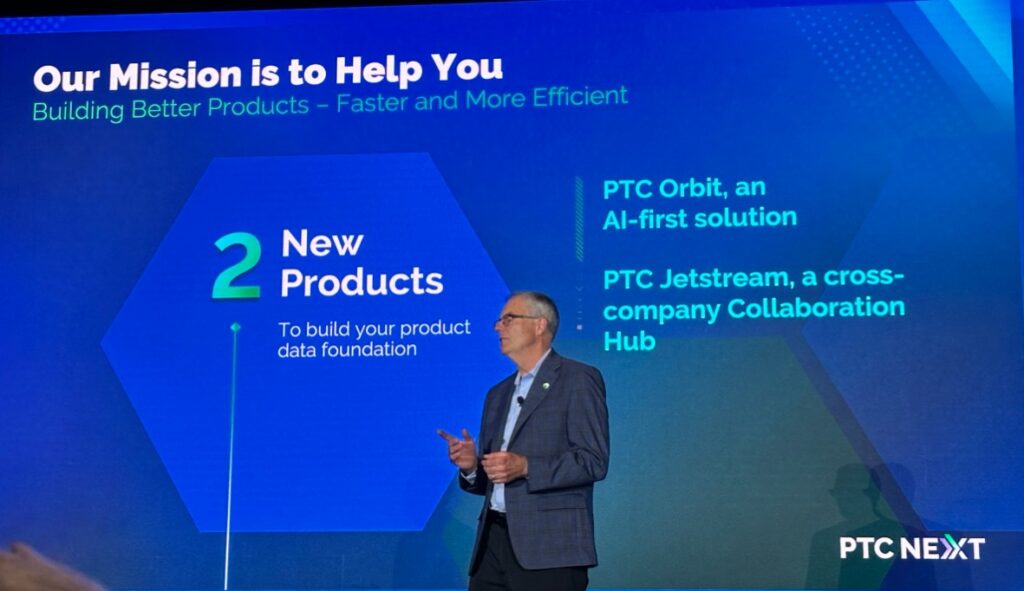
PTC Jetstream emerged as one of the most significant announcements at PTC Next 2026, not because of flashy AI features, but because of its potential architectural impact on the future of product lifecycle management (PLM). According to industry analyst Oleg Shilovitsky, Jetstream represents more than a collaboration tool. It combines three related concepts: a collaboration layer, a context layer, and the early foundation of a product-data layer.
The first aspect of Jetstream addresses a long-standing problem in engineering organizations. While product data is carefully managed within systems such as PLM and CAD, many critical decisions are still made through emails, screenshots, presentations, and video calls. These discussions often lack traceability and become disconnected from the official product record. Jetstream seeks to bring those interactions into a structured environment where feedback, reviews, and decisions remain linked to the product data itself.
The second dimension is context. Jetstream associates comments and discussions with specific product versions, 3D views, and engineering artifacts. By capturing the reasoning behind decisions, it preserves information that traditionally disappears in inboxes and chat threads. This capability is particularly important for AI-driven workflows, which require not only data but also an understanding of why decisions were made.
The third and most ambitious dimension is Jetstream’s potential evolution into a broader product-data platform. Built as a standalone, cloud-native, multi-tenant SaaS application, it operates independently of Windchill while remaining connected through APIs and integrations. This architecture allows internal teams, suppliers, and external partners to collaborate without the complexity typically associated with enterprise PLM deployments. PTC has also indicated a future direction that could add cloud-based data management capabilities, further expanding Jetstream’s role.
The article argues that the broader PLM industry is shifting from a focus on controlling product data to enabling meaningful use of that data across engineering, manufacturing, and service processes. Jetstream reflects this transition by emphasizing connected product context, traceable decision-making, and collaboration. Whether it ultimately becomes a true product-data layer or evolves into another large platform remains an open question, but its architecture signals an important change in the direction of PLM.
