

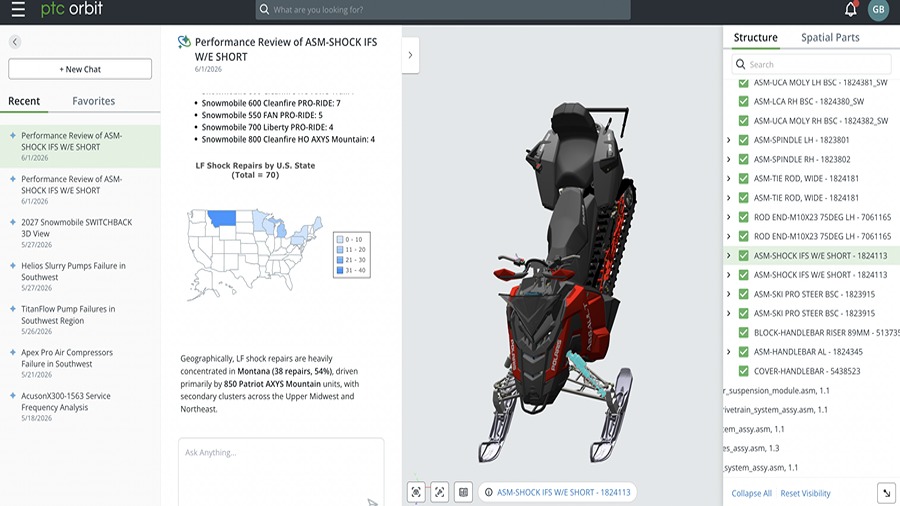
BOSTON, MA, June 15, 2026 – PTC Orbit is a cloud-native asset intelligence system, connecting design, manufacturing, service, and operational data after equipment enters the field. The system links PLM, ERP, CRM, IoT, EAM, and FSM systems into a asset record and uses AI to make asset information available to engineering, quality, and service teams. According to PTC, the product extends its Intelligent Product Lifecycle by connecting the product as designed with the asset as maintained.
Manufacturers track revisions, configurations, and change orders in PLM during design and production. After shipment, the state of each asset is spread across disconnected systems. PTC Orbit is intended to serve as an as-maintained system of intelligence, giving teams a current asset view for product reliability analysis, service planning, and aftermarket revenue programs.
“Asset data fragmentation is one of the most persistent barriers to operational efficiency in manufacturing,” Eric Kaese, field service management lead, Deloitte. “With products like PTC Orbit, organizations have the opportunity to deepen capabilities, moving them from reactive decision‑making entities to more scalable, insight‑led operations.”
“With more than 25% of our sewer level monitoring devices offline at any given time, we needed a single, coherent view of network condition and risk across our operations,” said Andrew Oliver, head of operational technology platforms, Southern Water. “PTC Orbit gave us that capability and the ability to prioritize high-risk areas, optimize field activity, and make more informed investment decisions at scale.”
PTC Orbit supports three primary functions:
- Asset data consolidation: Connects and reconciles asset data from PLM, ERP, CRM, IoT, EAM, FSM, and other enterprise systems to create as-maintained view of each asset, addressing the visibility gap that can open when products ship.
- AI-powered lifecycle intelligence: Applies AI to detect service patterns and failure trends, calculate asset health scores, and forecast service and maintenance demand by asset group, account, and region.
- AI-assisted access and interaction: Enables enterprises to work with asset data through an AI canvas that surfaces insights dynamically based on user context, replacing static dashboards with information on demand.
“Asset data has always existed everywhere, but nowhere could it truly be used,” said Joseph June, general manager of SLM and AI strategy, PTC. “With PTC Orbit, we built a new AI-first solution from the ground up to be the system of record for asset intelligence. With this new solution, we’re shifting asset data from something teams manage after the fact to something they can use proactively across the entire product lifecycle.”
PTC Orbit was presented at PTC NEXT Chicago, held June 9-10 at the Swissôtel Chicago. The PTC NEXT On-Demand Experience Hub is now live, with new content being added for customers and partners seeking access to material shared during the event.
Source: PTC
About PTC

PTC was founded in 1985 and headquartered in Boston, MA, develops software for engineering and product development teams worldwide. Its portfolio includes CAD, PLM, IIoT, application lifecycle management, and augmented reality tools. The software supports product design, manufacturing, data management, and service operations. PTC serves manufacturers in aerospace, automotive, electronics, industrial equipment and energy sectors. The company reports more than 30,000 customers globally, including 95% of Fortune 500 manufacturers. PTC employs about 7,500 people worldwide. It operates primarily on a subscription-based business model focused on digital product development and connected operations.
