

CHICAGO — PTC has decided that zero annual conferences is too few. Two is just right. Here is what happened at a reinvigorated PTC annual event: PTC NEXT, the replacement for LiveWorx.
PTC NEXT will be the company’s new twice-yearly event. After having gone dark for two years, they have decided to double down.
PTC NEXT made its debut June 9-10 at the Swissôtel Chicago. It’s been two years since the last LiveWorx. PTC will now bundle everything into two “innovation seasons,” Spring and Fall, each anchored by a flagship event. Spoiler: Next NEXT is in Barcelona. Closer for PTC’s European customers, explains a PTC spokesperson. And a nice perk for Boston-based PTC staff.
“PTC has never built more innovation in one season, and PTC has never shown more innovation in one place,” promised Dirk Schart, master of ceremonies, PTC marketer by day, hard rock musician by night.
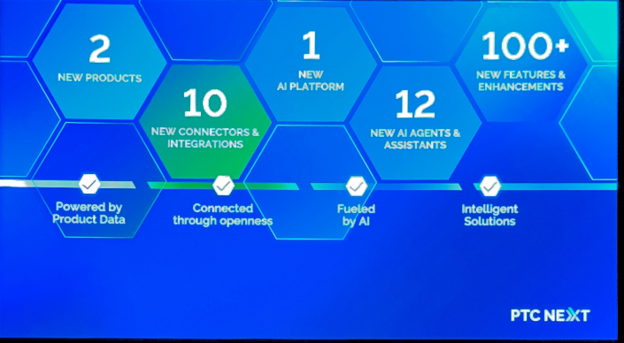
Dirk has mapped the announcements on a slide of empty hexagons he called the Product Innovation Wayfinder. The audience, he conceded, had already renamed it. “People call it the honeycombs, the holiday calendar… maybe we’ll have a naming competition.”
The 500 or so attendees — customers, partners, analysts, and press — got a torrent of info, as if to make up for lost time. There were two new products (PTC Orbit and PTC Jetstream), a new AI platform, 12 AI agents, 10 new integrations, and more than 100 enhancements across the portfolio (PTC press release, June 10 2026).
Neil Barua: AI, We Got This.
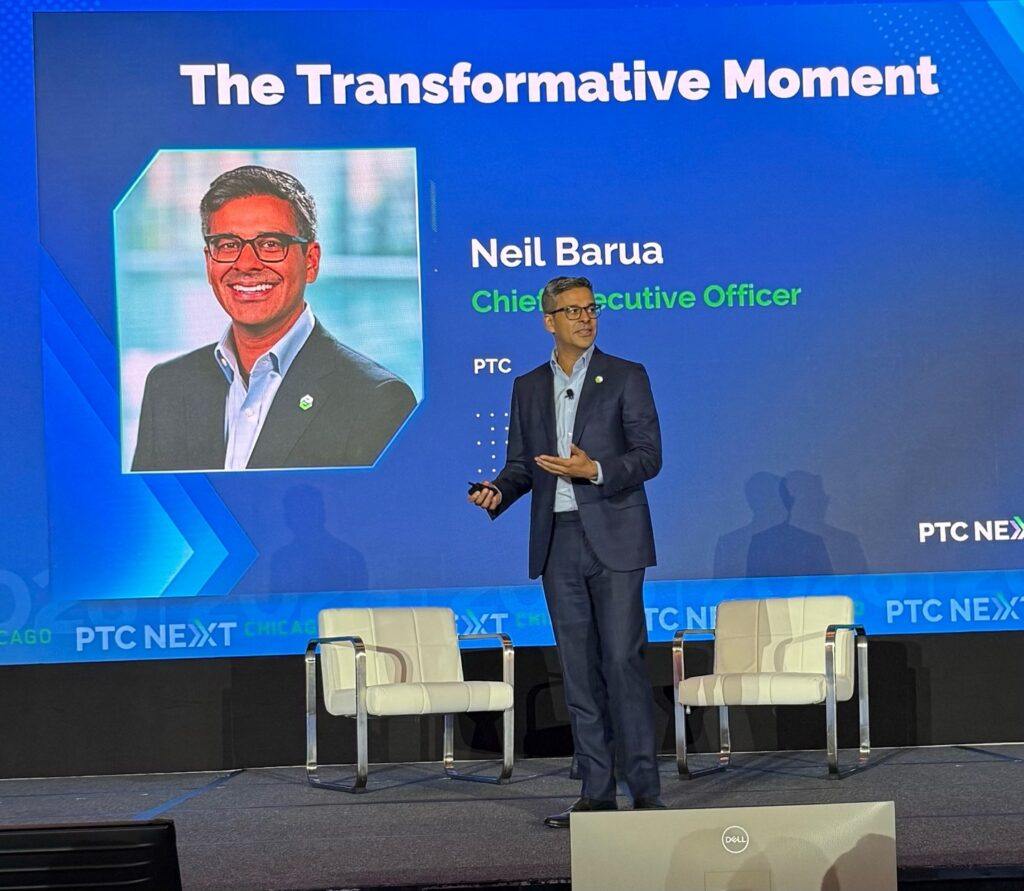
“AI is going to be the roller coaster of roller coasters,” said new PTC CEO, Neil Barua. “One day we’re telling our employees, use it at will. The next day we’re saying, wait a second, token costs are going up, don’t use it anymore.” He went further: having talked to CEOs of big companies and founders of foundation model labs alike, “whether they admit it or not in private, no one really knows what this technology can do consistently at scale.”
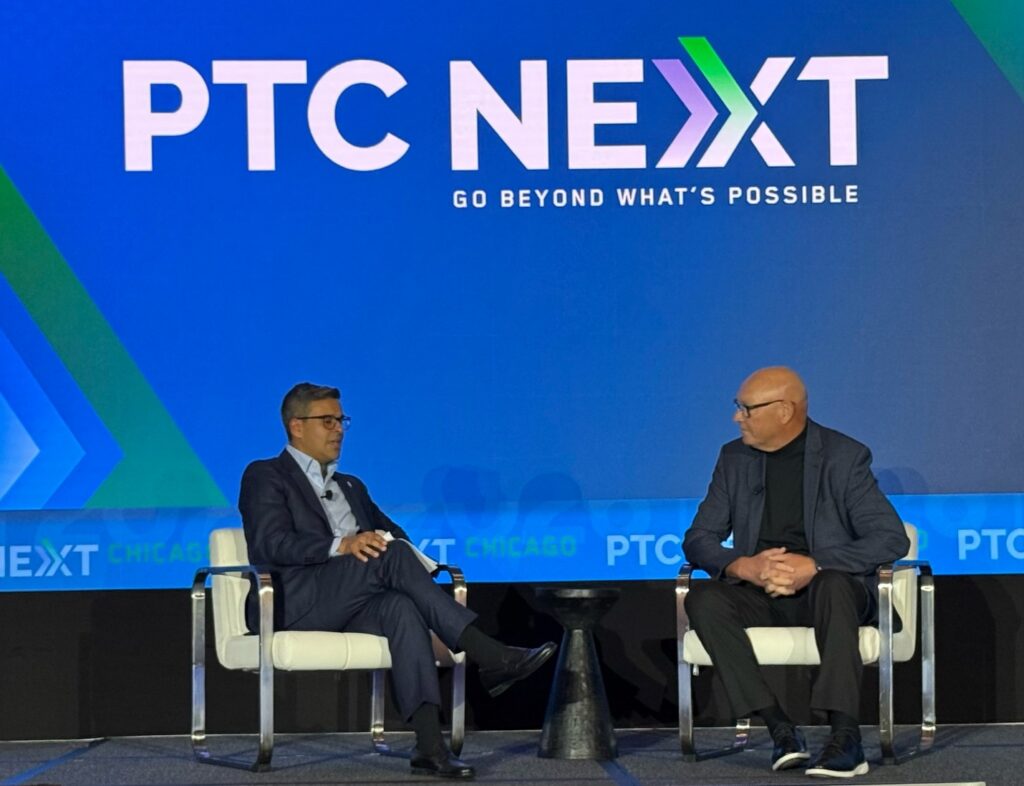
Stephen Olive, Chief Digital Strategy Officer at the U.S. Department of Energy, joined Barua in a fireside chat. Steve (“only my Mom calls me Stephen”) is is leading his sixth digital transformation — this one compressing a five-year program into 18 months. Olive offered the line of the day on legacy change processes, describing the DOE practice of putting “50 people in a conference room with a stack of paper” to trace a unit’s engineering history — what he called, from his Raytheon days, “hanging paper.”His advice for getting transformation funded was equally quotable: “Overwhelm them with value proposition. There’s not a CFO in today’s world that will not give you the investment dollars… if your value proposition overwhelms it.” Olive said he currently has 23 value propositions in ROI analysis for a single digital thread — sparked in part by a hallway conversation with the head of the NSA, who told him product development timelines need to move from 10-15 years down to three to five.
Has he actually secured the funding?
“I don’t have it yet, I’m still overwhelming.”
The audience loved it.
Stevenson’s History Lesson
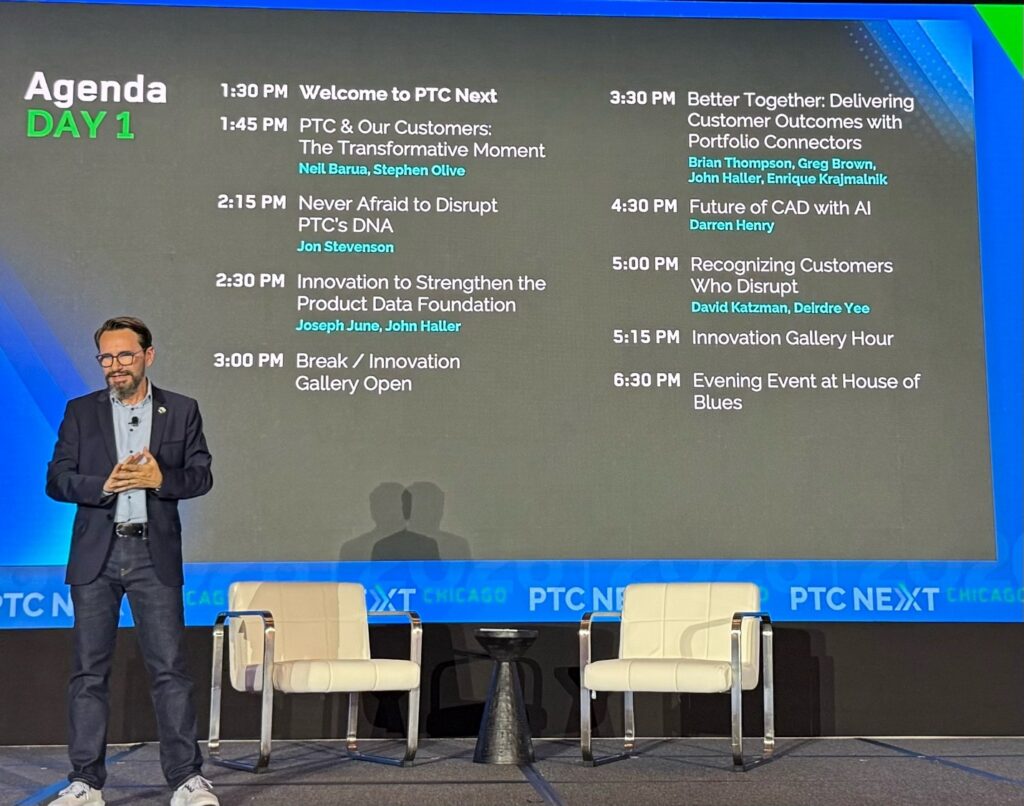
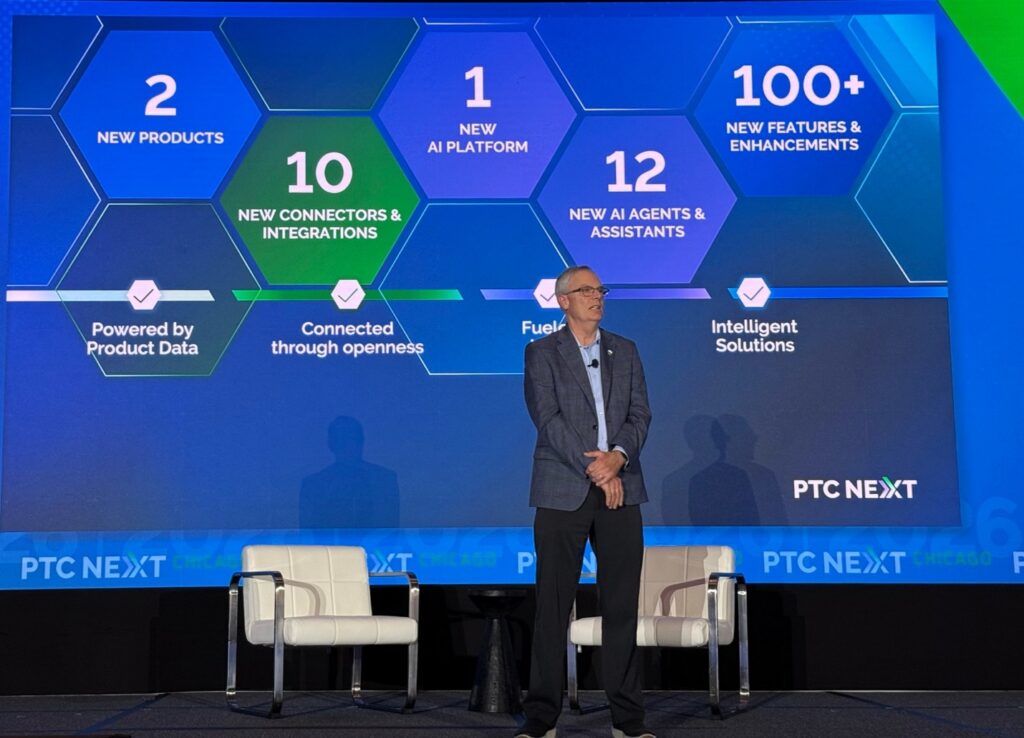 Jon Stevenson, who returned to PTC and is now the lead CAD guy at PTC. His hiatus from CAD took him to Stratasys and GrabCAD. Returning to PTC last August, he serves as Executive Vice President and Chief Product Officer, securing the credibility in the design and software business vacated since Jim Heppleman left.
Stevenson used his presentation to remind the audience that disruption is the company’s founding habit.
In the beginning was was Sam Geisberg, the Russian-born mathematician who founded PTC in 1985 and shipped Pro/ENGINEER three years later — the first feature-based parametric solid modeler, establishing the model for every MCAD program since. John Deere was customer number one. Windchill and Heppleman came in 1998. It was the first PLM system built for the Internet — a year before Salesforce existed, says Stevenson. Adding to the CAD, PLM core were MKS Integrity and Codebeamer acquisitions that brought software lifecycle management under the same roof as hardware. Servigistics and ServiceMax extending the lifecycle past the loading dock. After that, Onshape, “the only truly cloud-native CAD system in existence.”
“We see where the market needs to go, sometimes before the market even realizes it. We move decisively, and we reset customer expectations,” Stevenson said. The intelligent product lifecycle — IPL, in PTC’s current vocabulary — is the same pattern applied to “the biggest transformation we’re going to see in manufacturing in our lifetime.”
PTC is not averse to disrupting itself, says Stevenson, with an “AI-native SDLC” [software development life cycle] inside its own product organization, with purpose-built agents at every phase of software development, from requirements to automated test execution.
“If you want to know where AI is going in manufacturing or engineering, you should look at what’s happening in software first,” he said.
Product Announcements: Orbit and Jetstream
PTC Orbit is an AI-first, cloud-native solution that pulls asset-centric data from PLM, ERP, CRM, IoT, EAM, and FSM systems into a single unified asset record. The pitch, from Joseph June, PTC’s head of AI strategy and general manager of the service business: manufacturers lose line of sight on a product the moment it ships, creating what PTC calls an “engineering quality blind spot” — design intent in one system, field reality in another, and nobody with the holistic view.
John Haller, PTC’s PLM general manager, gave an example.
“I’ve got a 25-year-old design engineer that’s thinking about changing some part. Wouldn’t it be nice to know that there’s 300,000 of those things that just shipped to customers yesterday?”
Orbit is new but already a customer: UK utility Southern Water has been running an early-access version called Asset 360. Notably, Orbit’s interface is built around asking questions rather than navigating prebuilt views — the AI dynamically renders BOM views, drawings, or graphs depending on what you ask. June calls the design philosophy “AI-first,” meaning the product assumes its primary user may not be a human at all, but another agent.
PTC Jetstream is the simpler — and possibly the more universally needed — of the two: a multi-tenant SaaS collaboration tool for sharing and reviewing product data with people who have no desire or inclination to use Windchill. Think marketing, purchasing, the 3D printing bureau, the 250 suppliers…
“This is going to be the easiest to deploy, easiest to use product that we’ve ever built,” Haller said. “We have a rich history of bringing very complicated tools to market for engineers.”
Invited collaborators click an email link, sign in, and can view, section, measure, and annotate full assemblies; comments capture the exact view state, and the whole discussion publishes back into Windchill change processes — where, naturally, AI can later mine the decision history.
The differentiator this time, per Haller, is that the crown jewels stay in Windchill but the suppliers can look in.
Jetstream enters closed beta in July and goes generally available in October.
The NVIDIA angle
PTC told of its two-way NVIDIA relationship. NVIDIA has long run Windchill internally as its PLM system, and PTC is part of NVIDIA’s DSX blueprint for designing, building, and operating AI factories at scale. Among the 10 new integrations: Windchill and Creo connectors to NVIDIA Omniverse, and a workflow connecting Onshape to NVIDIA Isaac Sim, letting engineers publish sim-ready robotic assets — kinematic joints intact — straight from an Onshape assembly into robot training environments. (PTC press release, June 10 2026). An Onshape connector to Altium 365 rounds out the ECAD-MCAD story.
Darren Henry on Vibe-CAD
 The session CAD watchers came for was Darren Henry’s — a self-described “CAD junkie” with three decades in the industry, including 15-plus years as an early SolidWorks employee and another early-employee run at Onshape. His assignment: separate AI-in-CAD substance from all the hype.
Henry walked through PTC’s advise/assist/automate framework with receipts. Onshape’s AI Advisor — a RAG system trained on every tutorial, help article, and webinar Onshape has produced — now fields more queries than all of Onshape’s other help channels combined, by 30 percent, and support tickets per user have declined. Creo 13 ships the same advisory capability; Creo’s “assist” tier, now in beta, is model-aware — it can find every annotation tied to a display state, or flag MBD dimensions whose precision doesn’t match their tolerances, turning hours of tedium into minutes.
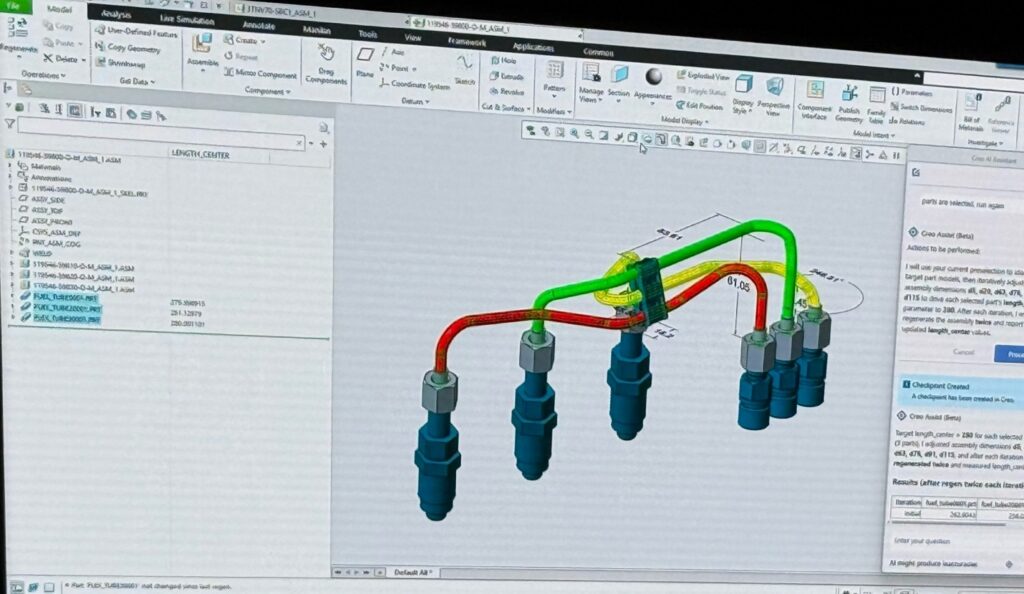 The “automate” tier, shown as a proof of concept, optimized three fuel lines on a Bobcat engine to equal length — in a sandbox, with every AI-touched parameter tracked, and a human accepting or rejecting the result.
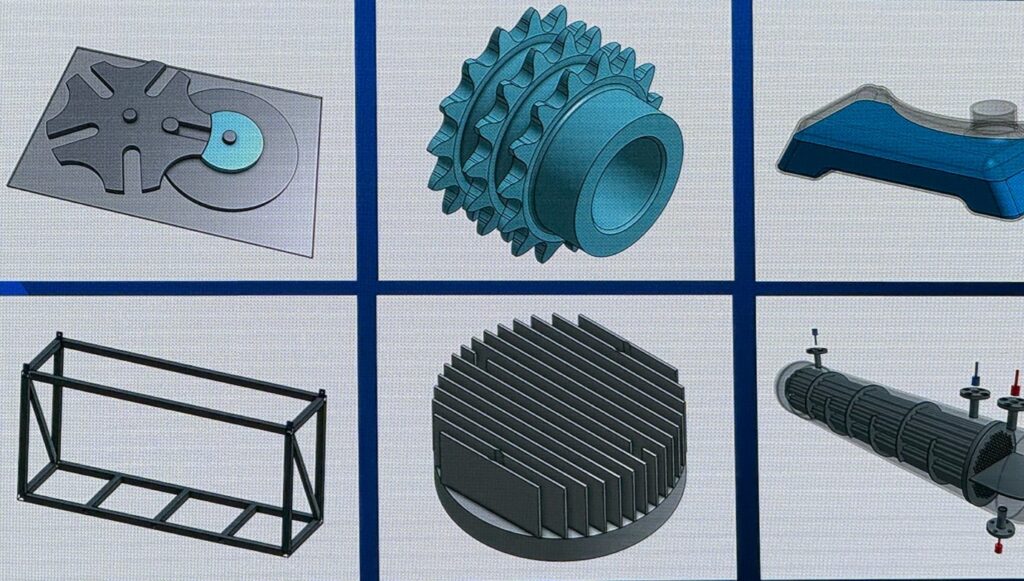
Henry put up a grid of models made from when LLMs piped into CAD systems via MCP — including one claiming MIT had open-sourced a model that “could end the $150-an-hour CAD business.”
“I just invite you to look at the complexity of these models,” Henry said. “I think you’ll agree they’re rather simplistic.”
He did a takedown of text-to-CAD. Ask Claude to model a washer, and it will — but edit the sketch and you’ll find the circles were never constrained concentric.
The viral Raspberry Pi case? No coincident corners, no horizontal/perpendicular relationships. A washer needs four constraints; a simple box, about a dozen; a single sprocket tooth, around 80. “Most people’s designs land somewhere between that sprocket tooth and that rectangle.” LLMs, he argued, simply do not understand the language of CAD — sketch constraints, feature dependencies, topology — and the resulting models are brittle, uneditable, and totally devoid of design intent.
PTC’s answer is a layer of abstraction it has had since Onshape’s founding: FeatureScript, the CAD-specific language Onshape uses to build its own features, which happens to be exactly the kind of code LLMs are good at writing. Wrap it in an MCP harness, let the model write, test, and iterate FeatureScript in Onshape, and the results change dramatically.
Henry’s gallery: an AI-generated roller chain sprocket configurator built from a prompt, a manufacturer’s catalog page, and a tooth-profile spec — about 400 lines of code, one encapsulated feature, fully editable, with standard Martin Sprocket sizes built in.
“I’ll argue this is the most complex sprocket configurator on the planet,” says Henry. A fluid-volume feature for tank design, takes roughly 200 lines.
The showstopper, however, is built by his colleague Michael LaFleche: a shell-and-tube heat exchanger with engineering-grade thermal performance calculations, ASME conformant, flanges, baffles, weld-prep cuts, a weld-time estimator that fetched arc-time data from the web, a tube cut list, and self-generated documentation. Here are about 2,100 lines of FeatureScript, 20 prompts, one day of intermittent prompting — and, by the AI’s own estimate, 150 to 200 engineering hours saved across disciplines no single engineer possesses.
The new AI economics matter here, Henry noted. AI use means tokens spent. With Onshape, tokens are spent once, creating the tool. Every subsequent edit and reuse across the organization is token-free parametric regeneration. Compare that to burning tokens on every edit of a brittle text-to-CAD model.
His framing, credited to his mentor, none other than the legendary Jon Hirschtick: “We’re not going text-to-CAD. We’re going text-to-code-to-CAD.”
Onshape will surface this work through a new Onshape Labs group in the near future; Creo is developing a similar compact CAD-specific language.
Day 2: June’s big bet
Joseph June’s day-two AI keynote was a welcome down-to-Earth explanation of AI, LLMs and agents.
“Can you tell me the difference between the latest Gemini model versus the Claude model? There’s definitely a difference, but it probably doesn’t impact you that much” — so the scarce resource isn’t the model. It’s the data. Specifically, PTC’s product data foundation, which June characterizes as decades of recorded decisions: who changed what, why, with what outcome. “AI can learn the decision-making pattern of the successes and failures of those decisions.”
The new AI platform — the “Intelligence Layer” — gives PTC’s products a common substrate: an agent layer (productized, governed, observable, each shipping with an MCP server), a data layer (semantic models, vector stores, and graphs so AI can reason over PLM data, which June notes was historically structured for display, not reasoning), and a model orchestration layer mixing foundation, domain-specific, and private models. Orbit and Jetstream are built on it; Windchill and Codebeamer will use it too.
The target use case for agent orchestration is telling: engineering change management — the most cross-functional, multi-system, committee-laden process in manufacturing. If a swarm of Creo, Windchill, Codebeamer, and ServiceMax agents can run an ECO informed by your company’s historical decision patterns, that, June argued, “would transform how we do things in our industry.”
The customer evidence came from Balaji Balakrishnan, Rivian’s director of global service parts planning excellence, who ran an internal AI automation challenge — 50 planners, four teams, one week, real business problems — and discovered “getting effective prompts was more important than the actual coding.” Rivian built an agent that tells a service-center technician when constrained parts will actually arrive, deployed Servigistics’ AI assistant without a system integrator, and is launching machine-learning forecasting this quarter.
Scott Stopchak of defense contractor V2X explained the company’s move to cloud as a reallocation of human capital: let PTC carry the tech stack so the defense industrial base can “move at the speed of relevance.”
Product Lightning Round
Creo 13, formally announced via press release during the event, packs over 115 core enhancements (PTC press release, June 10 2026). Paul Sagar, VP of CAD product management, singled out composites: a design change that previously triggered a 20-minute model regeneration now takes 20 seconds, and entire composite definitions — plies, transitions, draping analysis — can be copy-pasted onto new mold surfaces. Also new: browser-style tabs for open models, which somehow took until 2026.
Onshape showed AI quick render (sketches to photorealistic image in about 30 seconds), teased the Onshape-Windchill connector now in beta, and continued its Altium and robotics push. Greg Brown, Onshape product management VP, summed up the cloud-native advantage: “Cloud CAD gave us the platform; AI is the multiplier.”
Windchill gets a plugin framework so customers can install AI agents — including the new Windchill AI Assistant — without upgrading Windchill itself, a concession to enterprise upgrade reality that deserves more applause than it got. Mark Lobo, SVP of PLM product management, demoed a problem-report agent that turns a technician’s screenshot into a structured Windchill problem report, and a parts-rationalization workflow using computer vision to find duplicate parts by geometry. His line of the panel: AI takes PLM “from a system of record to a system of intelligence.”
Codebeamer ships semantic search later this month — find “headlamp” even if it is called something else in in German — plus highly automated delta merging for parallel requirements branches, which Mark Simpson, ALM product VP, framed as bringing source-code-grade configuration management to requirements.
Arena‘s Alan Goodrich showed AI features that toggle on per workspace and reach all 1,500 customers simultaneously, including an assistant that audited his own workspace configuration and produced a prioritized remediation roadmap.
ServiceMax is building voice-driven work documentation — technicians narrate what they did, and the AI populates the compliant forms.
Awards, Astronauts and an Ocean Crossing
PTC closed day one by honoring three customers: Johnson & Johnson MedTech took the Blueprint for Success award for its Creo/Windchill-based transformation; Leidos won the Liftoff award for consolidating three PLM systems into one Windchill environment and migrating 1,700-plus users; and the Vanguard award went to a longtime Onshape customer for reinventing its design process on cloud-native CAD.
The day-two customer panel was the event’s quiet gem. Trish Nicoli, NASA’s digital engineering deputy program manager, described how Windchill-anchored digital engineering let NASA assess post-launch damage from Artemis II and roll back the mobile launch platform in 17 days — “significantly faster than we’ve ever been able to roll back before.” Asked about competition, she didn’t name Blue Origin or SpaceX specifically except to acknowledge their domestic and other “Partners. Our competition is China. China does complete engineering projects in three to five years.”
Guillermo Villa, head of R&D digital transformation at Johnson & Johnson, who consolidated 37 PLM systems and 28 ERPs, swam upstream of commonly held principles of consensus. “Compromise and consensus is a bad thing. Being more directive and not giving people a choice really is the right approach.”
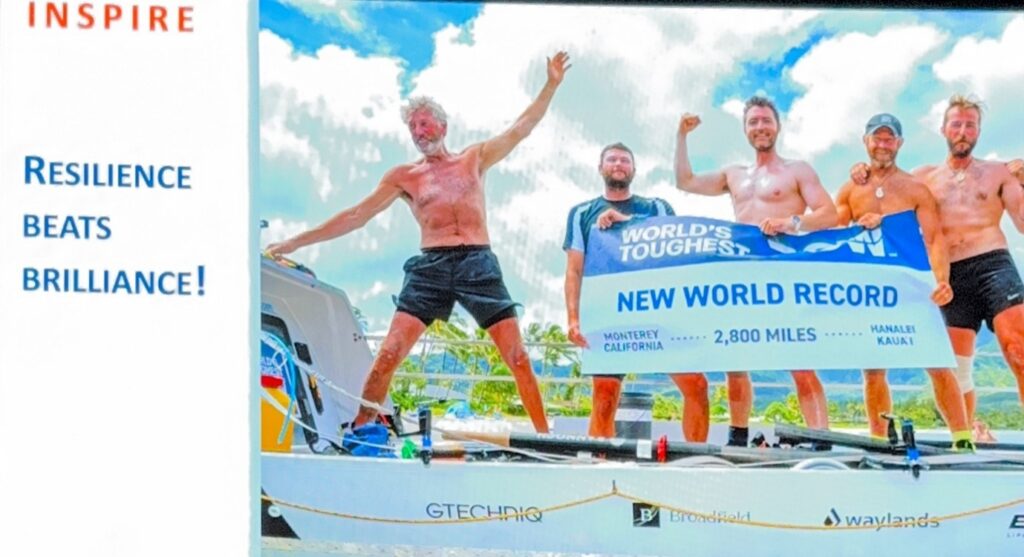 The closer was Kevin Gaskell, the former group CEO of Porsche GB, BMW GB, and Lamborghini GB, who turned around Porsche’s UK business from dead last — 32nd of 32 brands in customer satisfaction, three years of unsold inventory hidden on airfields — to number one in four years. Gaskell, whose team recently rowed from California to Hawaii, beating the world record by 20 days (his goal was to beat it by 10), delivered an hour on leadership that hit the spot. The motivation speaker is normally early in a conference, and I was not initially in the mood to be motivated. But over the course of the presentation, I was enthralled.
His framework — commit, connect, create — boiled down to one usable sentence: “Business as usual needs to be change as usual.”
 Credit to Dirk Schart and PTC for a show well done.
