

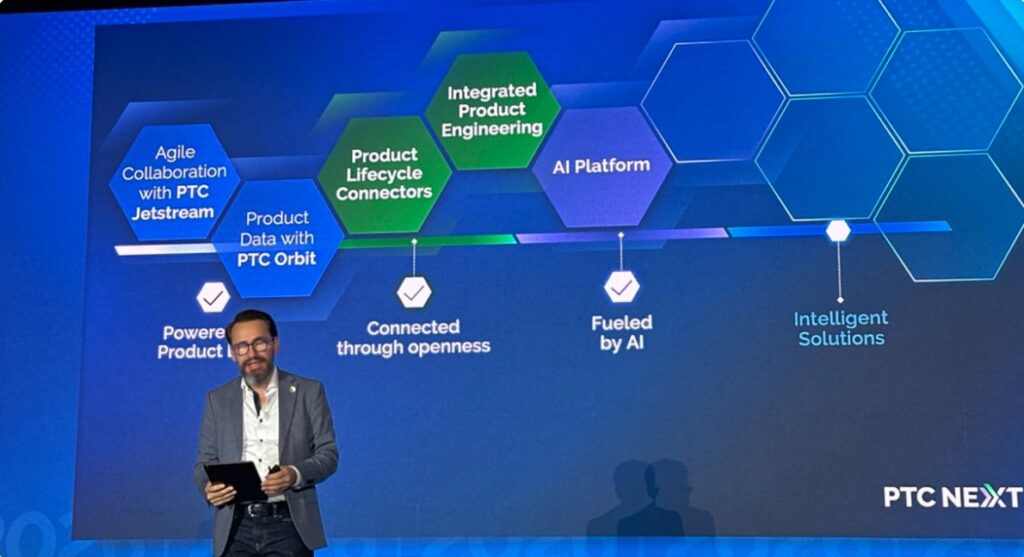
At PTC Next 2026, PTC presented a vision of product lifecycle management centered on a new “context layer,” an AI-enabled foundation designed to connect engineering information, workflows, and enterprise knowledge. According to analyst and commentator Oleg Shilovitsky, the announcement represents one of the most significant developments from the event because it addresses a long-standing challenge in PLM: providing AI systems with meaningful product context rather than isolated data points.
The proposed context layer is intended to unify information from CAD, PLM, requirements management, software development, manufacturing, and service systems. Instead of forcing users to search across disconnected applications, the platform aims to create a shared understanding of products, relationships, and decisions. This would allow AI assistants and agents to access consistent product knowledge and generate more relevant insights. The concept aligns with a growing industry focus on “product memory,” where AI systems can retain and understand engineering context over time.
However, the article raises an important question: Is this truly a new architectural approach, or is it effectively a modern version of the traditional PLM monolith? Historically, PLM vendors attempted to create centralized systems that stored all product information in a single environment. While those systems promised a single source of truth, they often became difficult to implement, customize, and scale across complex organizations. The concern is that a context layer could gradually evolve into another large, centralized platform under a different name.
The article suggests that the success of PTC’s strategy will depend on whether the context layer remains open, federated, and capable of connecting diverse data sources without requiring all information to be moved into a single repository. If achieved, it could provide the foundation needed for effective AI-driven engineering workflows. If not, it may recreate many of the challenges that have historically limited PLM adoption.
Ultimately, PTC’s announcement highlights a broader shift in the industry. As AI becomes embedded in engineering software, the battle is no longer just about managing product data. It is increasingly about managing product context and delivering that knowledge to both humans and intelligent agents.
