


SAN DIEGO, CA, June 22, 2026 – Qualcomm introduced the Snapdragon Reality Elite Platform at Augmented World Expo as a chipset platform for spatial computing devices, including video-see-through (VST) headsets and lightweight optical-see-through (OST) glasses. The platform is designed to improve visual fidelity and support on-device AI processing for XR form factors.
“XR adoption continues to expand, with more than 60 million devices2 already in market and growing momentum across industries.” said Ziad Asghar, senior vice president and general manager of XR, wearables and personal AI. “As more advanced and integrated XR platforms are developed, demand is increasing for XR technologies that deliver higher performance, greater intelligence, and improved power efficiency. Snapdragon Reality Elite is designed to meet those demands with powerful on‑device AI, enabling faster, longer‑lasting, and more immersive experiences, and reinforcing our leadership in VR and MR as we build purpose‑built XR chipsets from the ground up.”
Designed for Generative AI
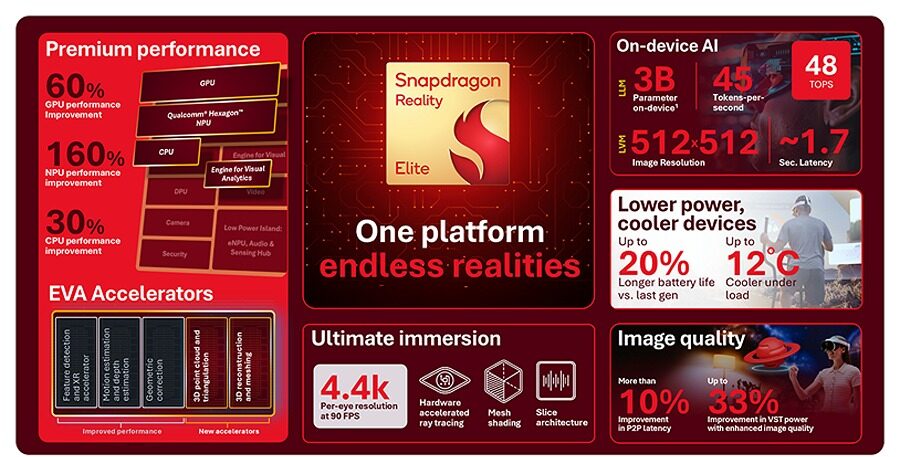
Snapdragon Reality Elite is designed to deliver up to 48 TOPS of on-device AI performance, with support for large language and vision models used in generative XR applications. The platform can support photorealistic avatars using Gaussian Splatting, LLM-based agents and real-time large vision model (LVM)-driven object generation that places digital content in the user’s environment.
The AI features help XR experiences respond with contextual awareness and natural interaction. Snapdragon Reality Elite also improves head and hand tracking and supports see-through features, allowing users to interact with digital content and maintaining awareness of their physical surroundings.
XR Performance and Power Efficiency
Snapdragon Reality Elite delivers up to 60% higher GPU performance, up to 30% higher CPU performance and up to 160% higher NPU performance. These gains give developers more headroom for richer visuals, faster interactions and more mixed reality scenarios. The added performance is intended to support immersive content viewing, mixed reality applications and spatial perception while maintaining power efficiency for extended wear.
The platform supports visuals up to 4.4K per eye at 90 frames/second. The improvements to video see-through reduce latency and improve image quality to help digital content align with the physical world. The platform also includes IP hardening, including the EVA block, which provides hardware acceleration for computer vision workloads.
Those performance and graphics improvements are paired with higher power efficiency. The Snapdragon Reality Elite platform delivers up to 20% longer battery life at the same workload and operates up to 120C cooler under load. Those improvements can support lighter, cooler headsets and tethered glasses for extended use.
Device Partners and Platform Adoption
Snapdragon platforms are used across the XR ecosystem, including Android XR, to power headsets and glasses from OEMs and partners. Snapdragon Reality Elite is being used as a platform for XREAL Project Aura, which is scheduled to launch later this year, and for an upcoming Play for Dream device.
“XREAL Project Aura represents a new benchmark for optical see‑through XR glasses, bringing powerful AI‑driven experiences to both work and everyday life,” said Chi Xu, co‑founder and CEO of XREAL. “Snapdragon Reality Elite is a foundational part of this achievement, delivering the performance, efficiency, and advanced on‑device AI capabilities required to realize our vision for next‑generation XR. From developers who demand more headroom to consumers who expect seamless, premium experiences, Snapdragon Reality Elite enables Project Aura to excel.”
“Play for Dream is excited to adopt Snapdragon Reality Elite for our next generation of immersive devices,” said Huang Feng, founder of Play For Dream. “The platform gives us the performance and efficiency we need to advance high‑quality XR experiences.”
Source: Qualcomm Technologies
About Qualcomm Technologies

Qualcomm Technologies, Inc., a subsidiary of Qualcomm Inc., is an American semiconductor and wireless technology company headquartered in San Diego, CA. Established in 1985, the company specializes in designing and supplying integrated circuits and system software for wireless telecommunications. Its product portfolio includes Snapdragon processors, modems, and platforms utilized in smartphones, automotive systems, Internet of Things (IoT) devices, and industrial equipment. Qualcomm operates primarily through two segments: Qualcomm CDMA Technologies (QCT), which focuses on semiconductor products, and Qualcomm Technology Licensing (QTL), which manages its patent portfolio. The company serves a global clientele across various industries, including mobile, automotive, computing, and industrial sectors, leveraging its expertise in 5G, AI and low-power computing to drive innovation and connectivity worldwide.
