

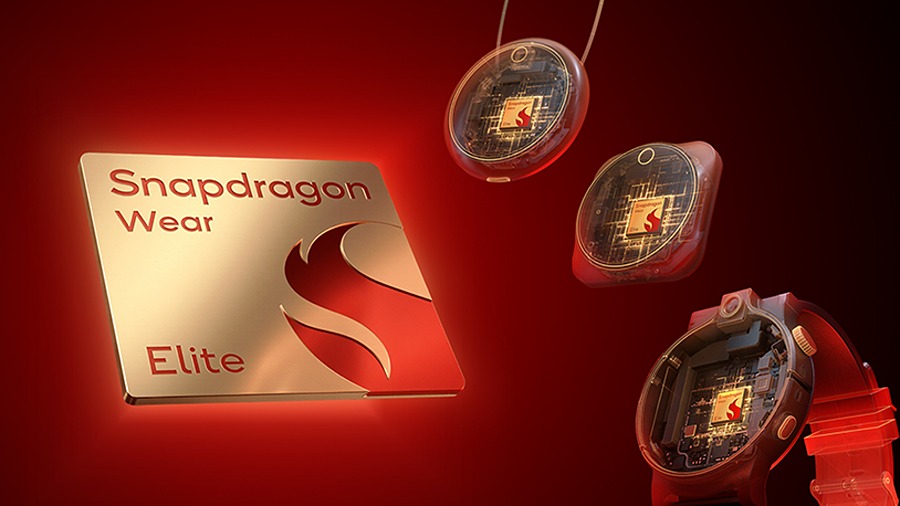
BARCELONA, Spain, Mar 4, 2026 – Qualcomm has introduced the Snapdragon Wear Elite platform, a personal AI platform for wearable computing devices. The platform targets always-on wearables designed to run AI tasks on the device. Snapdragon Wear Elite supports WearOS by Google, Android, and Linux, enabling broad software compatibility for wearable systems. It also integrates an NPU for on-device AI and low power connectivity for continuous operation.
“Snapdragon is transforming personal computing by enabling a new category of Personal AI devices. Spanning a broad range of form factors, these devices are no longer simply extensions of the smartphone, but active participants in a distributed AI network across mobile, compute, XR, wearables, and more,” said Alex Katouzian, executive vice president and group general manager, mobile, compute, & XR (MCX), Qualcomm Technologies. “Snapdragon Wear Elite delivers powerful edge AI with an integrated NPU architecture and advanced sensor processing, enabling true, Personal AI experiences. This is our next step toward our vision of the “Ecosystem of You”, where intelligence seamlessly travels with the user, learning and adapting to their context across their personal devices.”
Snapdragon Wear Elite in the Ecosystem of You
Snapdragon Wear Elite runs AI workloads on wearable devices using the Qualcomm Hexagon NPU. The platform supports models with up to billion parameters at the edge. Snapdragon Wear Elite combines sensor fusion, computing, and low-power connectivity to support personal AI functions. The platform supports context-aware recommendations, natural voice interaction, life logging, and AI agents that perform actions and coordinate tasks for users.
Speed and Efficiency for Longer Wearable Use
Snapdragon Wear Elite combines power efficiency and performance for wearable devices. The platform offers 5x higher single-core CPU performance and up to 7x faster GPU1 performance for app launches, multitasking, and graphics.
The platform supports multi-day battery life. Power management extends daily use by about 30% compared with the previous generation. Rapid charging restores about 50% battery capacity in around 10 minutes.
The new Snapdragon Wear platform introduces a multi-mode connectivity architecture integrating six technologies: 5G RedCap, Micro Power Wi-Fi, Bluetooth 6.0, UWB, GNSS, and NB NTN.
- 5G RedCap delivers low-power cellular connectivity for always-connected wearable devices.
- Micro Power Wi-Fi enables always-on Wi-Fi connectivity at low power for wearable devices that require continuous AI context syncing and data exchange.
- Bluetooth 6.0 enables proximity-aware interactions that allow devices to find, connect, and operate across personal device ecosystems.
- UWB enables secure proximity-based interactions, including device finding and interactions with assets such as cars, homes, and enterprise systems.
- GNSS enables AI processing for location context that helps wearable systems adapt interactions based on user location.
- NB NTN supports connectivity beyond terrestrial networks, enabling satellite-based two-way messaging when cellular and Wi-Fi coverage is unavailable, in collaboration with ecosystem partners including Skylo.
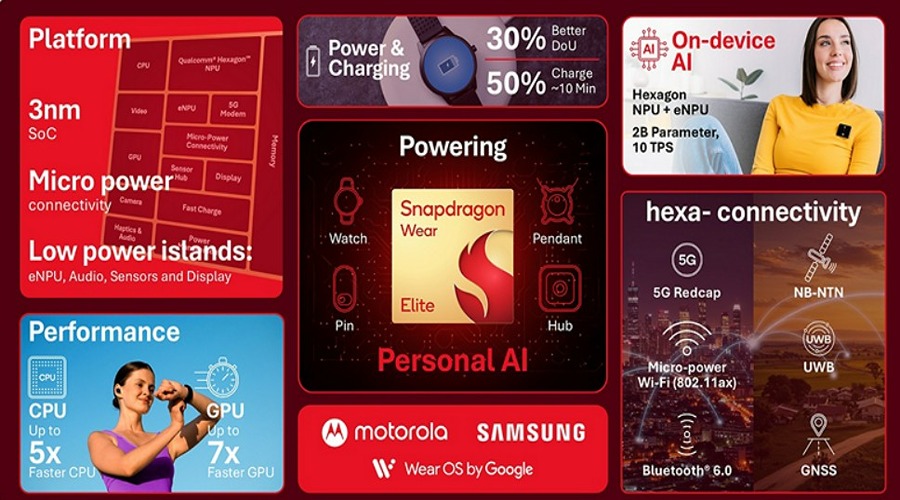
Global partners are supporting the platform including Google, Motorola and Samsung.
“With Wear OS, we are reimagining the smartwatch experience and moving from an operating system to an always with you intelligent system that understands and works for you,” said Bjørn Kilburn, GM of Wear OS by Google. “The Snapdragon Wear Elite platform opens new possibilities, delivering the performance, battery life and connectivity essential for the next generation of Wear OS.”
“With our AI perceptive companion concept, or ‘Project Maxwell’ that we showcased at CES, we are exploring the limits of what’s possible in personal intelligence,” said Francois LaFlamme, vice president and chief strategy and marketing officer at Motorola. “The shift toward Personal AI depends on a foundation that can balance on‑device intelligence, sensing, connectivity, and more efficient compute, so these devices can move with you, learn from you, and support more intuitive interactions throughout the day. The Snapdragon Wear Elite Platform gives us the opportunity to fully explore the potential of concepts like Maxwell and to push even further beyond what we have demonstrated so far.”
“Samsung and Qualcomm Technologies share a long history of advancing what’s possible in mobile computing, and we are thrilled to extend this partnership into the wearable category,” said InKang Song, executive vice president and head of technology strategy team, MX Business at Samsung Electronics. “By integrating the new Snapdragon Wear Elite platform, the next-generation Galaxy Watch will be an even more holistic wellness companion. This marks an important step in our ongoing efforts to deliver more efficient and personalized experiences, right from your wrist.”
1Compared to Snapdragon W5+ Gen 2 Wearable Platform.
Source: Qualcomm
About Qualcomm

Qualcomm Technologies, Inc., a subsidiary of Qualcomm Incorporated, is a leading American semiconductor and wireless technology company headquartered in San Diego, CA. Established in 1985, the company specializes in designing and supplying integrated circuits and system software for wireless telecommunications. Its product portfolio includes Snapdragon processors, modems, and platforms utilized in smartphones, automotive systems, Internet of Things (IoT) devices, and industrial equipment. Qualcomm operates primarily through two segments: Qualcomm CDMA Technologies (QCT), which focuses on semiconductor products, and Qualcomm Technology Licensing (QTL), which manages its patent portfolio. The company serves a global clientele across various industries, including mobile, automotive, computing, and industrial sectors, leveraging its expertise in 5G, AI and low-power computing to drive innovation and connectivity worldwide.
