

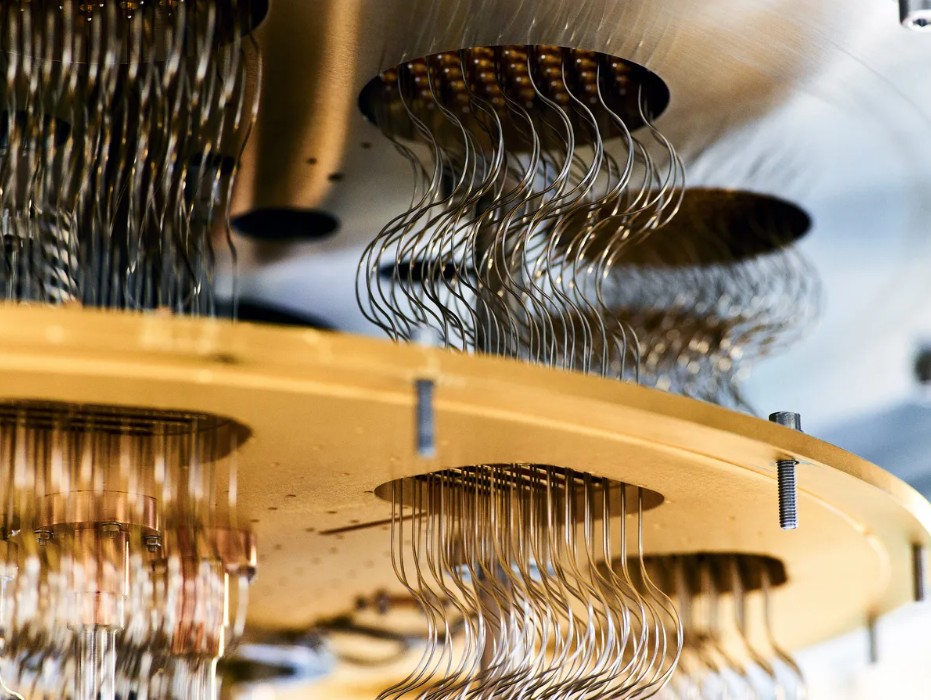
The research team at Google Quantum AI unveiled an algorithm dubbed “quantum echoes” that simulates molecules in a novel way: it performs a sequence of operations on a quantum processor, perturbs one qubit, then runs the sequence in reverse and compares the results, tells IEEE Spectrum. This approach allows the algorithm to detect how a small perturbation affects a larger molecular system, helping capture the complex interactions inside molecules that classical computers struggle with.
In experiments using Google’s Willow chip (a 105-qubit superconducting device), the algorithm ran on 65 qubits and achieved a speed approximately 13,000 times faster than the best classical equivalent on the Frontier supercomputer. More importantly, because two quantum processors running the algorithm in parallel achieved matching outcomes, the result offers a verifiable quantum advantage, something critics have long argued lacked.
The article underlines that while this development marks a milestone, it remains early stage: the molecule sizes simulated so far are still small, and classical methods still hold up. Google’s team states their work does not yet deliver a broad-scale real-world quantum advantage.
The promising application lies in molecular modeling for areas such as NMR spectroscopy, drug discovery, catalyst design, and battery materials. By mapping how atomic interactions propagate through a molecule, quantum echoes may enable modeling that classical computers find increasingly intractable. The piece emphasizes that superior hardware (low error rates, many qubits) was crucial. Google’s Willow chip reportedly achieved an error rate of about 0.1%.
For engineers and researchers in quantum and materials technologies, this signals a shift: quantum algorithms are moving beyond contrived benchmarks and toward tasks with genuine scientific value. However, significant scaling, error-correction, and system-complexity challenges remain before widespread adoption. Quantum echoes might be a sound ripple, or the starter wave, of practical quantum simulation.
