

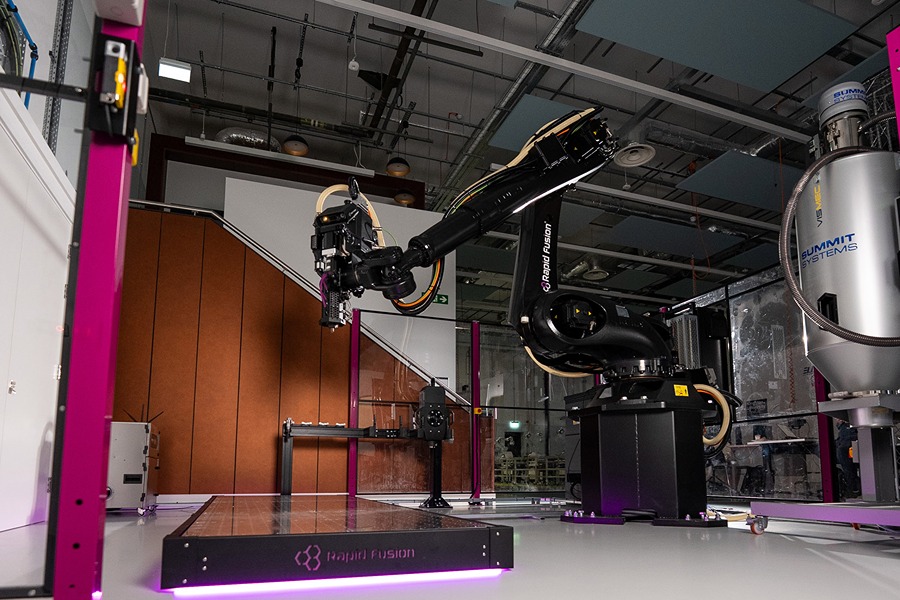
Rapid Fusion has installed a £450,000 Zeus Robotic Cell at Kingston University’s Faculty of Engineering, Computing and the Environment. Located at the university’s Roehampton Vale campus, the modular system combines large-format additive manufacturing (LFAM), industrial scanning and computer numerical control (CNC) milling, allowing researchers and industrial partners to print, scan and machine components within a single manufacturing platform.
The system supports prototyping and low-volume production of complex components. Rapid Fusion says integrating additive and subtractive processes can reduce outsourcing, streamline production workflows and improve quality.
Zeus incorporates an industrial scanning camera from Zivid and AI-driven CAD/CAM robot programming software from Ency. The system scans custom parts or molds and uses the resulting data to generate machining toolpaths with less manual input.
“This is a real show of intent from our partners at the university and gives them access to one of the most advanced LFAM robots in the world,” explained Jake Hand, CEO of Rapid Fusion.
“Zeus will provide staff, partners and grads with the opportunity to ‘print, scan and mill’ in one solution, removing a whole host of secondary ‘ops’ and, importantly, guaranteeing exacting tolerances as you are removing manually inputting the CNC toolpath.”
He continued: “This is the first time we’ve put this system into a university, but this is just the start. There’s a real skills gap in the UK for robotics and 3D printing experts, so need to do our bit to train budding engineers on equipment and tech that is going to be used in the world real now and during the next ten years.”
“This is what we’re doing with Kingston. As well as installing and training staff on the cell, we are also looking at how our technical experts can work with education professionals to shape the curriculum and maximize what learners can do with the solution.”
“It’s not just about developing people we can employ at Rapid Fusion. We’re doing this for advanced manufacturing as a whole – there’s lot of opportunity, but we need the right skills to go alongside the pioneering tech.”
Kingston University will also use Zeus to train undergraduate and postgraduate engineering students in additive manufacturing and robotic machining. Rapid Fusion has committed to offering work placements, exploring Knowledge Transfer Partnership (KTP) opportunities and contributing technical expertise to future curriculum development.
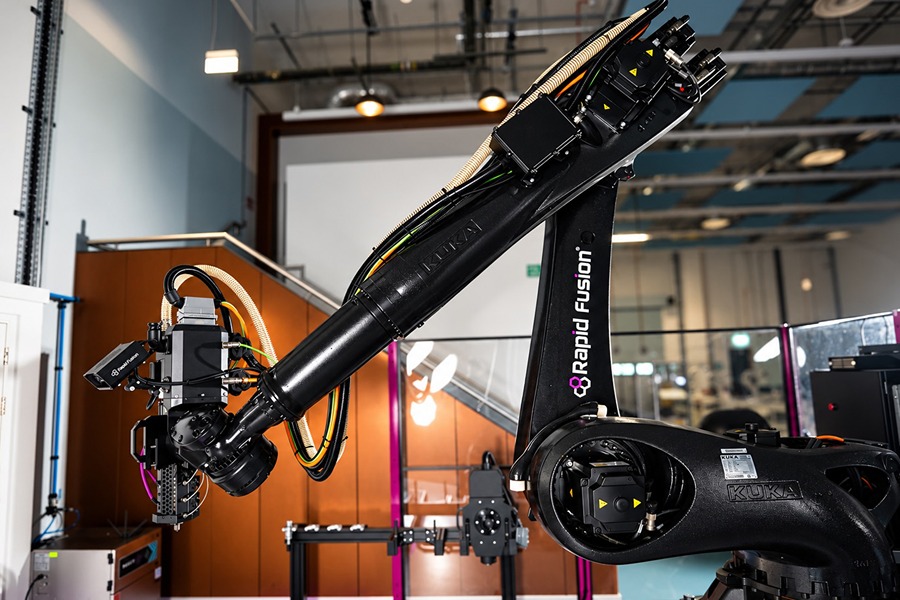
Rapid Fusion has developed LFAM robotic systems for about five years. Its existing products include Apollo, Medusa and Cerberus, a containerized manufacturing system to produce components in remote locations.
Lesley Stigling, operations manager at Kingston University said: “We are always exploring the latest technology and how it can add value to our industrial, research and educational offer.”
“One of our graduates, Raghav, went to work with Rapid Fusion and insisted we meet. That quickly led to us acquiring the Zeus system, which gives us a competitive edge in large-format additive manufacturing and machining.”
“I fully expect it will help us attract new research projects and cement existing relationships with industrial partners who are keen to push the boundaries of innovation and performance.”
Stigling concluded: “This equipment will also help drive our efforts to future-proof the faculty. Our undergraduates and postgraduates will learn on this state-of-the-art robot, giving them the hands-on experience and skills that employers want, and a head start in the graduate job market.”
Source: Rapid Fusion
About Rapid Fusion

Rapid Fusion, established in 2023 and based in Exeter, UK, develops large-format additive manufacturing (LFAM) systems for polymer-based applications. Its product portfolio includes pellet extrusion hardware and robotic 3D printing systems such as Apollo, Medusa, and Zeus, which are designed for high-speed, high-temperature printing. These solutions are used in aerospace, automotive, construction, marine, energy, and design sectors. The company manufactures its equipment in the UK and operates a 5,000-square-foot demonstration facility at Skypark for product trials and customer engagement. The company has received support from Innovate UK to expand its product capabilities and market reach. Its technology focuses on scalable, efficient production of large polymer parts using pellet-based 3D printing integrated with industrial robotics.
