

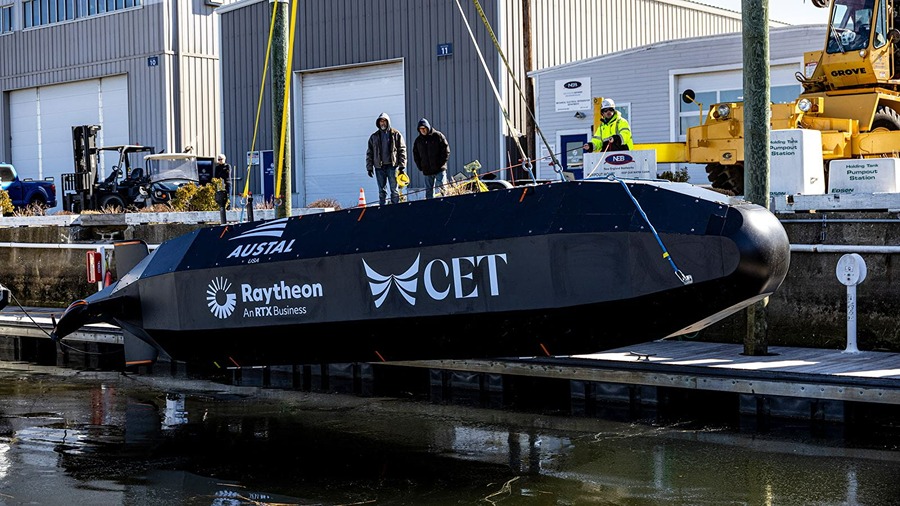
PORTSMOUTH, RI, Aug 11, 2026 – Raytheon and Composite Energy Technologies (CET) have demonstrated the submerged launch of HADALUS, a 34-foot unmanned undersea vehicle with more than 2,000 nautical miles of endurance, during missions on a U.S. Navy undersea test range. The vehicle launched while submerged during the tests. The demonstration was the first time the U.S. Navy had observed the capability in the water.
“This demonstration is an important step in a broader roadmap to deliver autonomous, end‑to‑end undersea capabilities that are far less detectable than surface platforms,” said Jen Gauthier, vice president of naval systems & sustainment at Raytheon. “By tightly coupling design, integration and at‑sea experimentation, we’ve proven we can bring new autonomous solutions to the fleet quickly and cost‑effectively.”
HADALUS has a 6-foot cross section and uses a free-flooded, all-carbon-fiber exoskeleton to provide structural strength and payload capacity. HADALUS could support missions that combine detection, reacquisition and engagement functions on one unmanned undersea platform. They estimate it would cost about one‑third to one‑fifth of comparable long‑endurance vehicles.
In less than 18 months, Raytheon and CET progressed from a conceptual sketch to a complete prototype successfully demonstrated in water. This was driven by investment from both companies in the design and build of the vehicle, integration of the launcher, sonar and electronics and full system testing leading up to the exercise.
Raytheon and CET developed the prototype in less than 18 months. The work included vehicle design and construction, launcher integration, sonar and electronics integration, and functional testing.
“HADALUS demonstrates that the undersea industrial base can move with greater speed and dynamism than traditional development cycles allow,” said Chase Hogoboom, CEO and president of CET. “By combining CET’s advanced composite vehicle architecture with Raytheon’s mission systems, sensors and integration expertise, we have created a highly capable platform that can be produced at a fraction of the cost of conventional alternatives.”
Source: RTX
About Raytheon

Raytheon, a business segment of RTX Corp., is a U.S.-based defense and aerospace company headquartered in Arlington, VA. With origins dating to 1922 and its current structure formed through a 2020 merger, Raytheon develops technologies in missile systems, radar, space-based sensors and cybersecurity. The company supports government and commercial clients across the defense, intelligence, aerospace and space sectors. Raytheon operates alongside other RTX business units, including Collins Aerospace and Pratt & Whitney. Its capabilities include guided weapons, air defense systems, satellite payloads and secure communications.
About Composite Energy Technologies

Composite Energy Technologies (CET) develops and manufactures subsea systems, composite structures and underwater vehicles. Founded in 2010, the company is headquartered in Bristol, RI. Its products include HADALUS underwater vehicles, subsea batteries, carbon-fiber pressure vessels and buoyancy control systems. CET also provides engineering and manufacturing services for custom composite structures and subsea equipment. Its capabilities include carbon-fiber fabrication, 3D modeling, 3D scanning, five-axis CNC programming, controlled curing and systems integration. The company serves defense, maritime and subsea infrastructure customers. Its engineering work covers autonomous vehicles and components for surface and full-ocean-depth operations. CET also tests and evaluates systems used in subsea applications.
