

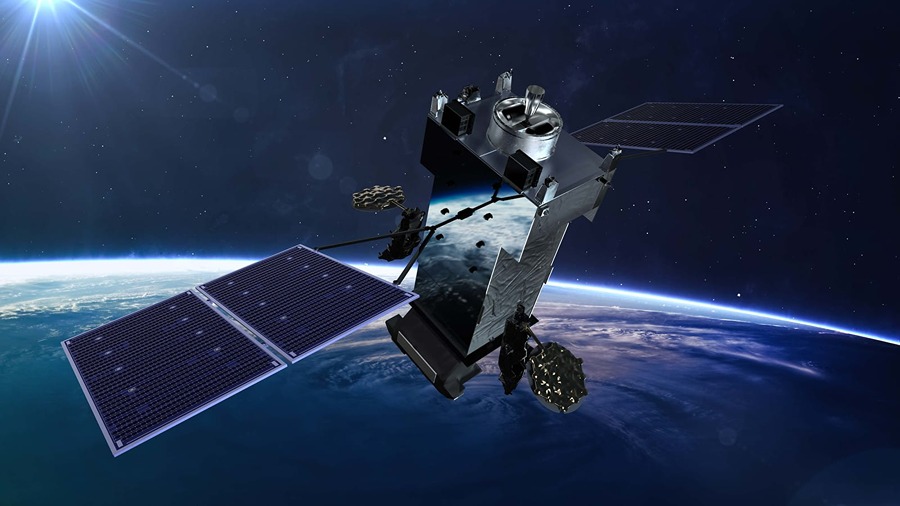
EL SEGUNDO, CA, Apr 30, 2026 – Raytheon has delivered its second sensor payload to Lockheed Martin for the U.S. Space Force’s Next-Gen OPIR GEO Block 0 satellite program, which is being built to provide missile warning and tracking from geosynchronous orbit.
The satellite program, formally called Next-Generation Overhead Persistent Infrared (Next-Gen OPIR) Geosynchronous Earth Orbit (GEO) Block 0, is also referred as NGG. The satellites are needed to detect and track missile launches, including hypersonic weapon systems and other threats.
“Demand for resilient missile warning and tracking across all orbital regimes continues to accelerate,” said Jeff McCall, vice president for mission solutions & payloads for Raytheon. “Programs like NGG demonstrate how high-altitude, long-duration observation sensing unlocks new mission coverage in key areas.”
Raytheon’s sensor payloads use optical designs and algorithms to detect heat signatures from missile launches. The sensors are designed for higher sensitivity and tracking performance within the missile warning architecture.
Lockheed Martin is building the NGG satellites to provide continuous coverage over mid-latitudes. The satellites will complement the current constellation and new missile warning systems in Low Earth Orbit (LEO) and Medium Earth Orbit (MEO). Raytheon designed and built the payloads for two satellites, with the first satellite complete and ready to support initial launch capability.
Source: RTX
About Raytheon

Raytheon, a business segment of RTX Corp., is a U.S.-based defense and aerospace company headquartered in Arlington, VA. With origins dating to 1922 and its current structure formed through a 2020 merger, Raytheon develops technologies in missile systems, radar, space-based sensors and cybersecurity. The company supports government and commercial clients across the defense, intelligence, aerospace and space sectors. Raytheon operates alongside other RTX business units, including Collins Aerospace and Pratt & Whitney. Its capabilities include guided weapons, air defense systems, satellite payloads and secure communications.
About RTX

RTX, formerly Raytheon Technologies, is a global aerospace and defense company that provides advanced systems, products and services. It specializes in aircraft engines, avionics, cybersecurity solutions and defense systems, serving the aerospace, defense, intelligence and security sectors. With a history spanning more than a century, RTX combines expertise from its predecessor companies to support technological development. Headquartered in Waltham, MA, the company employs about 185,000 people worldwide. Its clients include the U.S. Department of Defense, the U.K. Ministry of Defence, Airbus and Boeing. RTX supports commercial and military programs by focusing on safety, performance and efficiency, while addressing operational challenges across multiple sectors.
