

Researchers have developed a compact supercapacitor designed to be easily disassembled so that its components can be reused in new energy storage devices. The approach could address a persistent problem with rechargeable electronics: batteries and other storage systems often become electronic waste because their tightly integrated components are difficult to separate and recycle, tells Tech Xplore.
Developed by Tse Nga Ng, Nandu Koripally, and colleagues, the supercapacitor uses zinc ions in a water-based, nonflammable electrolyte instead of conventional lithium-ion technology with flammable electrolytes. The researchers combined this chemistry with dissolvable adhesives and reusable conductive materials to create an energy storage system designed around its entire material life cycle.
The device consists of a zinc metal-copper foil anode and an activated-carbon-fiber cathode. Between them is a solid electrolyte made from porous resin coated on plastic film and soaked in a zinc chloride solution. Heating creates strong bonds between the layers, producing a thin supercapacitor with a 2-volt potential. The bonding material can later be broken down in a mildly acidic liquid.
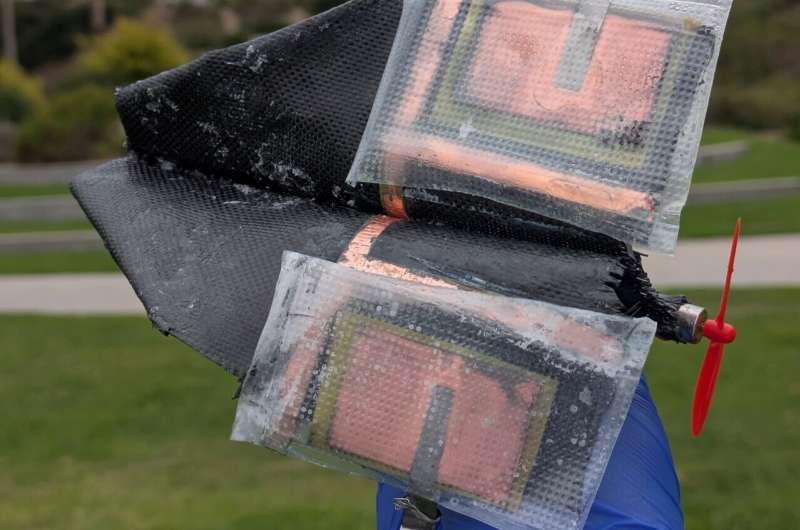
To demonstrate the technology, the researchers integrated four supercapacitors into a model glider’s wings. With its propeller powered by the devices, the glider traveled 12 feet, compared with 8 feet without external power.
Recycling tests demonstrated another advantage. Immersion in a mildly acidic, water-based solution separated a supercapacitor’s layers within 30 minutes. Researchers then reused the recovered carbon-fiber cathode twice with new electrolytes and zinc anodes. Across the original device and two recycling cycles, the carbon fibers completed more than 172,000 charge-discharge cycles while maintaining similar electrical performance.
The research suggests that recyclability can be incorporated directly into energy storage design. Such an approach could support lightweight, repairable devices while reducing the electronic waste associated with rechargeable technologies.
