

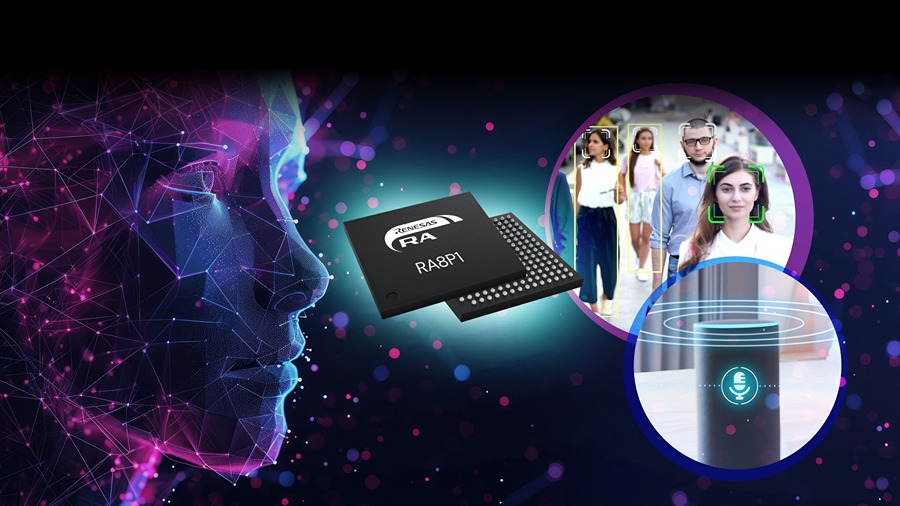
TOKYO, Japan, July 2, 2025 – Renesas has introduced the RA8P1 microcontroller (MCU) group targeted at Artificial Intelligence (AI) and Machine Learning (ML) applications, and analytics. The MCUs establish a performance level for MCUs by combining 1GHz Arm Cortex-M85 and 250MHz Cortex-M33 CPU cores with the Arm Ethos-U55 Neural Processing Unit (NPU). This combination delivers the CPU performance of over 7300 CoreMarks and AI performance of 256 GOPS at 500 MHz.
Designed for Edge/Endpoint AI
The RA8P1 is designed for edge and endpoint AI applications. It uses the Ethos-U55 NPU to handle compute-intensive tasks in Convolutional and Recurrent Neural Networks(CNNs and RNNs). This offloading gives up to 256 MACs per cycle that yield 256 GOPS performance at 500 MHz. The NPU works with common networks like DS-CNN, ResNet and Mobilenet TinyYolo. Depending on the chosen network, the Ethos-U55 can achieve up to 35x inferences per second compared to running on a Cortex-M85 processor alone.
Advanced Technology
RA8P1 microcontrollers use TSMC’s 22nm ultra-low leakage (22ULL) process, which balances performance and power efficiency. This process also enables integrated Magnetoresistive RAM (MRAM) with faster write speeds, higher endurance, and longer data retention than Flash.
“There is explosive growth in demand for high-performance edge AIoT applications. We are thrilled to introduce what we believe are the best MCUs to address this trend,” said Daryl Khoo, vice president of embedded processing marketing division at Renesas. “The RA8P1 devices showcase our technology and market expertise and highlight the strong partnerships we have built across the industry. Customers are eager to employ these new MCUs in multiple AI applications.”
“The pace of innovation in the age of AI is faster than ever, and new edge use cases demand ever-improving performance and machine learning on-device,” said Paul Williamson, senior vice president and general manager, IoT LoB at Arm. “By building on the advanced AI capabilities of the Arm compute platform, Renesas’ RA8P1 MCUs meet the demands of next generation voice and vision applications, helping to scale intelligent, context-aware AI experiences.”
“It is gratifying to see Renesas harness the performance and reliability of TSMC 22ULL embedded MRAM technology to deliver outstanding results for its RA8P1 devices,” said Chien-Hsin Lee, senior director of specialty technology business development at TSMC. “As TSMC continues to advance our embedded non-volatile memory (eNVM) technologies, we look forward to strengthening our long-standing collaboration with Renesas to drive innovation in future groundbreaking devices.”
Robust, Optimized Peripheral Set for AI
Renesas has integrated peripherals, memory, and security features to support voice AI, vision AI, and real-time analytics. For vision AI, a 16-bit camera interface (CEU) supports sensors up to 5 megapixels. A separate MIPI CSI-2 interface provides a low pin-count connection with two lanes operating, each up to 720Mbps. For voice AI, multiple audio interfaces, including I2S and PDM, support microphone input.
The RA8P1 offers both on-chip and external memory options for low latency neural network processing. The MCU includes 2MB SRAM for storing intermediate activations or graphics framebuffers. 1MB of on-chip MRAM is available for application code and storage of model weights or graphics assets. High-speed external memory interfaces are available for larger models. SIP options with 4 or 8 MB of external flash in a single package are also available for demanding AI applications.
New RUHMI Framework
Renesas has introduced RUHMI (Renesas Unified Heterogeneous Model Integration), a framework for AI deployment on MCUs and MPUs. RUHMI supports neural network models in a framework-agnostic manner, handling model optimization, quantization, graph compilation, and generating source code. RUHMI supports machine learning frameworks such as TensorFlow Lite, PyTorch, and ONNX. RUHMI includes tools, APIs, a code generator, and a runtime environment for deploying pre-trained neural networks, along with application examples and models optimized for the RA8P1. The framework integrates with Renesas’s e2 Studio IDE to provide a development environment for MCUs and MPUs.
Advanced Security Features
The RA8P1 MCUs offer security features for critical applications. They include Renesas Security IP (RSIP-E50D), which provides cryptographic accelerators supporting CHACHA20, Ed25519, NIST ECC curves up to 521 bits, RSA up to 4K bits, SHA2, and SHA3. Combined with Arm TrustZone, this enables element-like security functions. The MCUs also feature hardware-based Root-of-Trust and Secure Boot with a First Stage Bootloader (FSBL) stored securely. Additionally, XSPI interfaces with decryption-on-the-fly (DOTF) support allow encrypted code to be stored in external flash and decrypted during execution when transferred to the MCU.
Ready to Use Solutions
Renesas provides tools and solutions for the RA8P1 MCUs, including the Flexible Software Package (FSP), evaluation kits and development tools. FreeRTOS and Azure RTOS are supported, as is Zephyr. In addition, driver monitoring solution from Nota.AI and a traffic/pedestrian monitoring solution from Irida Labs is also present. Other solutions can be found at the Renesas RA Partner Ecosystem Solutions Page.
Key Features of the RA8P1 MCUs
Processors: 1GHz Arm Cortex-M85, 500MHz Ethos-U55, 250 MHz Arm Cortex-M33 (Optional)Memory: 1MB/512KB On-chip MRAM, 4MB/8MB External Flash SIP Options, 2MB SRAM fully ECC protected, 32KB I/D caches per core.
Graphics Peripherals: Graphics LCD controller supporting resolutions up to WXGA (1280×800), parallel RGB and MIPI-DSI display interfaces, powerful 2D Drawing engine, parallel 16bit CEU and MIPI CSI-2 camera interfaces, 32bit external memory bus (SDRAM and CSC) interface
Other Peripherals: Gigabit Ethernet and TSN Switch, XSPI (Octal SPI) with XIP and DOTF, SPI, I2C/I3C, SDHI, USBFS/HS, CAN-FD, PDM and SSI audio interfaces, 16bit ADC with S/H circuits, DAC, comparators, temperature sensor, timers
Security: Advanced RSIP-E50D cryptographic engine, TrustZone, Immutable storage, secure boot, tamper resistance, DPA/SPA attack protection, secure debug, secure factory programming, Device Lifecycle management
Packages: 224BGA, 289BGA
Winning Combinations
Renesas has combined the RA8P1 MCUs with compatible devices from its portfolio to offer an array of winning combinations, including Video Conferencing Camera with AI Capabilities, AI Drawing Robot Arm and AI-Enabled Surveillance Camera. These designs are vetted system architectures from devices that work together to bring a low-risk design for faster time to market. Renesas offers more than 400 winning combinations with products from the Renesas portfolio to enable customers to speed up the design process and bring their products to market. They can be found here.
Availability
The RA8P1 MCUs are available as of date. Renesas is also shipping an RA8P1 Evaluation Kit.
Source: Renesas
About Renesas Electronics Corporation

Renesas Electronics Corporation, headquartered in Tokyo, Japan, is a semiconductor manufacturer focused on the research, design, development, production, and sale of semiconductor components. Its product portfolio includes microcontrollers, analog and power devices, and system-on-chip (SoC) solutions, which are used across automotive, industrial, infrastructure, and IoT applications. As of December 31, 2024, the company employed approximately 21,204 people globally. For the fiscal year ending December 31, 2024, Renesas reported revenue of ¥1,348.5 billion and an operating profit of ¥223.0 billion.
About TSMC

Taiwan Semiconductor Manufacturing Company (TSMC) is the world’s largest dedicated semiconductor foundry, based in Hsinchu, Taiwan. Founded in 1987, TSMC developed the pure-play foundry business model and has become a key player in the global chip supply chain. The company manufactures advanced semiconductor components using process technologies like 5nm and 3nm nodes, with plans to move to 2nm and smaller. TSMC serves customers across industries like consumer electronics, computing, automotive, networking, and industrial applications. Major technology firms rely on TSMC to produce chips for smartphones, data centers, AI systems, and autonomous vehicles. In 2024, the company reported annual revenue of approx. US$88 billion. By the end of 2024, TSMC employed about 84,000 people worldwide. The company served 530 customers and made 11,900 products for various applications. With ongoing investments in new technologies, TSMC remains an integral part of the semiconductor industry.
About Arm

Arm Holdings plc is a British semiconductor and software design company headquartered in Cambridge, United Kingdom. Established in 1990, Arm specializes in designing central processing units (CPUs), graphics processing units (GPUs), and system-on-chip (SoC) architectures. The company’s intellectual property (IP) is licensed across various industries including mobile devices, automotive, consumer electronics, and data centers. Arm’s technology is integral to the operation of most smartphones and numerous embedded systems worldwide. As of March 31, 2024, Arm reported annual revenue of approx. $3.25 billion and employed approx. 7,100 people globally. The company’s business model focuses on licensing its IP to semiconductor companies and original equipment manufacturers (OEMs), enabling them to develop their own products.
