

1. Executive Summary
This report presents findings from a structured AI Engine Optimization (AEO) prompt study conducted across 50 CAD-relevant queries submitted to both ChatGPT (GPT-4o) and Google Gemini in March 2026. Queries spanned 7 verticals — Cross-Vertical, Industrial Machinery, Consumer Electronics, Medical Devices, Auto Tooling & Fixtures, HardTech Startups, and Adjacent Tools — and were evaluated for vendor visibility, response type, and citation behavior.
The study focuses on the ‘Contested Middle’ of the CAD market: segments where OEM mandates do not pre-determine software selection and where engineering teams make genuine, research-driven purchasing decisions. In these markets — from medical device startups to automotive tooling shops — AI visibility can meaningfully influence shortlists. This study tests whether ChatGPT and Gemini reflect that openness or reproduce incumbent bias.
The headline finding is that SOLIDWORKS dominates both platforms at similar rates, but the nature of that dominance differs. ChatGPT returns SOLIDWORKS with mechanical consistency regardless of context, while Gemini is more responsive to vertical signals — surfacing Onshape as the leading challenger with competitive frequency in cloud-native and startup-oriented queries. Critically, this study revealed a source ecosystem unlike anything one might expect: comparison content published by vendors themselves, resellers such as GoEngineer and TriMech, and aggregator platforms like Xometry drove a disproportionate share of citations — while traditional trade press was nearly absent.
A secondary finding with strategic implications: AI responses to CAD queries routinely surface not just core CAD tools but a wide ecosystem of adjacent products — simulation tools (ANSYS, COMSOL, Abaqus), PDM/PLM platforms (SOLIDWORKS PDM, Autodesk Vault, PTC Windchill, Siemens Teamcenter), visualization tools, and CAM software. Across 100 responses, over 216 unique products were mentioned. This means vendors in adjacent categories have a genuine — and often overlooked — AEO stake in CAD-oriented queries.
Challenger Opportunity Note: Unlike many software markets where AI surfaces a rich long tail of niche vendors, the CAD market is significantly more concentrated. Onshape and Shapr3D are the only meaningful challengers gaining AI visibility, and their appearance correlates directly with the presence of comparison content — particularly vendor-authored comparisons and reseller blog posts. For challengers, the AEO playbook is less about depth of educational content and more about owning the comparison search surface.
2. Scope & Methodology
All 50 prompts were structured as practitioner-level questions that an engineering leader, product manager, or technical buyer might ask when evaluating CAD software. Prompts were scored on a composite scale from 1–5 based on revenue impact, operational pain, buying proximity, AI surface likelihood, and differentiation fit. The study divided prompts into two equal stages: Discovery (30 prompts covering open-ended tool and use-case queries) and Evaluation (20 prompts focused on direct product comparisons).
Prompt Theme Distribution
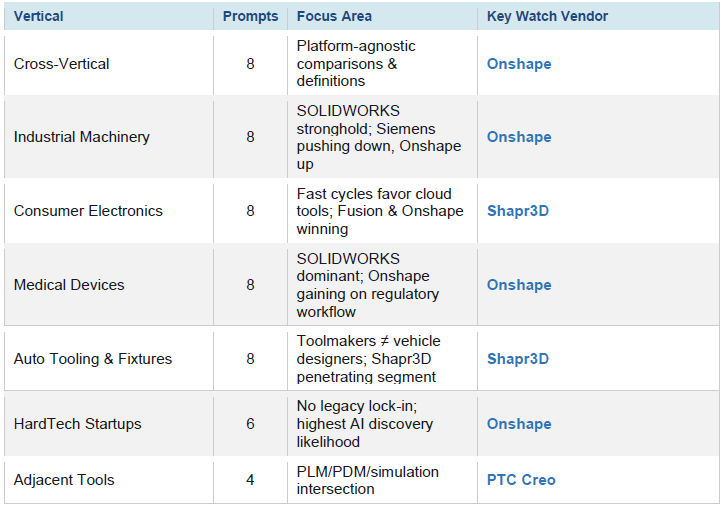
The 50 prompts covered 7 verticals with the following distribution:
Evaluation Environment
3. Platform Comparison
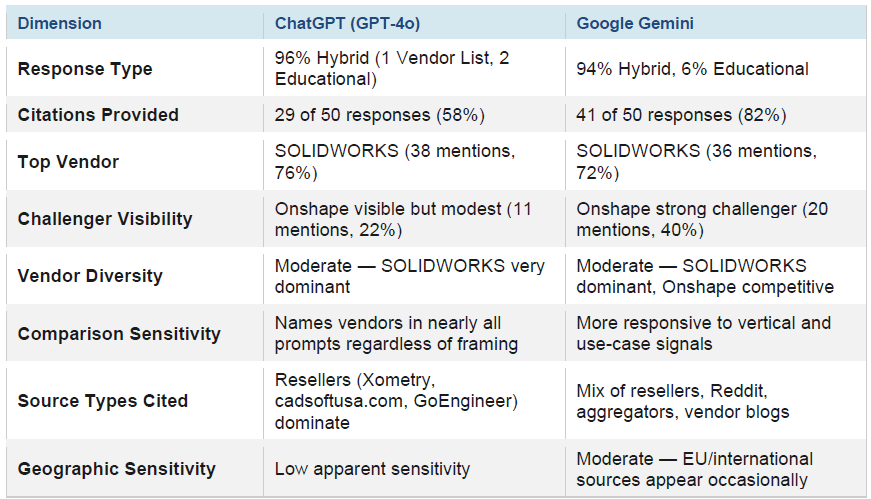
The two platforms exhibit meaningfully different behaviors in citation patterns, vendor selection logic, and response diversity — though less dramatically divergent than in the MES study. The table below summarizes the key structural differences across the eight dimensions evaluated.
Response Type: Hybrid Dominates Both Platforms
The CAD study shows both platforms delivering Hybrid responses at near-identical rates. The CAD market’s heavy emphasis on product comparisons — by design of the prompt set — likely drove this convergence. With 40% of prompts being explicit head-to-head comparison queries, both platforms shifted into recommendation mode with little hesitation.
ChatGPT produced one Vendor List response (a formatted list with minimal editorial framing) and two Educational responses. Gemini produced three Educational responses, all in the Discovery stage for prompts where the query framing was more conceptual than vendor-oriented.
Citation Behavior: Gemini Leads, ChatGPT Cites More Than Expected
Gemini cited sources in 82% of responses — a strong signal that Gemini’s recommendations are retrieval-driven and that the source ecosystem matters for visibility. ChatGPT cited sources in 58% of responses — higher than one might expect for a platform often characterized as operating purely from training data.
ChatGPT’s 58% citation rate is significant. In CAD, ChatGPT regularly surfaced sources — predominantly Xometry, cadsoftusa.com, and GoEngineer. This means the source citation ecosystem matters for CAD AEO on both platforms, not just Gemini. Vendors not represented in these citation pools have a specific, addressable gap.
Geographic Considerations
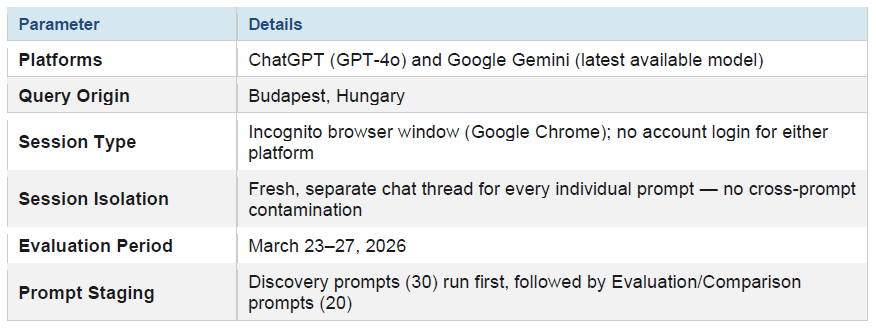
This study was conducted from Budapest, Hungary using incognito Chrome sessions without account login. The geographic origin introduces a potential Gemini weighting effect, as Gemini integrates more actively with Google’s regional search infrastructure. However, the CAD market is heavily dominated by global brands and English-language content, which likely suppresses regional bias. No distinctly European CAD tools appeared in responses as a result of geographic weighting.
ChatGPT showed no apparent geographic sensitivity. North American vendors targeting EU buyers should ensure their comparison content and reseller partner pages are indexed internationally.
4. Vendor Analysis
ChatGPT Vendor Visibility Rankings
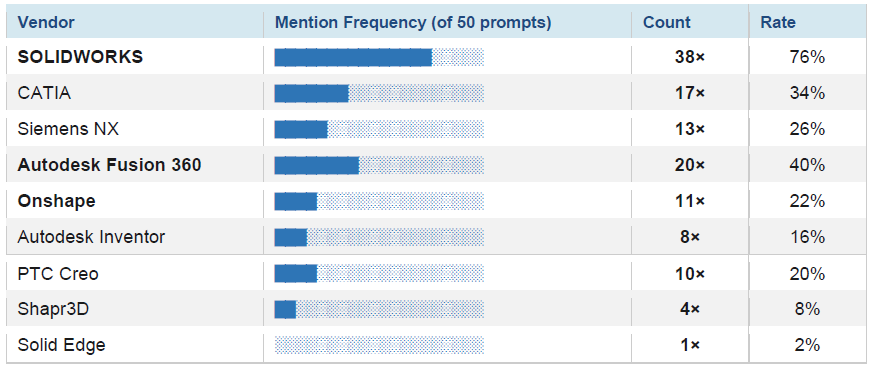
ChatGPT’s vendor recommendations are highly concentrated around SOLIDWORKS, which appeared in 38 of 50 responses — a 76% mention rate. CATIA and Siemens NX form a strong second tier, reflecting the enterprise-grade bias consistent with their training data footprint. Onshape achieves meaningful visibility as the primary cloud challenger, appearing in 22% of responses. Shapr3D appears only when specifically prompted by comparison queries.
Gemini Vendor Visibility Rankings
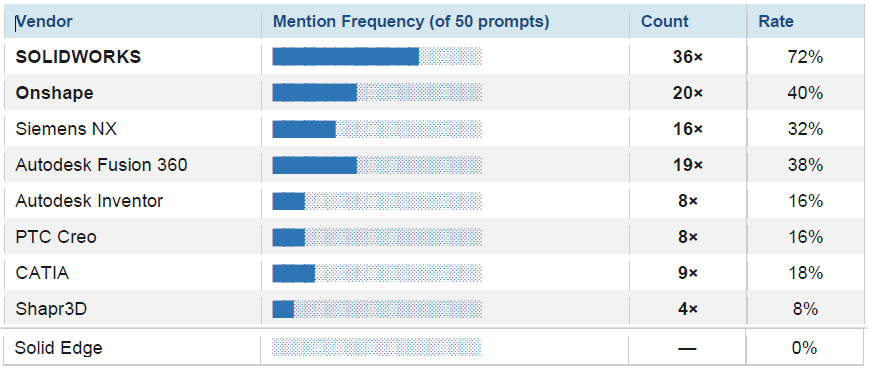
Gemini’s vendor landscape is notably different from the MES study — rather than surfacing a long tail of niche vendors, it mirrors ChatGPT’s top-tier selections but with one key divergence: Onshape rises to near-parity with SOLIDWORKS in total mentions (36 vs. 20). This reflects Gemini’s responsiveness to the comparison content and cloud-native positioning that Onshape (and its parent PTC) have invested in heavily. CATIA drops significantly relative to its ChatGPT performance, suggesting Gemini weights real-world citation signals over brand heritage.
Cross-Platform Vendor Overlap
The CAD vendor universe shows high consistency across both platforms for the top four tools: SOLIDWORKS, Autodesk Fusion 360, Siemens NX, and Onshape. These four vendors appear with meaningful regularity on both platforms and represent the core of the AI-visible CAD market. The divergence is primarily in positioning: Onshape’s rank position on Gemini (2nd) versus ChatGPT (5th) is commercially significant — it means Onshape benefits disproportionately from Gemini’s citation behavior.
Adjacent Products: A Wider Ecosystem Than CAD Alone
One of the most commercially interesting findings of this study is the breadth of adjacent products surfaced in AI responses. When buyers ask CAD questions, both platforms routinely recommend tools beyond core CAD software — and the adjacent product universe is substantial.
Across 100 responses (50 prompts × 2 platforms), a total of 216 unique products were mentioned — far exceeding the 9 tracked CAD vendors. The adjacent categories that appeared most frequently include:
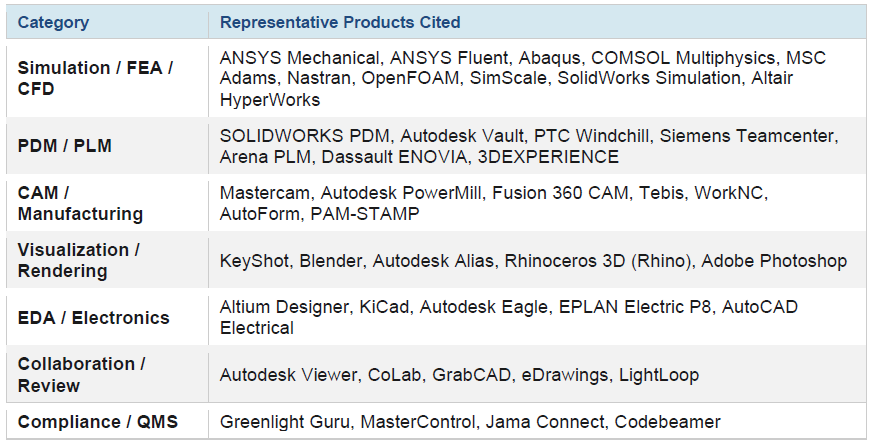
Strategic Implication for Adjacent Vendors: Simulation, PLM, PDM, CAM, and visualization vendors have a real stake in CAD AEO — their products are surfaced in response to engineering workflow questions even when the buyer did not ask about them directly. A simulation software vendor, for example, benefits from appearing in responses to ‘what tools do robotics engineers use?’ even if that prompt doesn’t mention simulation. Building content that connects your product to CAD workflows and CAD tool selection criteria is a direct AEO lever for adjacent category vendors.
The study split prompts into 30 Discovery queries (open-ended, tool exploration) and 20 Evaluation queries (direct comparisons). Stage-level performance reveals important strategic differences between vendors.
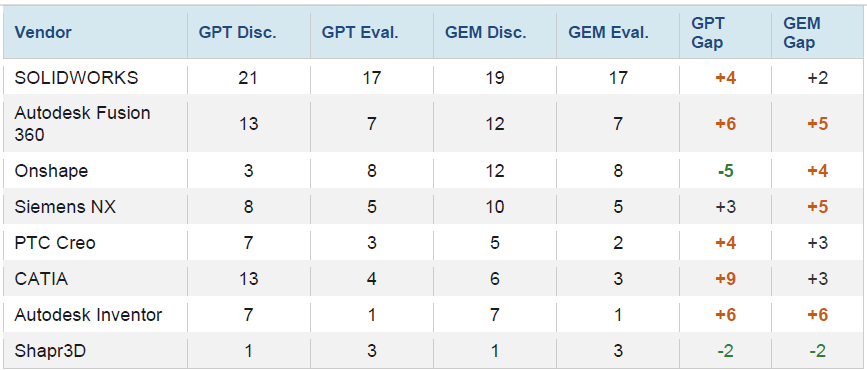
Note: Discovery Gap = Discovery mentions minus Evaluation mentions. A positive gap means the vendor appears more in early-funnel queries; negative means stronger in comparison queries.
Onshape’s stage profile is strategically revealing: it appears in only 3 Discovery responses on ChatGPT, but surges to 8 in Evaluation (comparison) queries. This confirms that Onshape’s AI visibility is almost entirely driven by comparison content — when buyers ask ‘Onshape vs. SOLIDWORKS,’ it wins the frame. Without the comparison prompt framing, it nearly disappears from ChatGPT’s recommendations. On Gemini, this gap is less pronounced, suggesting Gemini surfaces Onshape more organically — likely due to its strong cloud-native educational content footprint.
5. Source Ecosystem Analysis
One of the most striking findings of this study is the nature of the source ecosystem driving CAD AI citations. The study researcher’s field notes identified five significant patterns that have direct implications for AEO strategy.
5.1 Comparison Content Dominates — Including Vendor-Authored Comparisons
Sources that compared one tool against another were cited significantly more frequently than any other content type across both platforms. This held across all 50 prompts and appears to be a structural feature of how both AI platforms evaluate credibility in this market: comparison content signals evaluation-stage relevance that both platforms reward.
More surprisingly, vendor-authored comparisons were among the trusted sources. OnShape and Shapr3D in particular published direct competitive comparisons — including comparisons against SOLIDWORKS and other rivals — that were cited as credible reference material. A source from Vendor A comparing themselves to Vendors B and C was treated as an authoritative reference by both AI platforms.
AEO Implication: For CAD vendors, publishing head-to-head comparison content — including content authored on your own domain that compares your product favorably to competitors — may be one of the highest-ROI content investments available. The AI platforms do not appear to discount vendor-sourced comparisons in the way a discerning human reader might. This is a significant content opportunity that trade press absence has left largely uncontested.
5.2 Resellers as Trusted Sources
SOLIDWORKS and other established vendors operate through extensive reseller networks. Reseller blogs and comparison pages — from GoEngineer, TriMech Solutions, cadsoftusa.com, and similar partners — appeared repeatedly as cited sources on both platforms. These reseller sites carry substantial domain authority in the CAD space due to their volume of technical, practitioner-oriented content.
For vendors with reseller channels, this creates a distributed content amplification opportunity: reseller-authored comparison content, migration guides, and use-case content can generate AI citations independently of the vendor’s own domain. For challengers without established reseller networks, this represents a structural disadvantage that requires direct content investment to offset.
5.3 Trade Publications Were Nearly Absent — And That Creates an Opportunity
CAD trade publications — engineering.com, Develop3D, Digital Engineering, AEC Magazine, and similar outlets — were cited rarely or not at all across 100 AI responses. Industry analyst coverage was similarly sparse, with only isolated appearances. This is both an observation about the current state and a signal about a structural opportunity that publishers are positioned to capture.
The underlying reason for this absence is worth examining. Trade publications in the CAD space have historically operated with significant vendor influence: advertising relationships, sponsored content, vendor-supplied contributed articles, and press event access. This has produced a body of content that AI platforms may discount because it lacks the comparative specificity and apparent neutrality that drives citation. Publishers rarely run unsponsored, side-by-side comparisons of competing CAD tools. Critical assessments of market-leading products are uncommon. Negative findings are rarer still.
Publisher Opportunity: Engineering and CAD trade publications that invest in genuinely neutral, rigorous, head-to-head comparisons and critical product reviews stand to benefit disproportionately from the shift toward AI-mediated discovery. If AI platforms are already citing vendor-authored comparisons as trusted sources, independently produced comparisons from credible editorial brands would likely be weighted more heavily — and cited more often. Publishers willing to take an editorially independent stance on CAD tool performance, including frank assessments of limitations, are positioned to become the authoritative citation sources that are currently absent from the AI reference ecosystem
The practical implication for publishers: the content investment required is a shift in editorial philosophy as much as a production investment. Structured comparison frameworks, independent testing methodologies, and willingness to publish conclusions that may not favor advertising partners are the conditions for becoming an AI-cited authority in this space.
5.4 Aggregator Platforms and Review Sites
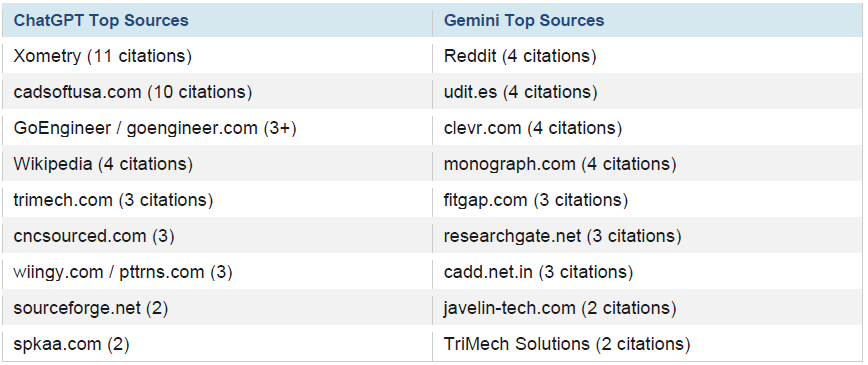
Xometry appeared as the single most frequently cited ChatGPT source in this study — appearing in 11 of 50 ChatGPT responses. As a manufacturing marketplace with extensive CAD-adjacent content including buying guides, comparison articles, and technical explainers, Xometry has become an unexpected AI citation authority. cadsoftusa.com (a SOLIDWORKS reseller) appeared in 10 ChatGPT responses.
On Gemini, the top sources were more diverse: Reddit (4 citations), udit.es (4), clevr.com (4), monograph.com (4), fitgap.com (3), and researchgate.net (3). This pattern suggests that Gemini draws from a broader pool of web content, including community discussion platforms and niche technical sites, while ChatGPT has developed a smaller but more authoritative-appearing source pool.
5.5 Vendor-Cited Sources and the Credibility Paradox
Vendor websites were cited as sources for information about their own products — a finding the researcher noted with some surprise. More striking still is the broader pattern: the AI platforms appear to treat the entire reseller-vendor-aggregator ecosystem as a credible reference pool, without applying the skepticism a human researcher might bring to sources with obvious commercial interests.
This creates a somewhat circular AEO ecosystem: vendors who invest in comparison content, resellers who amplify that content, and aggregator platforms who synthesize it are all feeding the same citation loop. Trade press and independent analysts — who might provide more balanced perspectives — are largely absent from this loop. For AEO purposes, the implication is pragmatic: appearing in the citation ecosystem requires participating in it on its own terms.
6. Key Observations
| 01 | SOLIDWORKS Is the Unchallenged Default — But Its Nature Differs by Platform
SOLIDWORKS appeared in 38 ChatGPT responses (76%) and 36 Gemini responses (72%) — making it the dominant incumbent by a wide margin. However, the character of this dominance differs. On ChatGPT, SOLIDWORKS is named first in 38% of all responses where it appears, and it surfaces consistently regardless of vertical, use case, or buyer context. It is the default recommendation that ChatGPT falls back to even when the prompt framing would logically favor a different tool. On Gemini, SOLIDWORKS is cited first in 47% of its appearances, but its first-position rate declines noticeably in startup-oriented and cloud-native queries where Onshape or Fusion 360 lead the response. This suggests Gemini applies more contextual weighting, while ChatGPT treats SOLIDWORKS as the baseline safe answer. |
| 02 | Onshape Has Cracked the Comparison Prompt — But Not the Discovery Prompt
Onshape’s most revealing data point is its stage split: 3 Discovery mentions vs. 8 Evaluation mentions on ChatGPT; 12 vs. 8 on Gemini. On ChatGPT, Onshape is essentially invisible when buyers ask general ‘what tools should I use?’ questions — but it surges when they ask ‘how does Onshape compare to SOLIDWORKS?’ This is a fragile competitive position. Visibility that depends entirely on the buyer knowing to ask about you is not true top-of-funnel awareness. The Gemini pattern is more encouraging: Onshape’s 12 Discovery mentions suggests it has built genuine content depth that surfaces even in open-ended queries. This gap between Gemini and ChatGPT visibility is likely a function of Onshape and PTC’s educational content investment — cloud-native architecture explainers, version control comparisons, remote collaboration use cases — which earns Gemini retrieval signals more effectively than it earns ChatGPT training weight. |
| 03 | Shapr3D’s Visibility Is Real but Narrow — and Prompt-Contingent
Shapr3D appeared in 4 ChatGPT responses and 4 Gemini responses — a modest but consistent showing. Importantly, all 4 ChatGPT appearances came in Evaluation-stage prompts where Shapr3D was explicitly named in the question (‘How does Shapr3D compare to…’). Shapr3D generated no unprompted Discovery mentions on ChatGPT. On Gemini, the pattern was similar. This raises a strategic question: Shapr3D’s AEO position is essentially one of reactive presence — it appears when asked about, but does not surface in open market queries. This is a meaningful constraint for a vendor competing in the ‘Contested Middle.’ The finding aligns with the researcher’s field observation that Shapr3D-authored comparisons were cited and trusted by the AI platforms. Shapr3D’s existing comparison content investment is working — but only in the context of Evaluation-stage prompts where its name is already in the query. |
| 04 | ChatGPT Cites Sources at a Higher Rate Than Expected — And It Matters
ChatGPT cited sources in 58% of CAD responses — higher than one might expect for a platform often characterized as operating from training data alone. The concentration of ChatGPT citations on Xometry and cadsoftusa.com suggests these platforms have achieved an outsized position in ChatGPT’s reference pool for CAD queries. |
| 05 | CATIA’s Decline on Gemini Signals Training-vs-Retrieval Divergence
CATIA appeared in 17 ChatGPT responses (34%) but only 9 Gemini responses (18%) — a nearly 2:1 ratio. This divergence is larger than for any other tracked vendor. CATIA’s brand prestige in aerospace and automotive OEM contexts is well-established in AI training data, which likely inflates its ChatGPT visibility. Gemini’s retrieval-based approach appears to discount CATIA’s presence because the ‘Contested Middle’ verticals in this study are not segments where CATIA generates substantial comparison content, practitioner discussion, or citation-worthy educational material. This is an important signal for any vendor whose brand recognition significantly exceeds its content footprint: ChatGPT may surface you based on training data weight, but Gemini will not reward heritage alone. Content must earn its citations through relevance to the queries being asked. |
| 06 | The Budapest Effect: No Apparent Regional Bias in CAD Queries
Running this study from Budapest, Hungary introduced the same potential geographic weighting one would expect from Gemini’s tighter integration with Google’s regional search infrastructure. However, the effect appears minimal here. No distinctly Central or Eastern European CAD vendors surfaced, and the overall vendor rankings closely mirror what a globally distributed study would likely produce. The CAD market’s heavy concentration of global brands, English-language content, and US/German software vendors appears to neutralize regional weighting effectively. The incognito Chrome protocol without account login is the appropriate methodology for establishing baseline platform behavior. Replicating this study from a North American IP address would be valuable for vendors with primarily US customer bases, but the geographic delta is likely to be modest in CAD given the market structure. |
7. Strategic Implications for AEO
The CAD AEO landscape differs from MES in two fundamental ways: the source ecosystem is dominated by comparison content rather than editorial depth, and the vendor universe is less diverse — meaning the AEO competition is between a smaller number of better-resourced players. Strategy must be calibrated accordingly.
7.1 Own the Comparison Content Layer
The single most impactful AEO investment for any CAD vendor is comparison content — structured, detailed, head-to-head analyses that address the specific questions buyers are asking AI tools. This includes content you publish on your own domain. The AI platforms cite vendor-authored comparisons as credible sources.
- Create dedicated comparison pages: ‘[Your Product] SOLIDWORKS,’ ‘[Your Product] vs. Fusion 360,’ etc.
- Structure these pages with clear criteria that match buyer decision factors: cost of ownership, collaboration features, version control, simulation integration, mobile/iPad support.
- Publish comparisons that acknowledge competitor strengths while framing your differentiators — one-sided comparisons are less likely to earn editorial citations from third parties.
- Ensure comparison pages are indexed, crawlable, and structured with schema
7.2 Activate the Reseller Content Channel
For vendors with established reseller networks, the reseller content channel is a high-leverage AEO asset that is likely underutilized. GoEngineer, TriMech, cadsoftusa.com, and similar resellers have already demonstrated their ability to earn AI citations — sometimes more frequently than vendors themselves.
- Develop co-branded or guided content programs that give resellers the brief, comparison framing, and data they need to publish authoritative comparison articles.
- Reseller migration guides (‘Why our customers switch from SOLIDWORKS to [Product]’) are a particularly high-signal content format.
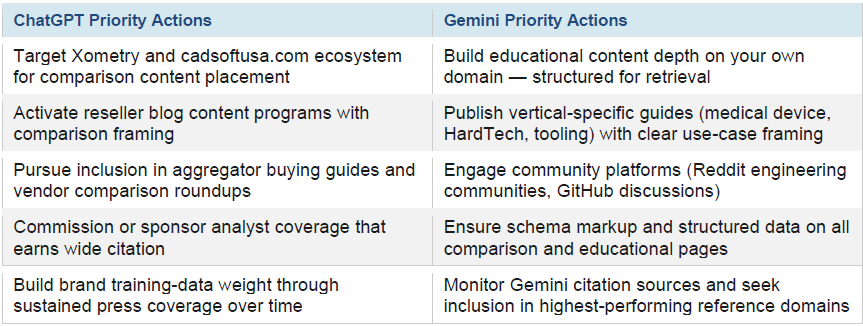
- For challengers without reseller networks, partnerships with Xometry or similar aggregators may be the fastest path to entering the ChatGPT citation pool.
7.3 Gemini-First for Discovery; Comparison Content for Evaluation
Onshape’s stage split data illustrates a principle that applies broadly: Gemini rewards educational content depth at the Discovery stage; comparison content drives Evaluation-stage visibility on both platforms. A well-rounded AEO program invests in both.
- For Discovery visibility on Gemini: invest in educational depth — cloud architecture explainers, version control use cases, vertical-specific workflow guides (medical device documentation, hardware startup toolchain) — published on your own domain and designed for retrieval.
- For Evaluation visibility on both platforms: the comparison content layer described in 1 is the primary lever.
- For ChatGPT Discovery visibility: the harder ChatGPT’s incumbency bias is driven by training data weight, not real-time retrieval. Meaningful ChatGPT Discovery presence requires sustained third-party coverage at scale — analyst reports, widely-cited comparison articles, community engagement (Reddit, engineering forums) — over a timeframe measured in months to years.
7.4 Don’t Wait for Trade Press — Build Toward It
The near-absence of CAD trade publications from the citation ecosystem is a structural observation, not a permanent condition. Engineers.com, Develop3D, Digital Engineering, and AEC Magazine have domain authority and readership that could earn AI citations — but currently, their content does not appear to be structured or indexed in a way that surfaces in AI responses for the query types in this study.
For vendors, the practical implication is twofold: do not rely on trade press placement as your primary AEO strategy (it is unlikely to yield near-term results), but do pursue it as a long-term credibility signal. Trade press coverage that generates secondary citations — reseller blogs linking to a Develop3D article, Reddit discussions referencing an engineering.com review — can enter the AI citation loop through indirect pathways.
Platform-Specific Priorities
8. A Note on Using These Findings
The findings in this report are best understood as leading indicators, not definitive benchmarks. A single study run — across one geographic origin, one point in time, and one set of 50 prompts — provides a directional view of the AI visibility landscape, not a precise measurement of it.
AI platforms are non-deterministic: the same prompt run twice in identical conditions will not always produce the same response. Model updates, retrieval index changes, and session-level factors all introduce variance. The rankings and patterns in this report reflect tendencies, not fixed positions.
For vendors, resellers, publishers, or other organizations seeking more specific, actionable intelligence — including visibility benchmarks for your own product, competitive gap analysis, or vertical-specific prompt coverage — this report provides a framework and starting point, not a complete answer. Running a targeted study customized to your product, buyer persona, and priority verticals will yield significantly more actionable results than applying these aggregate findings directly.
9. Limitations & Future Research
This study was conducted as a single run in a specific context. The following limitations should be considered when applying findings:
- Single geographic origin (Budapest, HU). Replication from US, UK, and German IP addresses would quantify geographic weighting effects and be particularly valuable for vendors with regionally concentrated customer bases.
- Single run — no repeatability testing. AI responses are non-deterministic. A second run of identical prompts would reveal response variance and vendor mention consistency High variance would indicate weaker signal; low variance would reinforce confidence in the rankings.
- Vendor sources not systematically The researcher noted vendor-cited sources qualitatively but they were not entered in the spreadsheet. Future runs should add a ‘source type’ column to classify sources as: vendor, reseller, aggregator, trade press, analyst, community, academic.
- ‘Other Vendors’ field not fully Vendors beyond the top 4 were captured in a free-text field but not included in systematic counts. This field likely contains meaningful signals for emerging tools and adjacent categories.
- Model version drift. Both ChatGPT and Gemini update their underlying models continuously. Findings from March 2026 may not Quarterly repetition is recommended for ongoing strategic monitoring.
- Adjacent Tools category was underrepresented (4 prompts). PLM, PDM, and simulation tool comparisons deserve a dedicated study, particularly given the compounding effect of CAD platform decisions on adjacent software selection.
Recommended next research phases include: a North American replication run for baseline comparison; a source-type classification overlay on existing data; a dedicated Medical Device vertical deep-dive (given the high regulatory specificity and buyer pain intensity of this segment); and a Phase 2 meta-session analysis using the qualitative protocol outlined in the study design document.
10. Appendix: Prompt Coverage by Vertical
The following table provides a summary of the 50 prompts organized by vertical and stage for reference. Full prompt text is available in the master prompt sheet.
| # | Vertical | Category | Stage | Prompt Summary |
| 1 | Cross-Vertical | Discovery | Discovery | Software engineers use to design physical products |
| 2 | Cross-Vertical | Definition | Discovery | What is parametric CAD vs. direct modeling? |
| 3 | Cross-Vertical | Best-Of | Discovery | Best CAD for small remote engineering team |
| 4 | Cross-Vertical | Use Case | Discovery | How engineers collaborate on 3D files |
| 5 | Cross-Vertical | Evaluation | Discovery | Cost to equip engineering team with CAD |
| 6 | Industrial Machinery | Best-Of | Discovery | Software for designing custom industrial equipment | |
| 7 | Industrial Machinery | Use Case | Discovery | Designing large assemblies with hundreds of moving parts | |
| 8 | Industrial Machinery | Best-Of | Discovery | Tools for robotics & automation mechanical design | |
| 9 | Industrial Machinery | Use Case | Discovery | Managing CAD data across multiple projects | |
| 10 | Industrial Machinery | Best-Of | Discovery | Most widely used CAD in industrial machinery | |
| 11 | Consumer Electronics | Best-Of | Discovery | Software for consumer electronics enclosures | |
| 12 | Consumer Electronics | Use Case | Discovery | How hardware startups design first physical product | |
| 13 | Consumer Electronics | Use Case | Discovery | Tools for designing injection-molded plastic parts | |
| 14 | Consumer Electronics | Vertical-Specific | Discovery | Best CAD for designing wearable devices | |
| 15 | Consumer Electronics | Use Case | Discovery | How industrial designers & engineers share CAD | |
| 16 | Medical Devices | Best-Of | Discovery | CAD for designing surgical instruments | |
| 17 | Medical Devices | Compliance | Discovery | Designing medical devices for FDA documentation | |
| 18 | Medical Devices | Vertical-Specific | Discovery | Tools for implantable devices & prosthetics | |
| 19 | Medical Devices | Evaluation | Discovery | How medical device startups choose software for regulatory submissions | |
| 20 | Medical Devices | Use Case | Discovery | CAD platforms for non-engineer review of 3D medical designs | |
| 21 | Auto Tooling & Fixtures | Best-Of | Discovery | Software for jigs & fixtures in automotive plants | |
| 22 | Auto Tooling & Fixtures | Vertical-Specific | Discovery | CAD tools used on the shop floor by tooling teams | |
| 23 | Auto Tooling & Fixtures | Vertical-Specific | Discovery | Tier-2 & Tier-3 stamping die design | |
| 24 | Auto Tooling & Fixtures | Emerging | Discovery | CAD on tablet or iPad in manufacturing | |
| 25 | Auto Tooling & Fixtures | Use Case | Discovery | Sharing CAD models with OEM engineering teams | |
| 26 | HardTech Startups | Best-Of | Discovery | CAD tools for defense tech startups |
| 27 | HardTech Startups | Vertical-Specific | Discovery | Engineering software for new space companies | |
| 28 | HardTech Startups | Evaluation | Discovery | How deep tech startups pick CAD without lock-in | |
| 29 | Adjacent Tools | Evaluation | Discovery | When engineering teams need PDM or PLM beyond CAD | |
| 30 | Adjacent Tools | Integration | Discovery | Simulation tools used alongside CAD | |
| 31 | Cross-Vertical | Comparison | Evaluation | Onshape vs. SOLIDWORKS for growing manufacturer | |
| 32 | Cross-Vertical | Comparison | Evaluation | TCO differences: SOLIDWORKS, Fusion 360, Onshape | |
| 33 | Cross-Vertical | Evaluation | Evaluation | When does a company outgrow SOLIDWORKS for NX or CATIA? | |
| 34 | Cross-Vertical | Comparison | Evaluation | Main reasons engineers switch from SOLIDWORKS to Onshape/Fusion | |
|
35 |
Industrial Machinery |
Comparison |
Evaluation |
SOLIDWORKS vs. Autodesk Inventor for industrial machine design | |
| 36 | Industrial Machinery | Comparison | Evaluation | Siemens NX vs. SOLIDWORKS for complex assemblies | |
| 37 | Industrial Machinery | Comparison | Evaluation | Is Fusion 360 good enough for professional industrial design? | |
| 38 | Industrial Machinery | Evaluation | Evaluation | Limitations of SOLIDWORKS for large assembly vs. NX/CATIA | |
| 39 | Consumer Electronics | Comparison | Evaluation | Shapr3D vs. Fusion 360 for consumer product design | |
|
40 |
Consumer Electronics |
Comparison |
Evaluation |
Onshape vs. SOLIDWORKS for hardware startup scaling to mass production | |
| 41 | Consumer Electronics | Comparison | Evaluation | Advantages of Fusion 360 over SOLIDWORKS for rapid prototyping | |
| 42 | Consumer Electronics | Comparison | Evaluation | Shapr3D’s iPad workflow vs. desktop CAD for industrial design | |
|
43 |
Medical Devices |
Comparison |
Evaluation |
Onshape vs. SOLIDWORKS for medical device startup & FDA submissions | |
|
44 |
Medical Devices |
Comparison |
Evaluation |
Regulatory compliance: SOLIDWORKS vs. PTC Creo for medical devices | |
| 45 | Medical Devices | Comparison | Evaluation | Onshape design history vs. SOLIDWORKS PDM | |
| 46 | Medical Devices | Comparison | Evaluation | PTC Creo vs. SOLIDWORKS for Class III medical device |
| 47 | Auto Tooling & Fixtures | Comparison | Evaluation | Shapr3D vs. SOLIDWORKS for automotive fixture & tooling | |
| 48 | Auto Tooling & Fixtures | Comparison | Evaluation | Fusion 360 as alternative to SOLIDWORKS for Tier-2 automotive | |
|
49 |
HardTech Startups |
Comparison |
Evaluation |
Onshape vs. SOLIDWORKS for hardware startup that needs to move fast | |
| 50 | HardTech Startups | Comparison | Evaluation | Tradeoffs between Siemens NX and Onshape for defense tech startup |
AEO Research Series · Ron Close · March 2026 · Version 1.0
CAD Market — 50-Prompt AEO Study · Budapest, HU · ChatGPT & Google Gemini
