

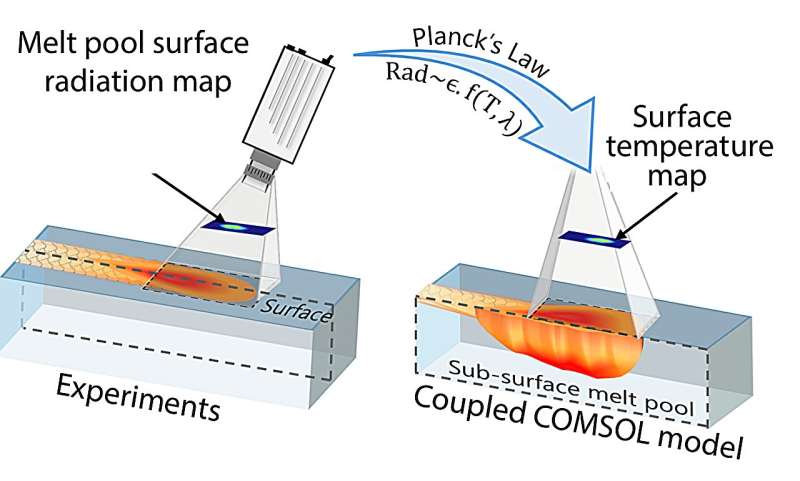
Researchers have developed a method for examining the hidden thermal behavior of molten metal during laser-based additive manufacturing. The approach combines high-speed infrared imaging with computational modeling to reconstruct three-dimensional temperature and solidification conditions beneath the melt-pool surface, tells Tech Xplore.
In laser-based metal additive manufacturing, a high-powered laser moves across metal powder, rapidly heating, melting, and solidifying the material. This cycle determines the metal’s microstructure, which influences the strength, toughness, and durability of the finished component. However, cameras can observe only the melt-pool surface, while critical solidification processes also occur below it.
The researchers studied MAR-M247, a nickel-based superalloy used in turbine blades and other components exposed to extreme temperatures. High-speed infrared imaging captured temperature changes at the melt-pool surface. Instead of building a simulation entirely from assumptions about laser absorption, heat transfer, and molten-metal flow, the researchers fed measured surface temperatures directly into a three-dimensional computational model.
The model reconstructed the thermal field below the surface and tracked the moving boundary between molten and solid metal. This allowed researchers to calculate local solidification speeds and temperature variations that are difficult to measure experimentally. The results showed that solidification conditions vary across the melt pool, even when the laser moves at a constant speed.
Electron microscopy confirmed that the model could capture changes in microstructural length scales and growth directions under different laser-processing conditions. The findings demonstrate that laser power and scanning speed alone cannot fully explain the properties of a printed component.
Eventually, this combined imaging-and-modeling approach could support closed-loop additive manufacturing systems that monitor microstructure formation layer by layer and adjust processing conditions before defects become embedded in critical aerospace, medical, or industrial components.
