

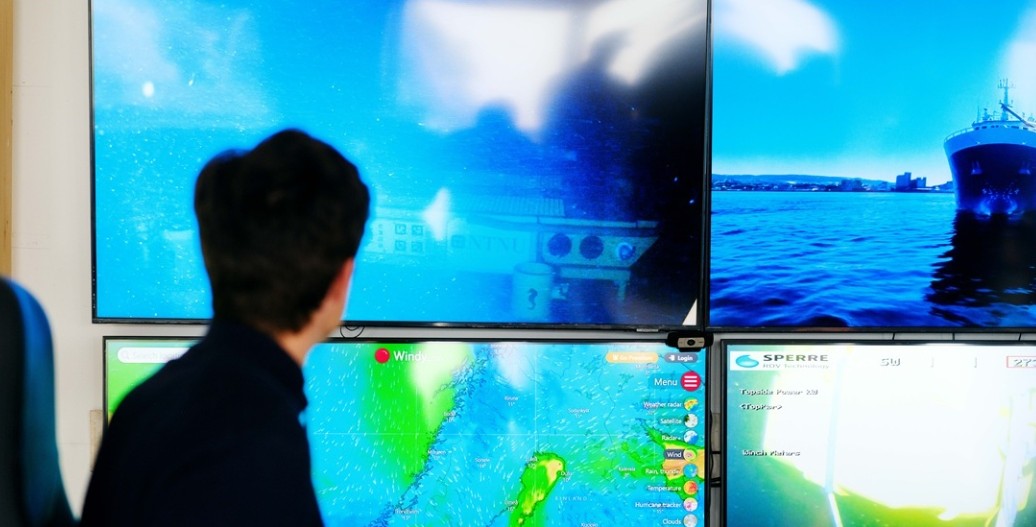
As economic activity in the world’s oceans expands, so does the need to monitor and protect critical underwater infrastructure such as pipelines, communication cables, power lines, and offshore installations. Traditional inspection methods rely on expensive ships, specialized crews, and remotely operated vehicles, making continuous monitoring both costly and environmentally intensive. Researchers at the Norwegian University of Science and Technology (NTNU) are working to change that through the development of resident underwater robots capable of operating autonomously from fixed bases on the seabed.
The research team recently conducted successful trials involving an autonomous underwater vehicle (AUV) and a docking station positioned 90 meters below the surface in Trondheim Fjord. During the tests, the robot independently carried out inspection missions, returned to the docking station, recharged its batteries, and uploaded collected data without human intervention. The achievement marks an important step toward long-term autonomous underwater operations.
The project used a modified Blueye X3 underwater robot equipped with cameras, sonar, sensors, communication systems, an induction charger, and a magnetic docking mechanism. To locate and enter the docking station, the vehicle combined acoustic communication, Ultra Short Baseline positioning, machine vision, and visual markers. Once docked, it transferred data through high-bandwidth communication links and recharged inductively.
Researchers believe resident underwater vehicles could significantly reduce operating costs while improving safety and lowering carbon emissions associated with ship-based inspections. Such systems could provide near-continuous monitoring of critical infrastructure, a capability that has become increasingly important in light of recent incidents involving sabotage of underwater assets.
The tests achieved a 90% autonomous docking success rate, but researchers emphasize that reliability must reach 100% before widespread deployment becomes feasible. Challenges remain in navigation, docking, communication, and autonomous decision-making. For example, fish passing in front of cameras occasionally confused the robot’s image-processing software.
Despite these hurdles, NTNU researchers view resident underwater vehicles as a scalable and cost-effective solution for seabed monitoring. Continued development could pave the way for permanently deployed robotic systems that remain on call beneath the ocean for months or even years at a time.
