

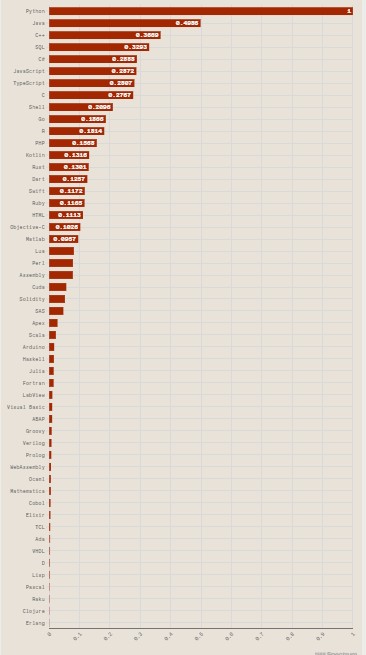
Every year, IEEE Spectrum publishes a ranking of the most popular programming languages. In 2025, however, the landscape shows signs of disruption, not just in who leads, but in how we should even measure popularity.
In Spectrum’s default ranking, Python retains the top spot, while JavaScript slips from third to sixth. The “Jobs” ranking, which tracks employer demand, also places Python first, reflecting its continued dominance in industry roles. Traditionally, this ranking draws on signals such as search trends, Q&A sites, GitHub activity, and mentions in research papers.
But 2025’s rankings face a challenge: those public signals are weakening. Programmers are increasingly turning to AI tools such as ChatGPT or Claude instead of querying forums like Stack Exchange. As a result, question volumes across languages have declined; Stack Exchange postings in 2025 are just 22% of their level in 2024. As programmers outsource more low-level work to AI assistants, the importance of syntax or language features may fade in favor of higher-level design, architecture, or problem framing.
This shift suggests that the very notion of a “top programming language” may become obsolete. If AI can code fluently in any language, then what matters is not the language itself but how effectively a human interacts with the AI to solve a problem. Future rankings may need new metrics; a focus on AI-aided workflows, prompt quality, or how intuitive an environment is to use.
The 2025 ranking is less a final word than a signal. The programming ecosystem is entering an AI era where language choice matters less, and the skills that will matter most may be problem decomposition, prompt design, and system-level thinking.
