

The Hardware FYI article surveys several emerging ideas and companies shaping the future of hardware engineering, manufacturing, and robotics. One theme is the growing importance of controlling production tools rather than relying entirely on off-the-shelf equipment. Drawing on Saturn’s effort to build an American actuator company, the article argues that manufacturing success often depends more on factory design than on the product itself. By developing custom production equipment in-house, Saturn reduced costs and lead times dramatically. A magnet-insertion machine that would have cost more than $12,000 and required weeks to arrive was replaced with a $900 in-house version. The company’s philosophy is to own process knowledge while relying on specialists for areas such as quality control and metrology.
The article also revisits the long-running CAD debate between history-based and direct modeling. Citing CAD expert Matt Lombard, it argues that many modeling best practices exist primarily to manage the fragility of feature-history trees. Synchronous or direct modeling shifts attention from preserving design history to editing geometry directly, potentially simplifying workflows and allowing engineers to focus more on design intent than model maintenance.
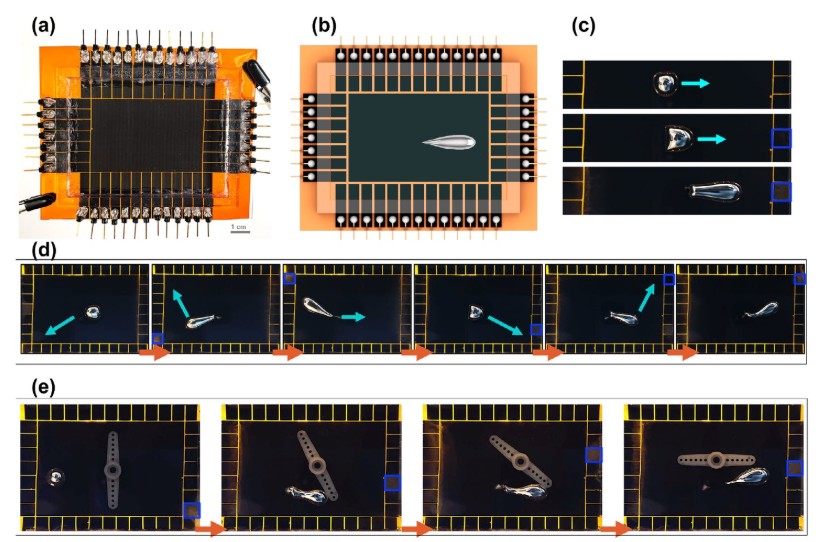
Another highlight is Itera, a startup developing reconfigurable circuit boards that use liquid-metal traces controlled through electrowetting. Instead of fabricating a new PCB for every design iteration, engineers could physically rewrite circuit connections on the same substrate. The technology builds on research into programmable liquid-metal movement and aims to accelerate electronics prototyping.
The article also examines world models for robotics and physical AI. Researchers are exploring several architectures that enable machines to predict future states of physical environments. Competing approaches include action-conditioned world models, video-based world models, and joint world-action systems, all seeking to improve robotic planning and manipulation.
The newsletter concludes with startup and funding news. Itera raised $12 million to commercialize its fluid circuit boards, Picogrid secured $45 million for defense-system middleware, Thea Energy raised $100 million to advance stellarator fusion technology, and the U.S. government is reportedly considering investments in domestic drone manufacturers. Together, these developments reflect a broader push toward faster iteration, greater manufacturing control, and more capable physical AI systems.
