

McNeel is embracing artificial intelligence to accelerate software development and expand modeling capabilities while preserving Rhino’s established business model. At Rhino World 2026, held near Barcelona, the company demonstrated its evolving AI strategy alongside the release of Rhino 9.
According to AEC Magazine, AI has significantly increased development productivity at McNeel. Developers using Claude reported nearly tripling their output, with merged pull requests rising from 3.3 to 9.5 per working day. AI also assists with debugging, automated testing, code analysis, and performance improvements, although developers continue reviewing changes.
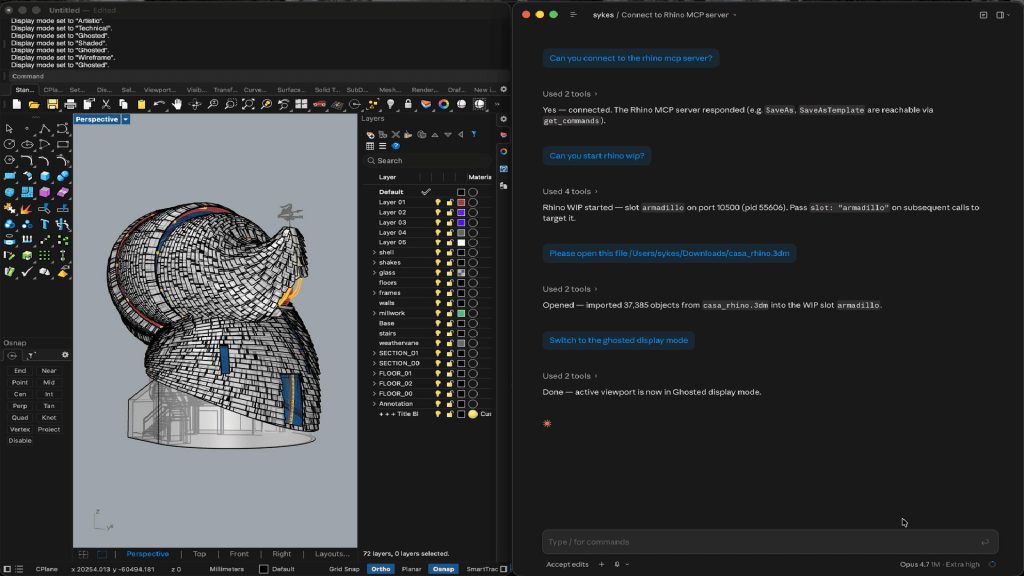
A major development is RhinoAI, an open-source plug-in connecting AI agents to Rhino through the Model Context Protocol (MCP). Users can interact with agents such as Claude and Codex to generate geometry, create Grasshopper definitions, automate modeling tasks, and develop custom plug-ins.
Demonstrations included converting sketches into parametric models, reconstructing objects from images, and simplifying imported CAD geometry. However, complex architectural modeling produced inconsistent results, highlighting the need for human guidance.
Rhino 9 introduces more than 100 enhancements, including improved freeform modeling, advanced drafting tools, and Grasshopper 2. New capabilities support live section drawings, metadata management, multithreaded calculations, and faster handling of large models.
Rhino.Inside.Revit continues connecting Rhino with BIM workflows, while Rhino.Compute extends cloud-based processing to Linux servers. AI experiments also demonstrated automatic furniture scheduling and model metadata generation.
Despite these advances, McNeel maintains perpetual licensing, unchanged upgrade pricing, and support for earlier Rhino versions.
The developments signal McNeel’s shift toward AI-assisted design and development without abandoning user control or its established software philosophy.
