

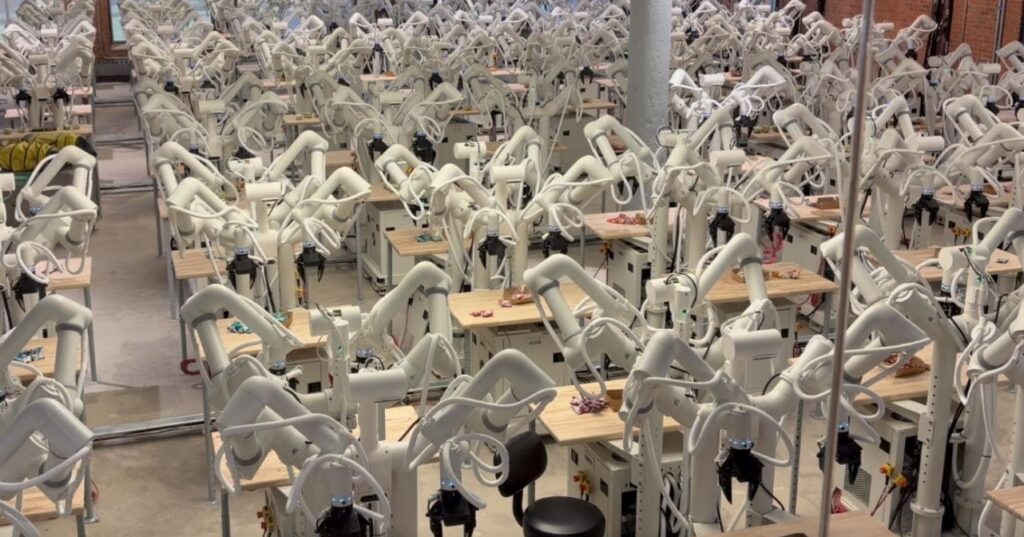
A growing trend in robotics is redefining the traditional concept of a factory. Instead of converting raw materials into physical products, these emerging “data factories” transform robot operations into valuable training data for artificial intelligence systems. The approach reflects a broader shift in robotics development, where real-world experience is becoming as important as hardware design and software engineering, tells this Hardware FYI article.
One example is Tutor Intelligence’s Data Factory 1, a facility housing 100 bimanual robots designed specifically to generate training data. Each robot is equipped with two six-degree-of-freedom arms and stereo RGBD cameras mounted on its wrists. According to the company, the facility can collect up to 1,000 hours of demonstration data per day. Human operators remotely supervise the robots, either individually or in one-to-many configurations, stepping in when robots encounter situations they cannot handle autonomously.
The underlying philosophy resembles human learning. Company founders compare the process to sending robots to kindergarten. Human operators first demonstrate tasks, after which robots attempt to perform them independently. When failures occur, operators provide corrective demonstrations that are incorporated into future training. As the number of deployed robots increases, more edge cases emerge, allowing machine-learning models to improve more rapidly through exposure to diverse real-world scenarios.
A similar concept is appearing in life sciences. Medra operates a facility containing 100 robots that conduct wet-lab experiments. While Tutor Intelligence’s system produces training data as its primary output, Medra’s robots generate experimental results. Both approaches share a common principle: giving AI systems direct interaction with the physical world rather than relying exclusively on simulations.
The text also highlights a useful engineering lesson through an overview of USB-C Power Delivery. Although USB-C is often viewed as a universal connector, power transfer follows a carefully controlled negotiation process. Configuration channel pins determine cable orientation and device roles before establishing a safe 5-volt connection. Higher voltages and currents are enabled only after communication between devices and verification of cable capabilities.
Together, these examples illustrate a broader engineering trend: intelligent systems are increasingly being built around structured feedback loops, where continuous interaction with the real world generates the data needed to improve performance, reliability, and adaptability.
