

Humanoid robots are advancing quickly, but their hands remain one of the toughest engineering challenges. Hardware FYI argues that building a useful robotic hand requires balancing dexterity, strength, sensitivity, reliability, and compactness within a single mechanism. A humanlike hand may need roughly 27 degrees of freedom while generating enough grip force to hold heavy objects and enough compliance to manipulate delicate ones.
The problem is already affecting commercialization. Hardware FYI notes that Tesla has identified hand development as one factor behind delays in scaling Optimus production. The newsletter points readers to Origami Robotics’ analysis of the problem, which centers on torque density and the gearboxes required to compensate for small motors.
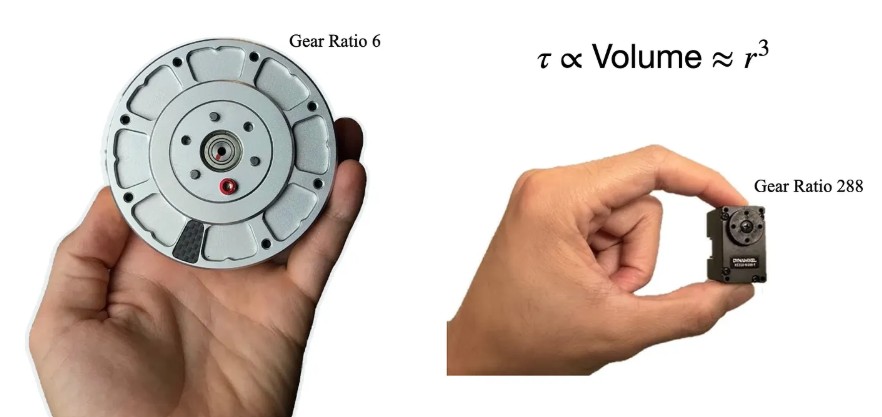
Motor torque scales approximately with volume. Shrinking a motor’s linear dimensions by a factor of 10 can therefore make it about 1,000 times weaker. Robotic-hand designers compensate with high gear reductions, sometimes ranging from 100:1 to 288:1 per joint. By comparison, a leg actuator may operate around 6:1. High ratios provide torque but can reduce force transparency and make accurate simulation more difficult, creating trade-offs for manipulation.
Hardware is only part of the challenge. Robots also need intelligence capable of controlling complex hands. Unlike large language models, manipulation systems cannot draw on an enormous existing corpus of training data. Developers must generate physical interaction data that corresponds closely to a robot’s particular hand architecture.
Companies are pursuing several approaches. Some use teleoperation, while others employ data-collection gloves designed to capture human hand movements and map them onto robotic hands. The latter approach grew partly from the 2024 Universal Manipulation Interface research project.
The article highlights a fundamental dependency in humanoid robotics: better AI alone cannot solve manipulation. Progress requires capable hardware, scalable data collection, and high-quality training information to advance together before general-purpose robots can reliably perform useful physical work.
