

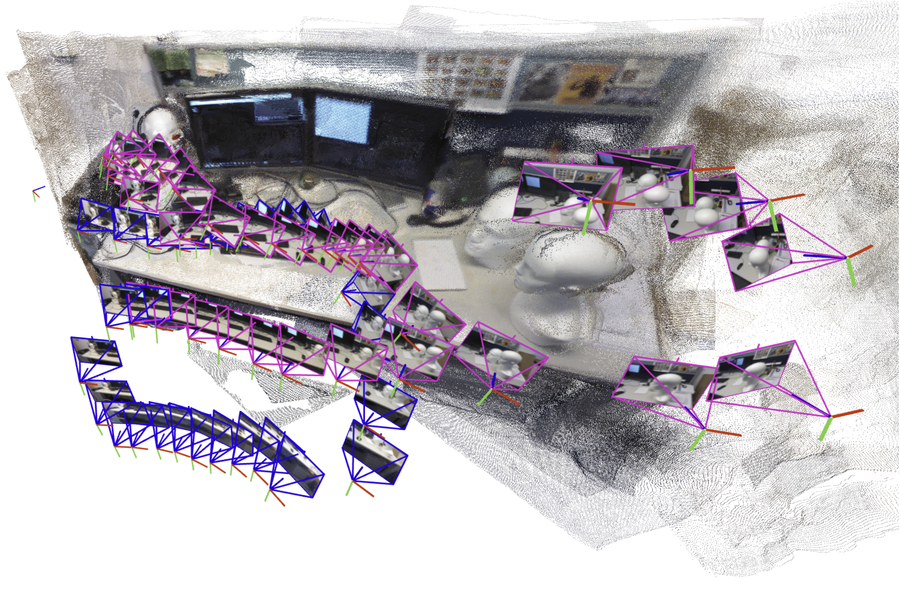
MIT scientists tackled a central challenge in robotics known as simultaneous localization and mapping (SLAM), where a robot must create a map of its environment while tracking its own position within that map, tells MIT News. Traditional machine-learning models for SLAM struggle in large, complex environments because they can only process limited batches of images at a time.
To overcome this, the team developed a novel approach: instead of attempting to map an entire scene in one go, the system builds smaller “submaps,” each derived from a handful of images, and then stitches these submaps together into a consistent 3D reconstruction. They addressed a common problem in alignment: when submaps suffer distortions, simple rotations or translations aren’t enough to align them correctly. By adopting methods from classical computer vision, the researchers represented submap deformations more flexibly, enabling accurate alignment across large environments.
The resulting system works with ordinary RGB cameras, requires no prior calibration or manual tuning, and can reconstruct environments in seconds with localization errors less than five centimeters.
From an engineering and design perspective, this work matters because it significantly lowers the barrier for deploying robots in unpredictable settings such as collapsed buildings, warehouses, or unfamiliar indoor spaces. The lightweight sensor requirements, speed, and accuracy open doors for scalable robot navigation without heavy sensor suites or complex setups.
In summary, the MIT system demonstrates that with intelligent AI architecture and classic vision techniques, robots can map large, real-world spaces quickly and accurately. For engineers building autonomous systems, it implies that fewer sensors, smarter algorithms, and modular mapping strategies can yield high performance in terrain where every second counts.
