

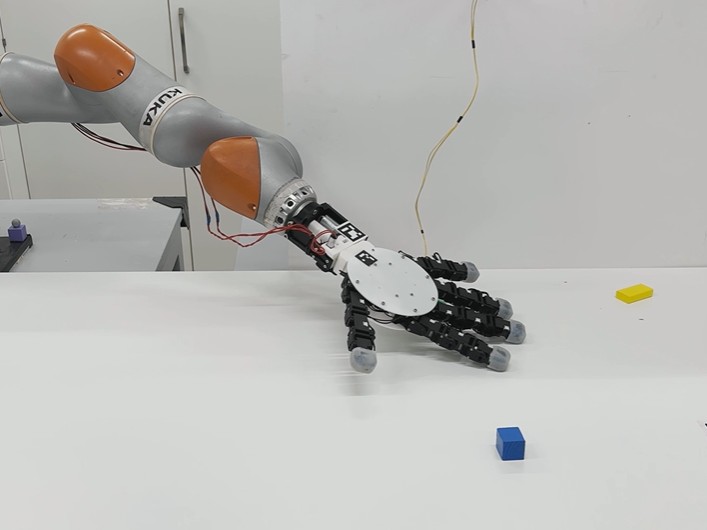
Roboticist Aude Billard’s daily experience juggling objects as a mother led her to question a long-standing assumption in robotics: that the human hand should be the model for artificial grasping. Her research team at the Swiss Federal Institute of Technology has now unveiled a radically different robotic hand, described in Nature Communications, that rethinks dexterity rather than imitates anatomy, tells The New York Times article.
The device resembles a disc-shaped palm fitted with multiple identical, flexible fingers made from silicone, motors, and 3D-printed parts. Instead of copying the structure of the human hand, the system uses software trained in simulation to determine optimal finger arrangements and activation sequences for grasping different objects, including several at once. Those learned strategies are then transferred to the physical robot. This design philosophy allows the hand to overcome limitations inherent in human anatomy. Any finger can pair with any other to grip an object, fingers can wrap around items or pin them to the palm, and the hand can grasp objects on both sides simultaneously, giving it a symmetrical versatility humans lack.
Its most unconventional feature is detachability. The hand can separate from the main robot and function as a crawling machine, using its fingers as legs to scuttle through tight spaces. In this mode, it can navigate confined environments such as pipes or machinery interiors, retrieve debris, and then return to its original role as a manipulator. The fingers can switch between walking and grasping roles, sometimes doing both at once.
Experts not involved in the research view the work as conceptually significant. Some note potential tradeoffs, such as reduced gripping force compared with rigid fingers, and limited evidence of fine manipulation once objects are held. Still, the design has been praised for expanding the range of possible robotic grasps and for challenging the assumption that bio-mimicry is the best path forward.
Billard hopes the project encourages broader creativity in robotics design. Instead of copying nature’s forms, the goal is to extend function beyond biology and spark new directions in engineering innovation.
