

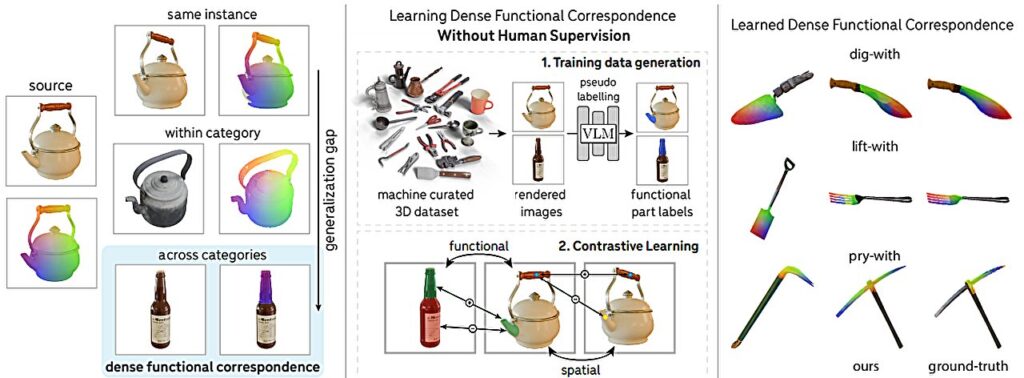
The new system, to be presented at the International Conference on Computer Vision (ICCV) 2025, goes pixel-by-pixel, mapping how object parts correspond across different instances, tells Tech Xplore. For example, it might recognize that the curved section of one tool corresponds to the blade of another, even though they look different externally. This ability to “transfer” functional understanding means a robot could select a novel tool and use it appropriately, based on recognizing the functional part rather than relying on prior label-training alone.
For engineers designing autonomous machines, this development is significant. It means fewer limits on the tools and environments a robot can handle. Rather than being trained on every possible variant, a robot can infer function from structure. That opens up more flexibility in manufacturing, service robotics, logistics, and unstructured settings. It also lowers the need for massive labelled datasets keyed to every possible object and the parts they contain.
Still, challenges remain. Real-world settings are messier: objects overlap, occlude each other, change over time, or have wear and tear. Translating a lab model’s success to broad-scale deployment will demand robust hardware, reliable sensors, and the ability to handle noise. But the core takeaway is clear: robotics is moving from “see and label” to “see, reason, and act.”
