

Researchers have developed a method that brings robotic hands closer to human-level dexterity by teaching their control systems to understand both visual and tactile cues, tells Tech Xplore. Traditional robot hands struggle with delicate manipulation because they lack the integrated sensory awareness that humans take for granted. They often fail to perceive what they hold when fingers occlude cameras, and they lack reliable touch feedback. A novel training framework addresses this gap by using inexpensive webcams and basic sensors to train a robot’s “brain” to link what it sees with what it feels.
The process begins with pretraining on a large library of human hand videos. By observing how human hands interact around objects, and how those interactions look visually, the robot learns to associate visual patterns with expected tactile outcomes. This visual-tactile training teaches the robot both where its fingers are relative to objects and how contact feels when a surface is touched. Such multimodal learning helps robots plan finger movements more effectively and respond to partial occlusions.
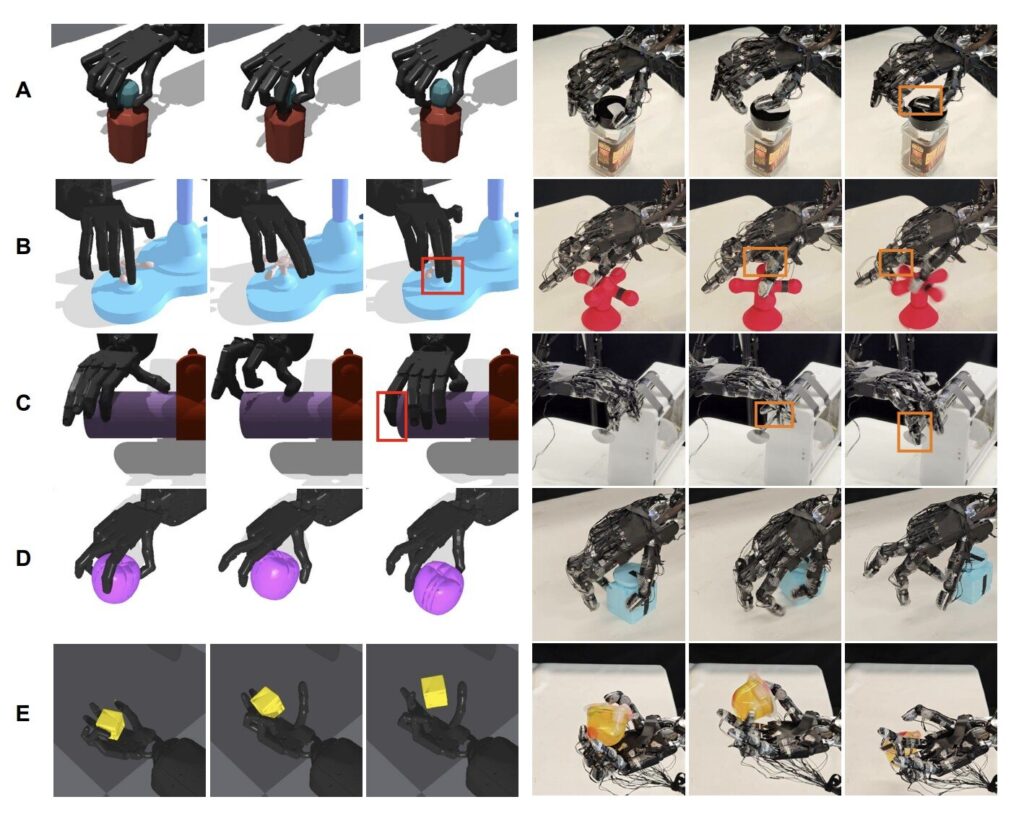
Experimental results show promise even with low-cost hardware. A four-fingered robotic hand equipped with this training framework achieved a 73% success rate on a range of manipulation tasks. That performance level demonstrates that practical, adaptable dexterity is possible without expensive sensors. Videos accompanying the research highlight the robot completing tasks that would traditionally challenge simple grasping systems.
This work parallels broader trends in robotics research that emphasize learning from human demonstrations and integrating multisensory information to close the gap between machine and human capabilities. By leveraging cheap sensory setups and data-driven models, engineers can build more capable robotic manipulators suited for diverse applications, from manufacturing and service tasks to assistive technologies. The approach also illustrates how visual-tactile learning, long a goal in robotics, can make practical strides when guided by careful training strategies.
