

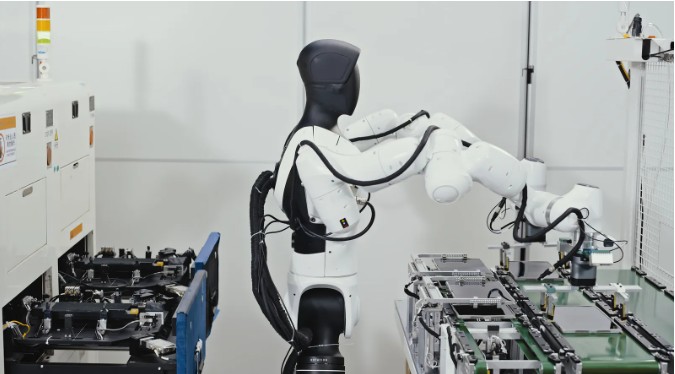
AgiBot is a Chinese robotics startup pushing the boundaries of industrial automation by combining teleoperation with reinforcement learning to train robots for new manufacturing tasks at unprecedented speed. According to a recent Wired.com article, its system allows a two-armed robot to go from zero to deployment on a live production line in about 10 minutes.
The process begins in a dedicated “robotic learning center,” where human operators teleoperate robots through a task, generating training data. This human-in-the-loop stage establishes a baseline. Then the robot’s AI, via a system called “Real-World Reinforcement Learning,” takes over and refines performance autonomously on the factory floor.
AgiBot’s pilot at electronics manufacturer Longcheer Technology involved picking up components from a test machine and placing them onto a production line, a task deemed suitable because it doesn’t involve highly flexible or fragile materials. The company emphasizes that quick re-training is essential because production lines frequently change, even mid-run.
For designers, engineers, and manufacturing professionals, this development is significant for several reasons:
- It shifts the economic model of robotics from rigid automation (one task per robot) to flexible learning machines capable of multiple tasks.
- With rapid task onboarding, factories can adapt faster to changes in products, variants, and volumes without extensive re-programming.
- The human-assisted phase creates a new kind of workforce, teleoperators who help train machines, raising questions around skill-sets, labor models, and the role of humans in automated systems.
However, AgiBot’s approach isn’t without challenges: the quality of training data, the robustness of AI in edge cases, and the cost of teleoperation infrastructure remain key hurdles. The article also notes that while the concept is promising, broader deployment across diverse tasks and materials is yet to be proven.
AgiBot’s approach may herald a new phase in industrial robotics, robots that can learn quickly and adapt on the fly, transforming the balance between flexibility, cost, and human labor in manufacturing.
