

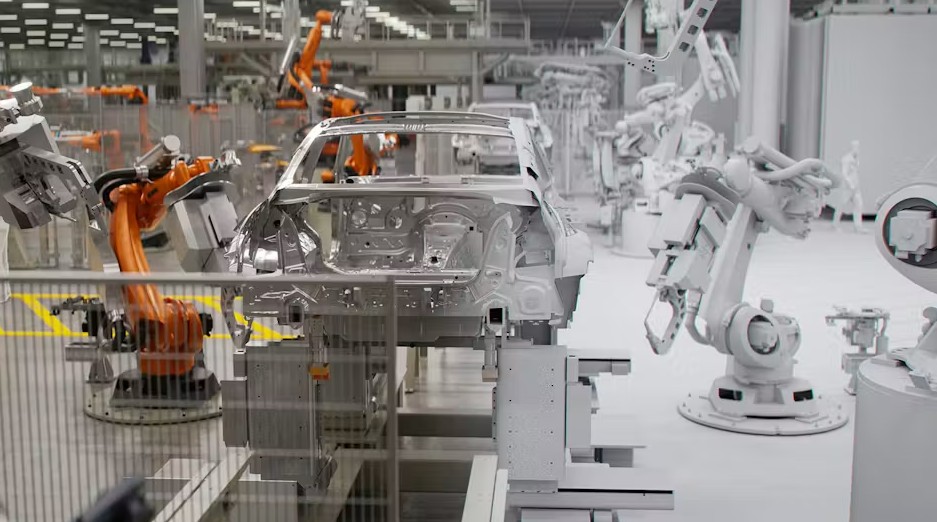
Rockwell Automation is expanding its industrial simulation capabilities by integrating its Emulate3D software with Nvidia Omniverse, RTX, and OpenUSD technologies. Announced at Automation Fair 2026, the integration aims to help engineers simulate complex manufacturing environments, validate automation systems, and optimize factory operations before physical deployment, tells Machine Design.
Emulate3D enables engineers to create virtual representations of manufacturing equipment, production lines, and robotic systems using predefined components or imported CAD assemblies. Manufacturers can evaluate equipment layouts, identify collisions, assess production flow, and validate control programming before installing machinery.
However, simulating increasingly complex manufacturing environments on individual workstations introduces computational limitations. Rockwell addresses this challenge through its Emulate3D Factory Test platform, which synchronizes distributed simulations to create comprehensive virtual factory environments.
Nvidia Omniverse provides the infrastructure for combining these simulations while supporting photorealistic visualization and GPU-accelerated physics calculations. Its capabilities enable engineers to examine manufacturing processes within more realistic virtual environments.
Central to the integration is OpenUSD, an open-source framework that combines geometric models with information about materials, physical properties, equipment movements, and sensor data. This approach facilitates interoperability among different engineering applications while providing structured information for artificial intelligence (AI) development.
The resulting virtual environments can generate synthetic training data for physical AI systems, supporting the development and validation of intelligent industrial automation.
For manufacturers, these capabilities could reduce commissioning risks, improve engineering collaboration, and identify operational inefficiencies before committing resources to physical infrastructure.
However, the article acknowledges practical challenges. Mastering Omniverse requires considerable training, while creating comprehensive digital factory representations demands significant engineering effort and detailed equipment information.
The integration also reflects growing competition among industrial automation providers as AI becomes increasingly embedded in manufacturing workflows.
For engineering professionals, the development illustrates the evolution of digital twins from equipment visualization tools into comprehensive environments for industrial simulation, automation validation, and AI development. Although implementation requires substantial preparation, identifying problems virtually could prevent expensive modifications during physical commissioning.
