

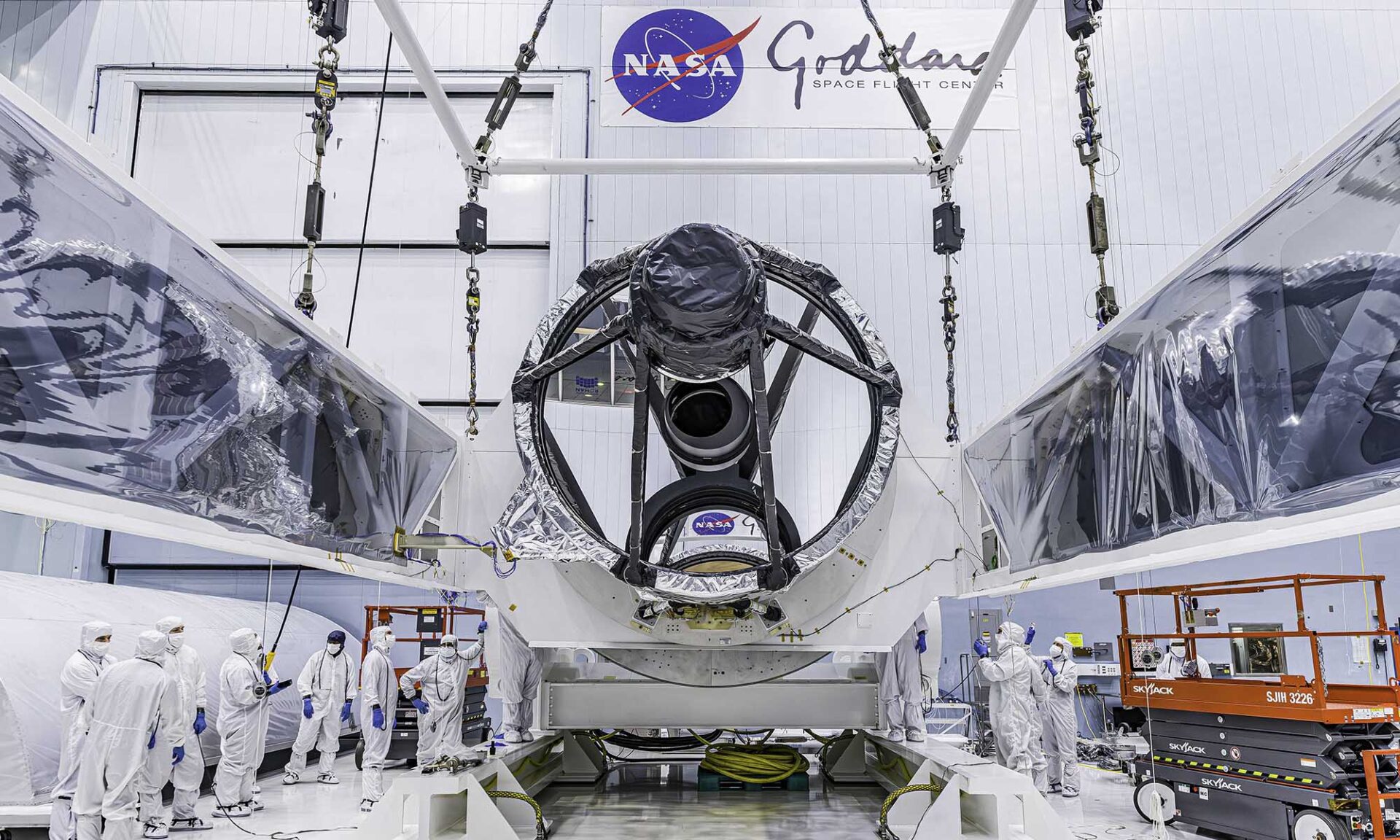
NASA’s Nancy Grace Roman Space Telescope is designed to survey the universe on a scale previous space observatories could not achieve. With infrared vision and a field of view at least 100 times larger than Hubble’s, Roman could measure light from a billion galaxies while helping scientists investigate dark matter, dark energy, and exoplanets.
Dozens of University of Rochester alumni contributed to the telescope through organizations including NASA, L3Harris Technologies, and Teledyne Technologies. Their work spans Roman’s optical systems, communications technology, guide sensors, electronics, coronagraph, and flight detectors.
Roman combines Hubble-like resolution with a much wider view. Its shorter optical design places the secondary mirror closer to the primary mirror, enabling the telescope to capture an area of sky larger than the apparent size of a full moon. This configuration will allow Roman to survey the universe 1,000 times faster than Hubble.
The observatory will also test an advanced coronagraph that uses optics, masks, deformable mirrors, and sensors to suppress starlight, potentially improving scientists’ ability to detect planets orbiting other stars.
Roman’s development presented major engineering challenges. Its optical telescope assembly, built by L3Harris in Rochester, must maintain precise alignment despite extreme temperature conditions. Engineers conducted vibration, acoustic, and simulated launch tests, followed by a 65-day thermal-vacuum test. Because Roman’s lightweight primary mirror sags under Earth’s gravity, engineers also developed a new technique to measure and account for this deformation during ground testing.
After launch, Roman will travel about a million miles from Earth. The telescope will then spend roughly three months deploying, calibrating, and testing its instruments. Once engineers verify its optical performance, scientists can begin using its unusually wide view to explore some of astronomy’s biggest unanswered questions.
