

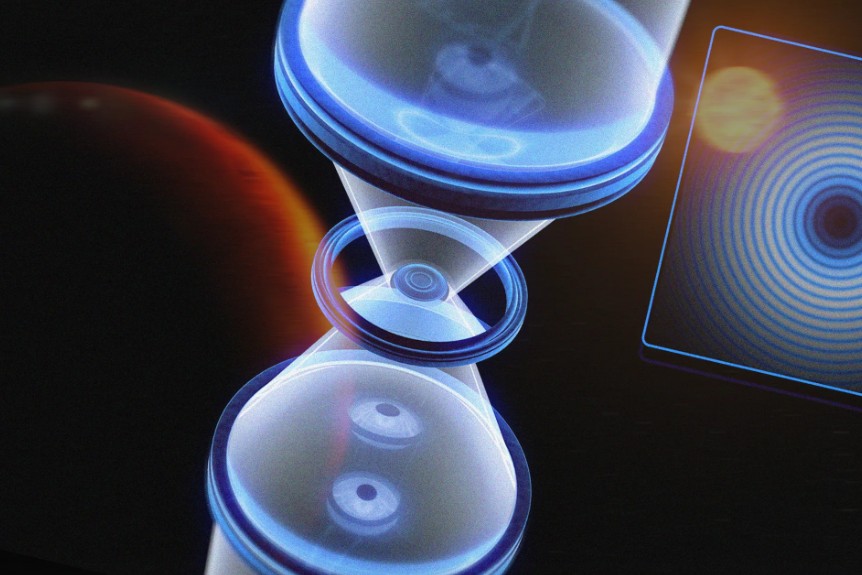
NASA’s Nancy Grace Roman Space Telescope will carry an experimental coronagraph designed to demonstrate technology that could eventually help astronomers directly image Earthlike planets. Although Roman’s primary instrument will address broad astrophysics questions, its coronagraph represents an important engineering step toward observing faint planets hidden by the intense glare of their stars, tells Wired.com (full article available to subscribers).
Coronagraphs work by blocking starlight so nearby, much dimmer objects become visible. Hubble and the James Webb Space Telescope already carry coronagraphs, but Roman’s instrument adds sophisticated adaptive optics. NASA compares its challenge to photographing a firefly beside a floodlight from across the country.
At the center of the system are two palm-sized deformable mirrors. Each contains about 2,300 tiny actuators that expand when electricity is applied, making minute adjustments to the mirror’s shape. These corrections counteract distortions that could scatter unwanted starlight across an image. Roman will mark NASA’s first use of active deformable mirrors in space.
The instrument also relies on highly sensitive detectors capable of amplifying signals from individual photons. Specialized masks suppress the central star’s brightness, creating conditions in which extremely faint planetary light can potentially be detected.
Engineers will evaluate the technology by attempting to observe several known exoplanets. Roman will also examine stars surrounded by dust and debris, where gaps in these disks could indicate otherwise unseen planets. The resulting data will help engineers understand how the coronagraph performs in space and what improvements future instruments require.
Roman’s coronagraph is primarily a technology demonstration, but its lessons could shape NASA’s proposed Habitable Worlds Observatory, potentially launching in the 2040s. That telescope would require a coronagraph as much as 100 times more capable to search for smaller, potentially habitable planets around sunlike stars. Roman therefore represents a critical engineering test for future efforts to directly observe worlds resembling Earth.
