

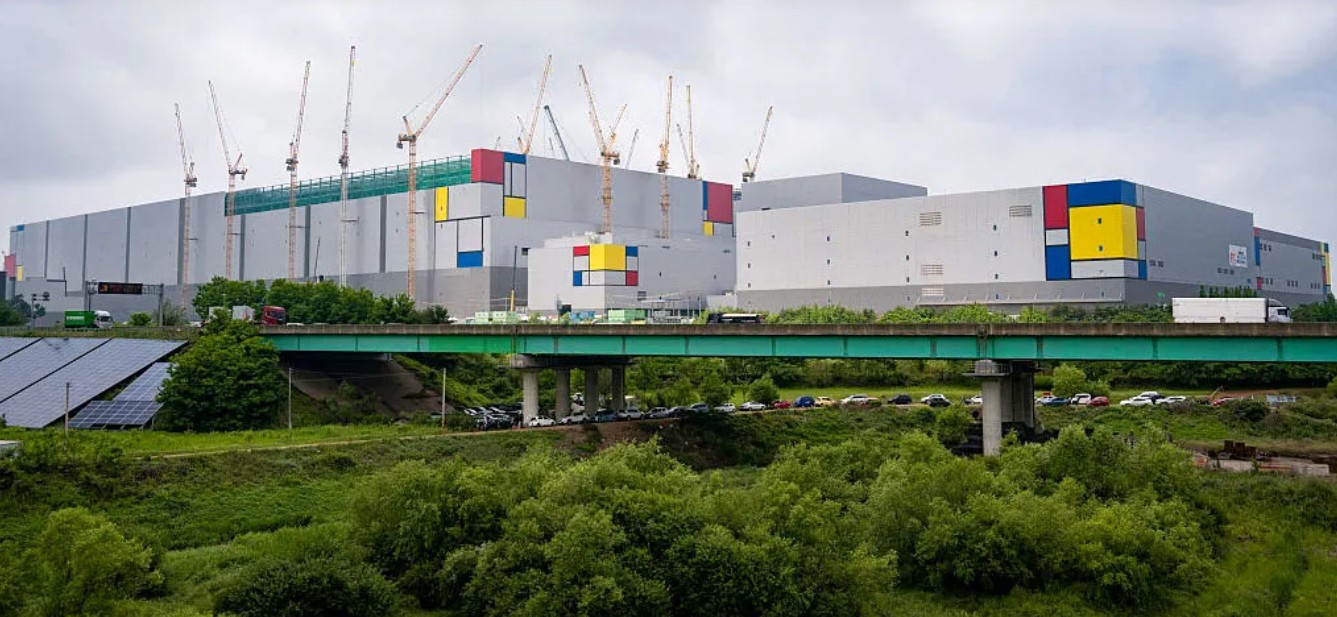
Samsung is rapidly expanding its enormous semiconductor manufacturing complex in Pyeongtaek, South Korea, as generative AI drives demand for advanced memory chips. The site, roughly the size of New York City’s Central Park, already has three fabrication plants operating around the clock. A fourth is coming online, while construction of a fifth has resumed after being halted during the memory-market downturn of 2024, tells MIT Technology review.
The expansion reflects a fundamental hardware requirement behind the AI boom. GPUs used to train and run generative AI models depend on specialized memory stacked close to the processor. In particular, high-bandwidth memory, or HBM, has become critical to AI accelerators because it can rapidly supply the large amounts of data required for intensive computation. Samsung expects memory demand to continue rising through 2028.
The project also represents an important competitive push for Samsung. Rival South Korean chipmaker SK Hynix has gained ground in HBM, including memory used with Nvidia’s AI accelerators. Meanwhile, TSMC remains dominant in the foundry market, manufacturing chips designed by other companies. Samsung’s Pyeongtaek investment is intended to strengthen its position as demand for AI-related memory accelerates.
The article also examines the human and physical scale behind semiconductor expansion. Thousands of construction workers move through the sprawling campus, supported by shuttle buses, restaurants, temporary housing, and nearby real estate businesses. Safety receives considerable attention amid cranes, excavators, chemicals, crowded work zones, and demanding construction schedules.
One worker profiled is 35-year-old safety officer Choi Hye-rin, who oversees crews building cable ducts and earns 140,000 won, about $97, per day. Her experience illustrates the employment opportunities being created around the semiconductor expansion.
Samsung’s Pyeongtaek build-out ultimately makes the physical scale of AI infrastructure visible. Behind increasingly powerful AI models lies an equally significant race to manufacture the memory needed to keep their GPUs running.
