

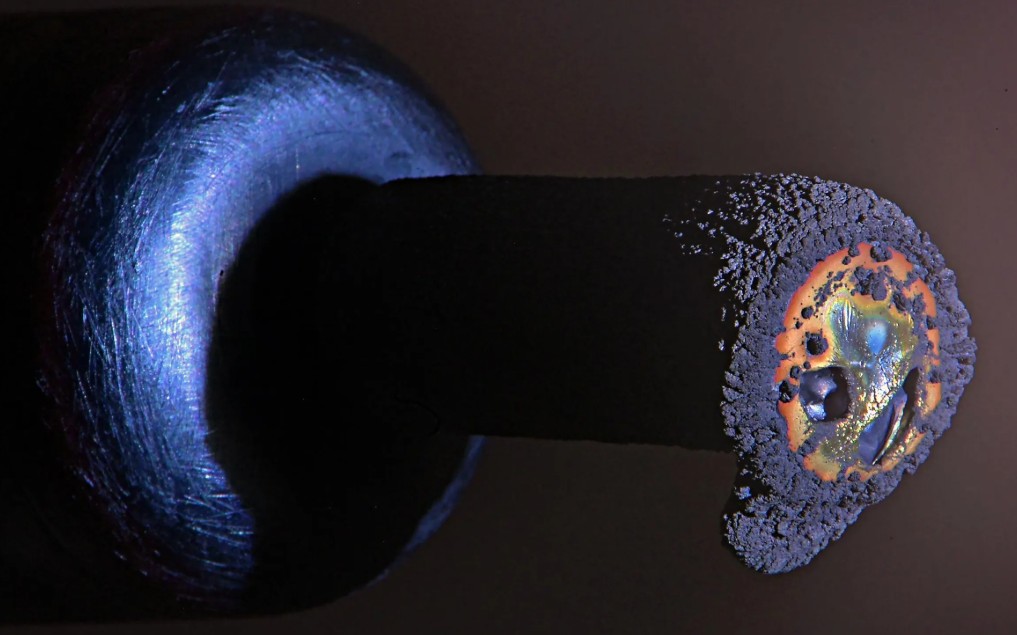
Researchers at the University of Stuttgart in Germany are using high-temperature plasma wind tunnels to investigate what happens when satellites burn up during atmospheric reentry. Their experiments are addressing a growing concern: spacecraft may disappear from orbit, but their materials can remain in Earth’s upper atmosphere as microscopic particles, tells IEEE Spectrum.
According to the European Space Agency, at least three large satellites or spent rocket stages burn up in the atmosphere every day. With about 18,000 operational and defunct satellites currently in orbit and companies planning much larger constellations, the amount of material returning to Earth could increase substantially.
The researchers are particularly interested in aluminum, a common satellite material. During reentry, it may form aluminum oxide, or alumina, which can contribute to ozone depletion and reflect sunlight, potentially affecting the upper atmosphere’s thermal balance. Scientists still need to determine exactly which aluminum compounds form and how long they persist.
Studying the process is difficult because most satellite destruction occurs between 60 and 80 kilometers above Earth, beyond the practical reach of aircraft and balloons but below satellite observation ranges. Plasma wind tunnels provide researchers with a laboratory alternative.
In one experiment, the Stuttgart team exposed a 100-gram cylinder of aluminum alloy 7075 to plasma. It melted into large drops after about 6.5 minutes. The researchers are now working to reproduce later stages of reentry to understand how vaporized aluminum reacts with oxygen.
The experiments also challenge assumptions that spacecraft components completely disappear during reentry. Tests on Inconel, a heat-resistant nickel alloy, showed that it was extremely difficult to melt. This finding echoes a 2024 incident in which debris from an International Space Station battery pallet survived reentry and struck a Florida home.
As satellite launches multiply, the research suggests that spacecraft design and reentry regulations may need to consider not only falling debris but also the atmospheric pollution left behind.
