

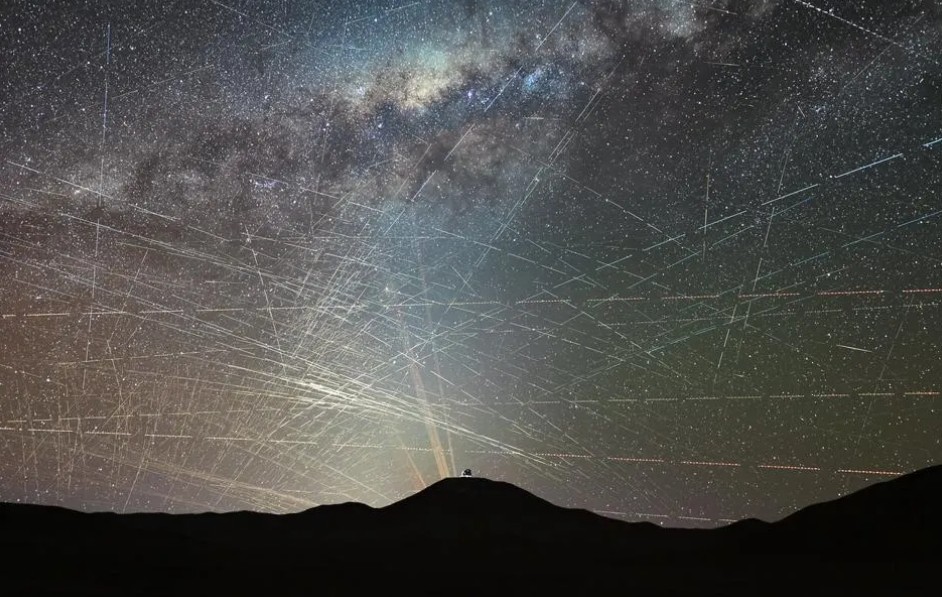
A new study from the European Southern Observatory (ESO) warns that plans to place more than 1.7 million satellites into Earth’s orbit could fundamentally change the night sky and threaten the future of ground-based astronomy. While satellite constellations promise global internet access, space-based data centers, and other commercial services, researchers argue that their cumulative impact on astronomical observations could be severe, tells Forbes.com.
Today, roughly 14,000 satellites orbit Earth, many of them part of large communication networks. However, proposed projects from companies such as SpaceX, Reflect Orbital, and other international operators could increase that number by more than one hundredfold. According to the study, these satellites would brighten the night sky, create bright streaks across telescope images, and make many scientific observations impossible. Particularly concerning are Reflect Orbital’s proposed mirror-equipped satellites, which could appear as bright as Venus even when not actively directing sunlight toward Earth.
Researchers estimate that the additional reflected light could make the entire night sky up to four times brighter in some situations. Images captured by advanced facilities such as the Vera C. Rubin Observatory could become unusable because of satellite interference. Even observatories in remote deserts and mountain regions, traditionally protected from artificial light pollution, would no longer have access to naturally dark skies.
The study recommends limiting the total number of operational satellites to approximately 100,000 and ensuring that future spacecraft are dim enough to remain invisible to the naked eye. The researchers argue that this threshold would allow satellite services to expand while preserving astronomy’s ability to study faint celestial objects. Regulators, particularly the U.S. Federal Communications Commission, now face decisions on several large satellite constellation proposals that could determine the future appearance of Earth’s skies.
Beyond astronomy, the authors highlight broader concerns, including disruption of ecosystems that depend on natural darkness, increased energy use associated with satellite launches, and a higher risk of orbital debris collisions that could trigger cascading failures known as the Kessler syndrome. The study concludes that balancing commercial ambitions with scientific and environmental priorities will be essential to preserving one of humanity’s most valuable shared resources: a dark, observable night sky.
