

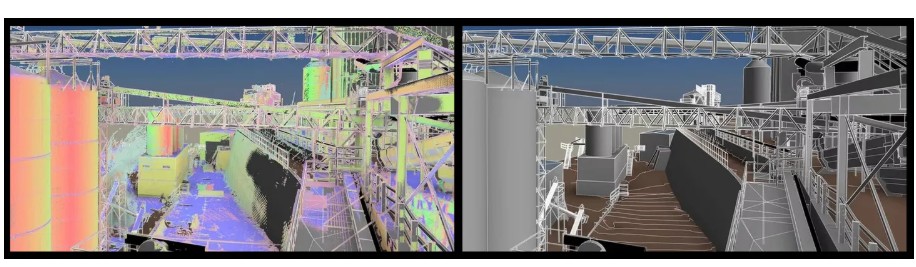
An article from UpFront.eZine explores the persistent challenges surrounding scan-to-BIM workflows in architecture, engineering, and construction. While laser scanning and photogrammetry technologies have become increasingly accurate and accessible, transforming raw spatial data into usable building information modeling files remains far more complicated than many software vendors suggest.
The report explains that scan-to-BIM workflows begin with capturing existing structures through LiDAR scanners, drones, or imaging systems that generate dense point clouds representing real-world geometry. Although these scans can record buildings with impressive precision, the resulting datasets are often massive, noisy, incomplete, and difficult to interpret automatically. Translating millions of points into intelligent BIM objects such as walls, doors, pipes, beams, and mechanical systems still requires significant manual effort.
A central problem lies in the difference between geometry and meaning. Point clouds capture shapes and surfaces, but BIM models demand structured information, relationships, classifications, and engineering logic. Existing buildings, especially older structures, rarely conform perfectly to design assumptions. Deformations, renovations, missing documentation, and construction inconsistencies create additional complexity that software struggles to resolve reliably.
The article also highlights the limitations of current AI-assisted automation tools. While machine learning can help identify architectural features and repetitive components, automated recognition remains error-prone in cluttered or irregular environments. Human oversight is still necessary to verify accuracy and ensure models meet construction and facility-management requirements.
Another challenge involves interoperability between scanning platforms, CAD systems, and BIM environments. Data exchange issues can introduce inefficiencies and compatibility problems across workflows involving architects, contractors, surveyors, and owners.
The article ultimately argues that scan-to-BIM should not be viewed as a fully automated pipeline but rather as a labor-intensive interpretation process combining measurement technology, engineering judgment, and digital modeling expertise. Despite ongoing advances in AI and reality capture, the gap between physical structures and intelligent digital twins remains technically and operationally difficult to close.
