

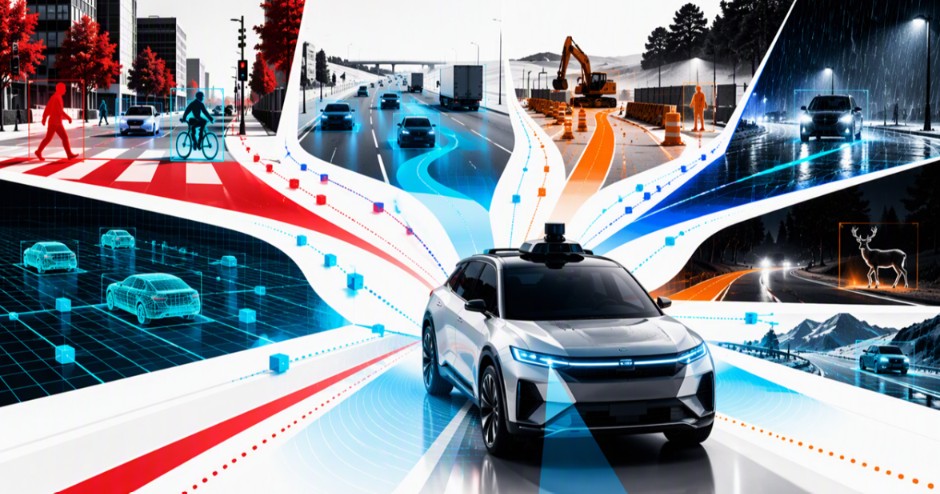
Traditional vehicle testing has relied heavily on accumulating road miles to evaluate performance and reliability. However, the growing complexity of advanced driver-assistance systems (ADAS) and autonomous driving technologies is forcing automakers to rethink this approach. According to Cadence, the diversity of driving scenarios matters more than the distance traveled.
ADAS systems must operate under countless combinations of road conditions, traffic patterns, weather, lighting, and sensor configurations. Even minor changes can create entirely new testing scenarios. For example, combining 10 road types, 5 weather conditions, 3 lighting conditions, 20 traffic situations, and 4 sensor configurations produces 12,000 possible test cases. Real-world programs can involve millions of combinations, making conventional road testing impractical.
Particularly challenging are rare but potentially dangerous edge cases, such as pedestrians emerging from behind parked vehicles, unexpected cyclist movements, or reduced visibility. These situations are difficult to reproduce consistently during physical testing.
Scenario-based validation addresses this challenge by systematically evaluating driving conditions through simulation. Engineers can create, modify, and repeat scenarios to assess system behavior across diverse environments. Daimler Truck, for example, uses simulation to vary vehicle speed, road friction, payload, and intersection geometry before conducting selected proving-ground tests.
The growing number of scenarios also makes automation essential. Automated tools can generate test variations, execute simulations, collect results, evaluate performance indicators, and identify regressions. Reusable scenario libraries further simplify testing by organizing highway situations, urban traffic events, weather variations, and critical edge cases.
Cadence emphasizes that effective ADAS validation increasingly depends on scenario coverage rather than mileage alone. Its Virtual Test Drive (VTD) technology supports this transition through realistic simulation environments.
As software-defined vehicles become more sophisticated, combining scenario diversity, repeatability, automation, and coverage analysis will help engineering teams identify safety risks more efficiently while reducing dependence on extensive physical road testing.
