

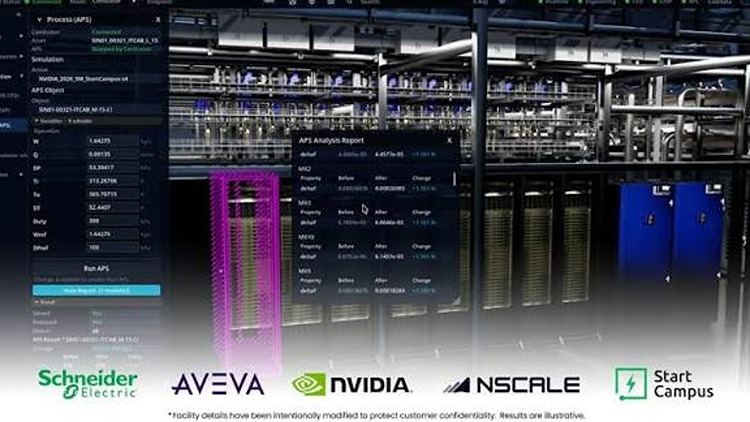
BERLIN, Germany, Oct 28, 2026 – Schneider Electric, AVEVA, Nscale, and Start Campus have piloted a digital twin that combines engineering and operational data with power, cooling and workload simulations for Nscale’s operations at the SIN01 data center in Portugal. The Immersive Twin uses the NVIDIA Omniverse DSX Blueprint, part of NVIDIA DSX Sim, to evaluate infrastructure changes before onsite implementation.
SIN01 is part of the 1.2 GW SINES Data Campus developed by Start Campus. It is designed to support successive generations of AI infrastructure and is expected to house more than 66,000 NVIDIA Rubin GPUs.
Nscale expects the digital twin to shorten time to token production, improve token efficiency and operations, increase flexibility, and reduce risks when updating its technology stack.
“Working with Start Campus, Schneider Electric and NVIDIA, we’re using digital twins to model how AI data centers operate in the real world – from power and cooling to token delivery,” said David Power, chief technology officer at Nscale. “This gives us a clearer view of where full-stack optimizations can be realized before changes are made on the ground. It’s about using intelligence and simulation to build and operate AI infrastructure more efficiently, and sustainably at scale.”
Testing Power, Cooling and Infrastructure Changes
The OpenUSD-based digital twin connects Schneider Electric, ETAP, AVEVA and third-party technologies across design and operations. It links IT/OT data for scenario testing involving power, cooling and process behavior.
The companies intend those simulations to support design validation, assessment of upgrades, procurement-risk reduction and performance optimization. Simulation-ready asset files also support interoperability and integration into digital twins.
Start Campus supplies the physical infrastructure, facility data, engineering expertise and operational environment. Nscale contributes workload and IT infrastructure requirements, allowing teams to model new configurations and technologies before implementation.
“Building a credible, end-to-end digital twin requires collaboration across the AI ecosystem,” said Pankaj Sharma, executive vice president, software & service with Schneider Electric. “By advancing energy tech, and connecting Nscale’s workload and IT infrastructure requirements with Start Campus’s physical facility and infrastructure data, while pairing it with Schneider’s digital twin technology, we’re bringing together critical perspectives needed to model AI factories more holistically and identify opportunities to optimize performance, efficiency and token production.”
“AI infrastructure needs to evolve as quickly as the technology it supports,” added Robert Dunn, chief executive officer at Start Campus. “Our collaboration with Schneider Electric, Nscale and NVIDIA has taught us that operators and customers design, develop and operate data centers best when they work from the same model. By using digital twin technology to simulate how a jump in rack density moves through the power train and the liquid cooling loop before it becomes a physical reality, we can test new hardware generations, agree the configuration with our customer and build it once. That accelerates deployment, improves efficiency and maximizes the value of every megawatt. This is an important step towards delivering resilient AI infrastructure at scale.”
Schneider Electric, AVEVA and ETAP joined the Alliance for OpenUSD (AOUSD) last year to support digital twin and AI factory development through the NVIDIA Omniverse DSX Blueprint. The companies continue to collaborate on reference architectures, integrated infrastructure, and software solutions. They also use Omniverse libraries to simulate and improve energy efficiency in operating environments.
Source: Schneider Electric
About Schneider Electric

Schneider Electric, founded in 1836, is a leader in energy management and automation. Headquartered in Rueil-Malmaison, France, the company delivers digital solutions that integrate energy technologies, real-time automation, software, and services across multiple sectors. Schneider Electric serves many industries, including buildings, data centers, infrastructure, and manufacturing, helping businesses improve efficiency, safety, and sustainability. Its offerings span electrical distribution, industrial automation, and smart grid and digital building technologies. Schneider Electric operates in over 100 countries and has approximately 168,000 employees. Its ecosystem includes over a million partners, making it a key player in delivering scalable, innovative solutions for an electric and digital world.
