

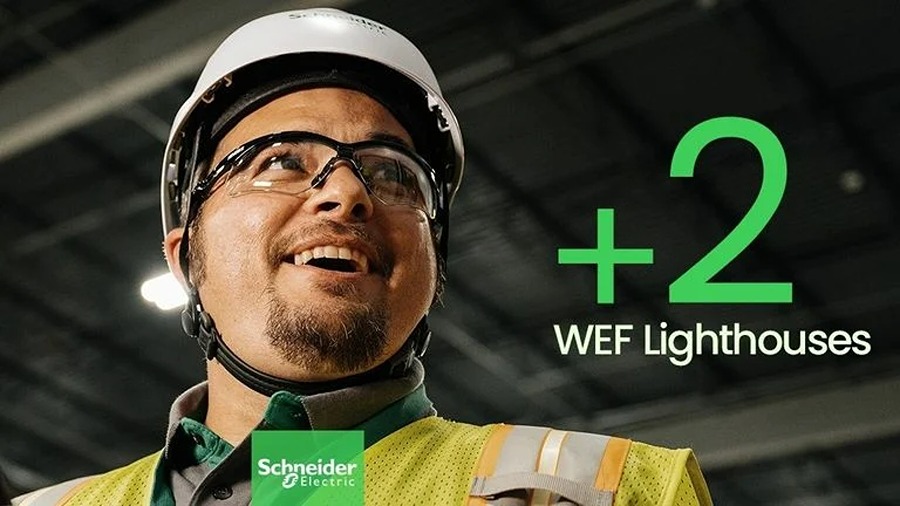
RUEIL-MALMAISON, France, July 9, 2026 – Schneider Electric’s El Paso (U.S.) and Beijing (China) manufacturing plants have received World Economic Forum (WEF) Global Lighthouse Network designations for work using AI, IoT and connected systems in engineer-to-order production, SF₆-free product development and factory decarbonization.
“This recognition from the World Economic Forum reflects our continued commitment to transform our supply chain through the combined power of people, digital, and sustainability,” said Mourad Tamoud, Schneider Electric’s chief supply chain officer. “El Paso and Beijing demonstrate how we can leverage advanced technologies, including AI, to deliver greater customer value while accelerating decarbonization across our operations and ecosystem.”
El Paso, United States – Engineer-to-Order Production and Delivery Gains
The El Paso site was recognized as Schneider Electric’s first Engineer-to-Order (ETO) Lighthouse facility and received a Customer Centric category distinction. It is also the first U.S. site to receive the distinction since 2021.
The El Paso facility produces customized low- and medium-voltage electrical systems to distribute power from the grid across industrial, commercial and residential applications. The El Paso plant digitized ETO processes across engineering, manufacturing and supply chain operations.
As data center demand increased, the site raised on-time delivery from 61% to 97%, reduced lead times by up to 35% and eliminated $43 million in backorders. The El Paso plant used IoT, AI, analytics and connected systems across its ETO value chain.
Beijing, China – SF₆-Free Products and Factory Decarbonization
The Beijing site was known for sustainability work across ETO and manufacturing. The plant focuses on SF₆-free products supported by EcoStruxure. The Beijing plant handled 30% business growth, insourcing and sustainability requirements and deploying more than 50 use cases. The work included SF₆-free product design, supplier decarbonization programs, AI-enabled energy optimization and SF₆ circularity initiatives.
The changes reduced Scope 1 emissions by 65%, eliminated Scope 2 emissions and reduced Scope 3 emissions by 43%. The site also improved energy efficiency by 36%. The Beijing site is extending decarbonization work through green logistics changes and collaboration across the value chain.
Source: Schneider Electric
About Schneider Electric

Schneider Electric, founded in 1836, is a leader in energy management and automation. Headquartered in Rueil-Malmaison, France, the company delivers digital solutions that integrate energy technologies, real-time automation, software, and services across multiple sectors. Schneider Electric serves many industries, including buildings, data centers, infrastructure, and manufacturing, helping businesses improve efficiency, safety, and sustainability. Its offerings span electrical distribution, industrial automation, and smart grid and digital building technologies. Schneider Electric operates in over 100 countries and has approximately 168,000 employees. Its ecosystem includes over a million partners, making it a key player in delivering scalable, innovative solutions for an electric and digital world.
About World Economic Forum
World Economic Forum is a Swiss nonprofit foundation founded in 1971 and based in Geneva. The organization convenes businesses, governments, international organizations, civil society groups and academics. It organizes meetings, research projects, communities and public-private initiatives. Its main event is the Annual Meeting in Davos-Klosters, Switzerland. The Forum also publishes reports, surveys and analysis on global issues. Its work covers climate, energy, trade, technology, finance, jobs and health. It works with companies and institutions in finance, technology, energy, manufacturing, health care and other sectors. Participants use the Forum for dialogue, research and project coordination. As of June 30, 2025, it reported 925 partnerships, including 123 strategic partners. As of 2025, it employed more than 1,000 people.
