

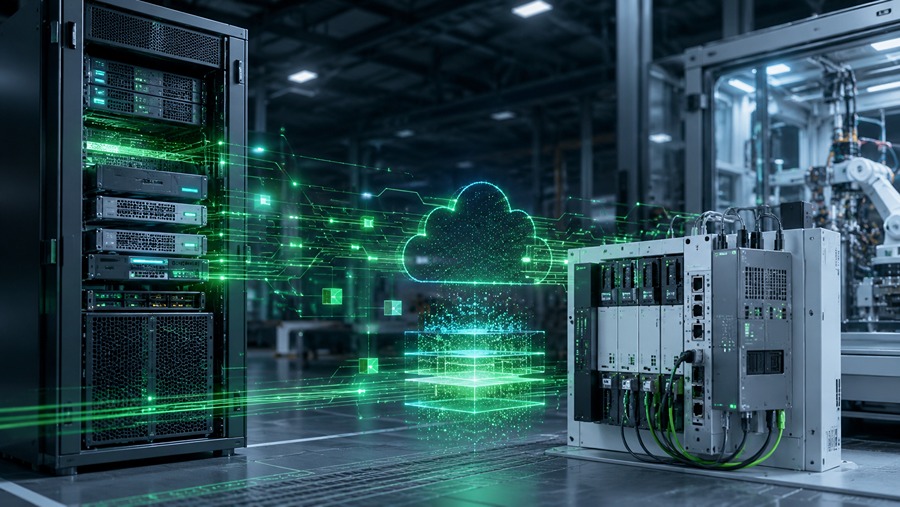
CHICAGO, IL, June 24, 2026 – Schneider Electric’s Industrial Automation Modernization as a Service combines EcoStruxure Automation Expert (EAE), services, and lifecycle expertise with HPE SimpliVity hybrid cloud infrastructure and software to help industrial organizations update automation environments without interrupting production.
The offering is aimed at operators managing aging control systems, cybersecurity requirements, workforce shortages, and preparations for AI-driven operations. Schneider Electric identifies proprietary architectures, operational risk, and the cost of large-scale infrastructure replacement as barriers to many modernization projects.
The solution is powered by Schneider Electric’s EcoStruxure Automation Expert and supported by HPE infrastructure technologies, including HPE SimpliVity. Schneider Electric says the combined platform provides reliability, data protection, and operational resilience for mission-critical industrial environments.
The model supports incremental modernization, software-defined automation, and continued use of existing automation investments. It is designed to work alongside existing PLC and DCS infrastructure, preserve deployed capital, and move automation modernization from large upfront infrastructure spending to a consumption-based operating model.
Industrial Automation Modernization as a Service is built around three service layers. The infrastructure foundation uses HPE compute, storage, and data protection technologies to provide a secure, resilient platform for industrial workloads. The software and control as a service layer uses open, software-defined automation that can be deployed, updated, and governed centrally. The people and lifecycle services layer covers assessment, migration, managed operations, cybersecurity, and continuous optimization.
Gwenaelle Huet, executive vice president, Industrial Automation, Schneider Electric said: “For too long, industrial enterprises have been forced to choose between operational continuity and technological modernization. Together Schneider Electric and HPE are removing that trade-off entirely – giving customers a single, governed foundation to modernize at their own pace. But this is about more than technology. Moving from CapEx to OpEx for industrial automation is a fundamental mindset shift for the industry – one that changes how automation is funded, consumed, and continuously improved. No more big upfront commitments that start aging on day one. Instead, an always-current service aligned to real operational needs. The industrial world is on an irreversible path toward AI: generative, agentic, and increasingly physical AI embedded directly in robotics and machines. Getting there requires open, software-defined infrastructure built on enterprise-grade hybrid cloud, and that’s exactly what Schneider Electric and HPE are delivering.”
What Industrial Operators Get
Industrial Automation Modernization as a Service combines three service layers to simplify modernization and operations.
- Infrastructure Foundation: HPE compute, storage, and data protection technologies that provide the platform for industrial workloads.
- Software and Control as a Service: Open, software-defined automation that can be deployed, updated, and governed centrally, across any compatible hardware, without touching physical assets.
- People and Lifecycle Services: Expert services spanning assessment, migration, operations, and cybersecurity.
The result: organizations modernize incrementally alongside existing PLC and DCS infrastructure, preserve capital already deployed, and stop treating automation as a depreciating asset.
Across all three service layers, the measurable business outcomes are consistent:
- CapEx → OpEx: Convert unpredictable capital expenditure into stable, consumption-based OpEx.
- Multi-site automation: Organizations can standardize automation across sites from a single platform, with 70% of industrial companies planning to virtualize automation by 2030.
- Faster time to value: Get to market 50% faster and reduce commissioning time by up to 60%.
- Security and energy performance: Unified cloud governance to enforce consistent OT cybersecurity policy across all sites. AI-driven optimization has demonstrated up to 40% energy reduction.
- No rip-and-replace: Adopt incrementally alongside existing PLC and DCS systems – preserving prior capital investment while establishing a foundation for long-term modernization.
Delivery Model Built on Open Standards
Both Schneider Electric and HPE are active members of UniversalAutomation.org, an initiative focused on software-defined automation based on the IEC 61499 standard. The approach intends to reduce dependence on a single vendor’s roadmap, allowing customers to modernize, switch vendors, and adapt as technology evolves.
HPE provides the integrated infrastructure for the offering and supports operational data availability from edge to cloud. The architecture is designed to support control logic running on-site at a remote facility, centrally in a private cloud, or distributed across both, while maintaining governance, uptime, and application portability.
Peter Groth, VP of OEM, Service Providers and Telcos, HPE commented: “Industrial enterprises are facing the same pressures that transformed enterprise IT a decade ago – rising complexity, skills scarcity, and demand for real-time intelligence at scale. EcoStruxure Automation Expert running on HPE SimpliVity and HPE software solutions gives organizations the unified foundation they need to meet these challenges head-on, with the governance, flexibility, and resilience to sustain modernization over time.”
Source: Schneider Electric
About HPE

Hewlett Packard Enterprise, formed in 2015 following the split from Hewlett-Packard, is headquartered in Spring, TX, and traces its roots to HP’s founding in 1939. The company provides enterprise IT solutions including servers, storage, networking, hybrid cloud services, high-performance computing, and software platforms such as HPE GreenLake. It serves industries including government, telecommunications, finance, and energy, supporting large enterprises, hyperscalers, and sovereign clients. In fiscal 2024, Hewlett Packard Enterprise reported approximately $30.1B in revenue, with about 65% generated outside the United States. The company employs around 61,000 people worldwide and holds more than 13,000 patents globally. Hewlett Packard Enterprise continues to focus on hybrid cloud infrastructure, AI platforms, and subscription-based service models through its edge-to-cloud offerings.
About Schneider Electric

Schneider Electric, founded in 1836, is a leader in energy management and automation. Headquartered in Rueil-Malmaison, France, the company delivers digital solutions that integrate energy technologies, real-time automation, software, and services across multiple sectors. Schneider Electric serves many industries, including buildings, data centers, infrastructure, and manufacturing, helping businesses improve efficiency, safety, and sustainability. Its offerings span electrical distribution, industrial automation, and smart grid and digital building technologies. Schneider Electric operates in over 100 countries and has approximately 168,000 employees. Its ecosystem includes over a million partners, making it a key player in delivering scalable, innovative solutions for an electric and digital world.
