

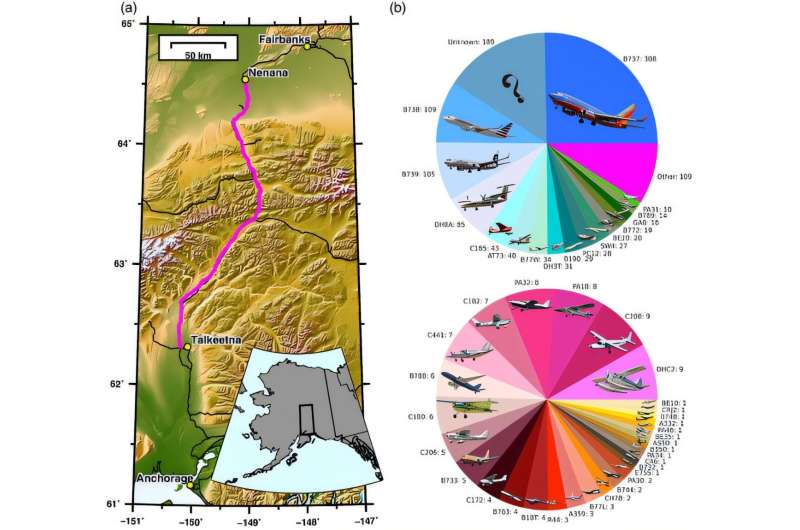
A team from the University of Alaska Fairbanks has demonstrated that seismometers, traditionally used to detect earthquakes, can also pick up the subtle ground vibrations generated by aircraft flying overhead, tells Tech Xplore. Their method exploits the fact that an aircraft’s acoustic waves cause measurable ground motion. By using sensors recording at 500 samples per second, they captured 1,216 flights across 35 days via 303 closely spaced sensors deployed along a highway in central Alaska.
In the seismic data, aircraft signals manifest at higher frequencies than typical geophysical signals. The researchers produced spectrograms showing how the Doppler effect shifts these frequencies as the aircraft approaches and recedes. They then mathematically removed the Doppler shift to derive a base frequency and its harmonics, a “frequency comb” unique to each aircraft type.
Because no catalog of such aircraft frequency patterns existed, the team built one by matching flight-tracking data from Flightradar24 with their seismic recordings and then grouping aircraft by categories such as piston, turboprop, and jet. They found surprisingly consistent frequency signatures across multiple flights.
The implications extend beyond simple detection. In addition to identifying aircraft type, the approach could estimate flight direction and speed by analyzing the Doppler curve. Anticipated future work includes determining detection ranges (i.e., the distance at which an aircraft can be detected) and merging data from multiple sensors to provide richer flight information.
This work opens a novel route to passive aircraft monitoring, especially in remote or environmentally sensitive regions where traditional radar or acoustic systems may be limited.
