

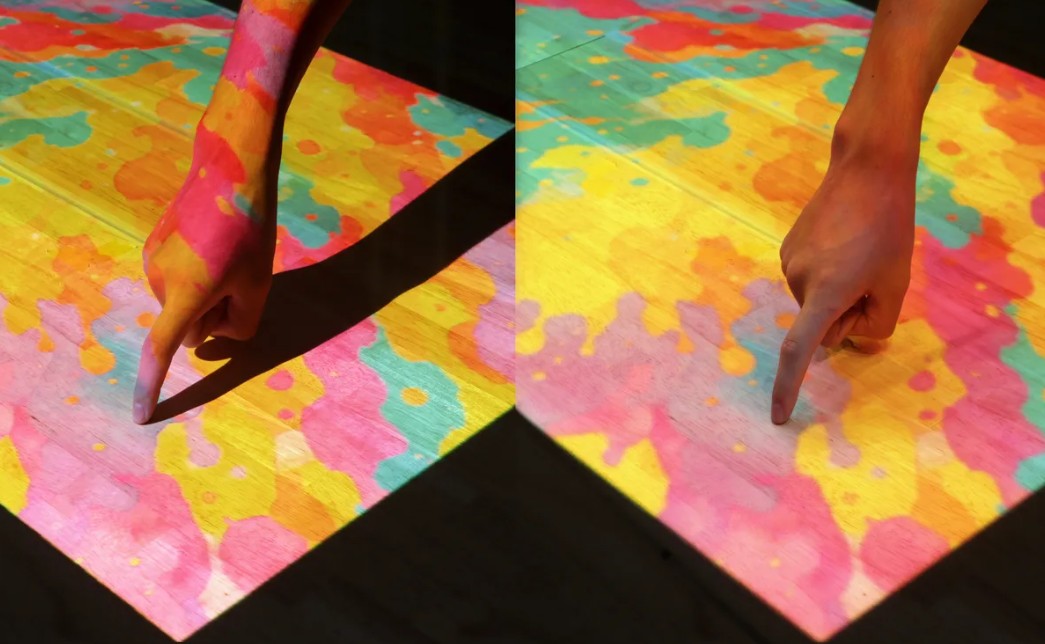
Spatial augmented reality has long promised immersive digital experiences without requiring headsets or smart glasses. Instead of displaying graphics on wearable devices, it projects digital images directly onto real-world surfaces. However, one persistent limitation has reduced its effectiveness: users often block the projector’s light, casting shadows that distort or completely hide projected content. A new system developed by researchers addresses this challenge by creating nearly shadow-free projections that make digital overlays appear far more natural and interactive, tells IEEE Spectrum.
The new approach uses multiple projectors positioned around the scene rather than relying on a single light source. Working together, these projectors compensate for areas blocked by a user’s body or hands. When one projector’s light is obstructed, another illuminates the same region from a different angle. Advanced algorithms continuously calculate how each projector should contribute to the final image, ensuring that the projected graphics remain bright and consistent even as people move through the space.
The researchers also developed software that adjusts the brightness and color of overlapping projections, preventing visible seams or uneven illumination. This produces crisp images that blend more convincingly with physical objects. During user testing, participants frequently struggled to distinguish between projected text and real printed text, demonstrating how effectively the technology enhances visual realism.
The advancement could expand the practical use of spatial augmented reality across education, manufacturing, museums, retail, collaborative design, and entertainment. Engineers could project assembly instructions directly onto equipment, designers could visualize digital prototypes on physical models, and educators could create interactive learning environments without requiring students to wear specialized hardware. Because the system relies on external projectors rather than personal displays, multiple people can share the same augmented experience simultaneously.
Although challenges remain, including the cost and calibration of multiple projectors, the research demonstrates a significant step toward making projection-based augmented reality more practical. By eliminating distracting shadows and improving image quality, the technology brings spatial augmented reality closer to everyday use in shared environments.
