

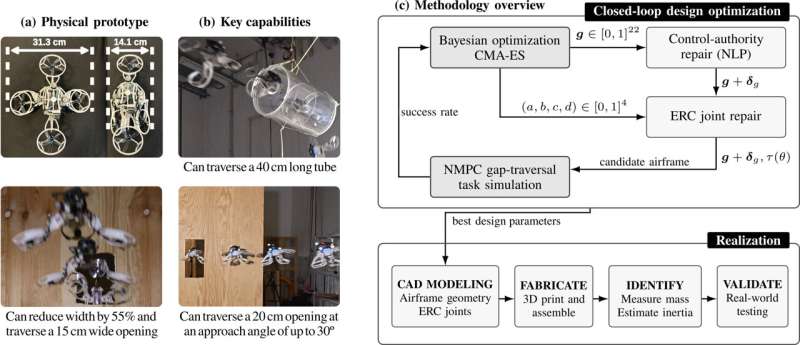
Drones operating in confined environments often encounter openings that restrict their movement. Conventional shape-changing designs rely on additional motors or complex flight maneuvers, increasing mechanical complexity and potentially compromising efficiency. European researchers have developed a quadrotor prototype that passively folds its arms upon contact with obstacles, enabling access to significantly narrower spaces, tells Tech Xplore.
The researchers employed a closed-loop design optimization method that simultaneously evaluated airframe geometry and joint flexibility. Computational simulations assessed candidate designs based on their ability to navigate openings, accommodate physical contact, and regain flight stability. Successful configurations guided subsequent design iterations.
The resulting prototype incorporates 3D-printed components and elastic rolling cam (ERC) joints. These spring-loaded mechanisms maintain structural rigidity during conventional flight while allowing the side arms to bend upon contact. The configuration reduces the drone’s width from 31.3 to 14.1 centimeters without requiring additional actuators.
During experimental testing, the prototype successfully navigated a 15-centimeter opening at approximately two meters per second. It also traversed a 40-centimeter-long cylindrical passage while maintaining its folded configuration.
Additional experiments demonstrated reliable navigation at approach angles of up to 20 degrees, although mechanical failures occurred at greater angles.
Compared with an equivalent rigid quadrotor, the prototype consumed less than 1% additional electrical power and exhibited only a two-millimeter increase in position-tracking error during ordinary flight.
However, confined-space navigation produced considerable rotational disturbances and temporary altitude losses. Computational models also underestimated certain physical flight responses, highlighting opportunities for improved simulation accuracy and mechanical refinement.
For engineers, the research demonstrates the potential of combining computational optimization, compliant mechanisms, and additive manufacturing to overcome conventional robotic design constraints.
Potential applications include infrastructure inspection, industrial maintenance, and search-and-rescue operations in confined environments. Further development could enable aerial robots to navigate complex physical surroundings more effectively while maintaining energy efficiency and minimizing mechanical complexity.
