

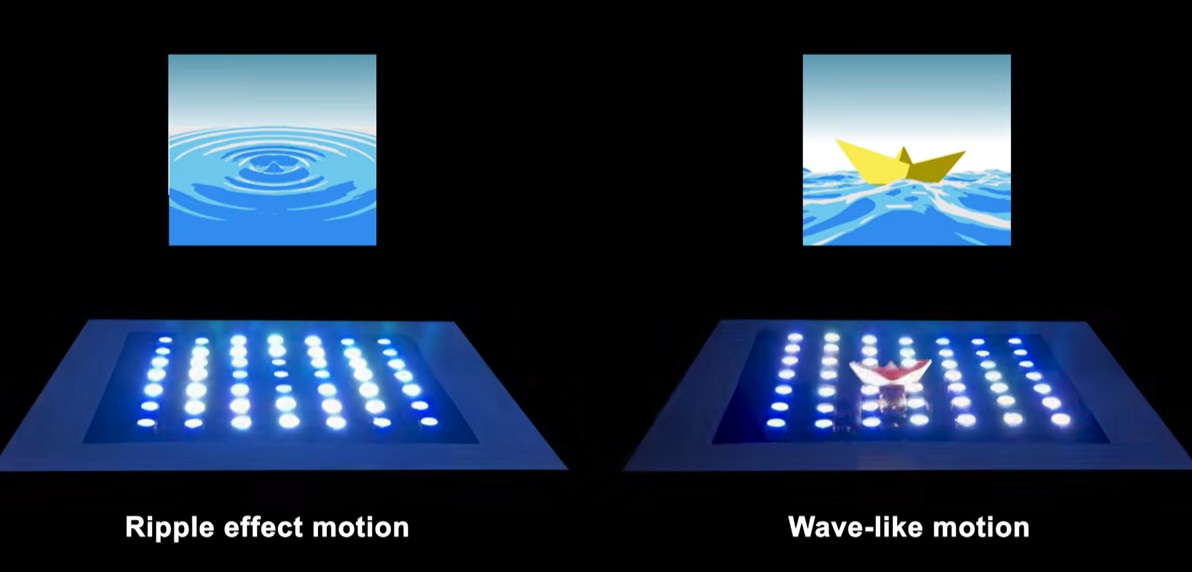
Researchers at Rice University and Kyung Hee University have developed a flexible, shape-shifting surface that can detect and reconstruct its own three-dimensional form in real time. The innovation addresses a longstanding challenge in human–machine interaction by creating a surface that not only changes shape but also continuously senses and reports its deformation without relying on external cameras or tracking systems. The technology could improve robotics, wearable electronics, medical devices, and immersive virtual reality systems.
The device is built as a programmable metasurface embedded with miniature tilt sensors distributed across its structure. As the surface bends, stretches, or folds, each sensor measures its local orientation. A computational algorithm combines these measurements to reconstruct the complete geometry of the surface, allowing the system to accurately understand its current shape in real time. This integrated sensing approach eliminates the need for bulky external monitoring equipment while maintaining precise shape awareness.
Unlike conventional flexible interfaces that primarily respond to touch or pressure, the new platform actively transforms its physical geometry while tracking every movement. This capability enables more intuitive interactions between humans and machines, where users can manipulate a surface directly, and the system instantly interprets those changes. Such adaptive interfaces could support responsive robotic skins, smart prosthetics, interactive displays, and wearable devices that naturally conform to the human body.
The researchers also demonstrated that the sensing framework remains effective across a wide range of complex deformations, highlighting its potential for applications requiring reliable operation under continuous movement. Because the sensing components are integrated directly into the metasurface, the design remains lightweight, compact, and suitable for portable technologies.
The work represents an important advance in programmable materials and intelligent interfaces. By combining mechanical adaptability with built-in shape perception, the technology lays the foundation for future systems that can physically interact with people in more responsive and natural ways. As research continues, the platform could contribute to next-generation human–machine interfaces that blur the distinction between passive materials and active, sensing technologies.
